
On remarque juste que tourner dans la cuisine pour attraper le sel demande un peu plus d’attention. Qu’un trottoir irrégulier semble soudain plus “dangereux” qu’avant. Que danser à un mariage implique de réfléchir à chaque pas de côté, comme si le sol avait changé de règles.
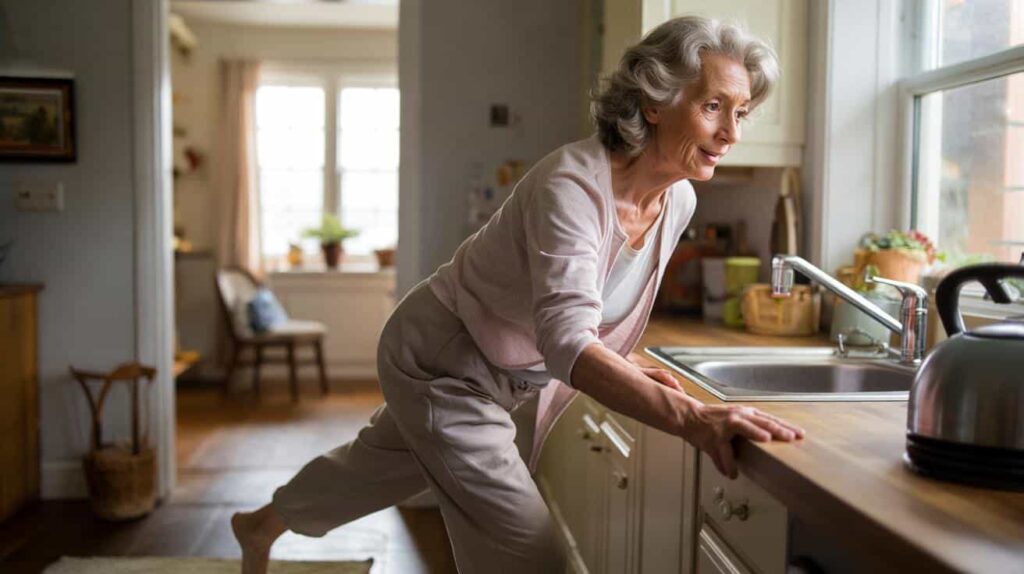
Ce qui fatigue vraiment, après 70 ans, ce n’est pas tant marcher tout droit. C’est tout ce qui sort de la ligne : pivoter, se retourner, faire un pas de côté pour éviter un chien, un enfant, une valise. C’est ce petit décalage du centre de gravité qui donne le vertige.
Le paradoxe, c’est que la plupart des seniors continuent à ne s’entraîner qu’en ligne droite. Ils marchent, parfois vite, parfois longtemps, mais presque jamais *latéralement*. Une faille invisible se creuse.

Un jour, cette faille se manifeste en une seconde. Une seconde de trop.
Why sideways movement becomes your real “lifeline” after 70
At a community hall in Bristol, a small group of over-70s shuffle to the side along a line of chairs. No music. No Lycra. Just slow, careful steps, hips and ankles working a little harder than usual.
A woman in a pale blue cardigan laughs as she wobbles, catching herself on the back of a chair. “Better here than on the pavement,” she says. There’s a tiny pause, the kind that holds a whole story of near-falls and silent fears.
Forward walking, they’ve all got. Sideways? That’s where things get real.
For decades, most of us train only one “direction” of movement. We walk, we jog a bit, we go from sofa to sink, from door to car. Straight lines, predictable surfaces, same patterns.
By 70, the body has quietly edited out what it doesn’t use. Sideways steps, quick weight shifts, tiny ankle corrections. All the skills that protect you when the bus jolts, the dog pulls the lead, or the supermarket floor is more slippery than it looks.
Research backs up what physios see every week: after 70, loss of lateral strength and balance is a bigger predictor of falls than simple walking speed. A fall isn’t just a bruise. It can mean a broken hip, a lost confidence, a home that suddenly feels full of traps.
Here’s the twist. The movements that best protect you from falls are not marathons or heroic gym sessions. They’re slow, sideways, almost boring at first glance.
How to train sideways and balance without feeling like you’re “in rehab”
One of the simplest drills physios love starts at the kitchen counter. Stand side-on, one hand resting lightly on the worktop. Feet under your hips, toes pointing forward, chest relaxed.
Step your outside foot to the side, just a small step. Then bring the other foot to meet it. You’ve just done your first lateral walk. Repeat 8–10 steps in one direction, then back again. No rush. Let your foot fully land before you move the other.
As it gets easier, bend the knees slightly, like a tiny squat as you move. You’ll feel your hips and outer thighs wake up. That’s your “anti-fall” muscle group clocking in for duty.
Ground-level truth: most people either go too hard, too fast, or not at all. A new exercise feels “easy”, so they double the time. The next day, the hips ache, confidence drops, and the routine quietly disappears. Or they file it mentally under “physio stuff” and wait until something bad happens.
Start with very small doses. Two minutes by the kitchen counter while the kettle boils. A few steps sideways along the hallway, one hand grazing the wall. That’s it for the day.
Soyons honnêtes : personne ne fait vraiment ça tous les jours. The reality is closer to “a few times this week” than a perfect schedule. That still moves the needle, as long as you keep coming back to it instead of quitting because you “missed a day”.
What frightens many over-70s isn’t exercise itself, but the idea of “losing balance on purpose”. There’s a quiet pride in being “still steady on my feet”, and any wobble feels like a personal failure. It isn’t. It’s simply the nervous system learning.
“Good balance training lives in that thin line between safe and slightly scary,” says a London-based physio I spoke to.

“If you never wobble, you’re not challenging the system. If you’re constantly clinging to furniture, it’s too much. The sweet spot is where you sometimes need the rail, not where you’d fall without it.”
To make things practical, many therapists use simple “tiers” to progress:
- Tier 1: Stand on two feet, holding on, then with just one hand, then fingertips.
- Tier 2: Same thing, but turn your head left and right as you stand.
- Tier 3: Side-step along a counter or hallway, first looking ahead, then gently turning the head.
- Tier 4: Add soft knees, almost like a slow side-step dance.
Each tier is one step away from the floor – not ten. That’s what makes it sustainable after 70.
The hidden power of “micro-challenges” in daily life
There’s a man in his late seventies I met in Manchester who hadn’t set foot in a gym in decades. His “programme” was a modified walk to the shops. On the way there, he chose the flattest, safest pavements. On the way back, he picked the slightly trickier side: a mild camber, a sloping kerb, a few uneven patches.
Every few metres, he’d step sideways around a lamppost instead of in front of it. At crossings, he’d shift his weight from one foot to the other while waiting for the green man, feeling how the ankles responded.
“I’m not training,” he told me. “I’m just making normal life count twice.”
That’s the quiet revolution after 70: turning everyday moments into balance practice without making a big show of it. Standing at the sink? Try bringing your feet a little closer together for 10 seconds, then back out. Waiting for the kettle? Rise onto your toes, holding the counter, then slowly lower.
On a good day, you can add one tiny sideways challenge. Stepping out of the car, pause for a second with one foot on the ground, one still in the car. Feel the weight shift, then step fully out. On stairs, keep the hand on the rail, but notice how the pelvis moves side to side with every step. That awareness alone starts to change how the muscles fire.
We’ve all had that moment where the pavement suddenly “tilts” under us and we stumble, heart racing, glancing around to see who saw. Those split-seconds are where sideways strength and balance pay off. Not in the perfect, controlled exercises, but in the messy, real-world stumbles you recover from instead of hitting the ground.
What almost nobody tells you is this: *small* balance wins still remodel the brain. Each time you catch yourself, each time your ankle corrects, your nervous system is quietly rewriting its playbook.
Moving into your seventies without shrinking your world
The real cost of losing sideways movement isn’t just physical. It’s social. It starts with avoiding that café with the slightly awkward step at the entrance. Skipping the family walk because “it’s a bit uneven there”. Declining the wedding dance “just in case”.
Bit by bit, the map of safe places shrinks. The house becomes the main territory, then certain rooms, certain routes. Movement narrows, and with it, conversations, chances, joy. The body is still technically “mobile”, but life has to be negotiated like a hazard map.
Reintroducing sideways motion and balance work is a quiet rebellion against that shrinking map. It’s not about chasing youth. It’s about keeping your options open. Being the grandparent who can step off a slightly wobbly boat. The neighbour who still pops to the shop in winter because the icy patch near the gate no longer feels like a monster.
There’s a shift that happens when people realise they can train for that. Not for numbers on a machine, but for keeping the right to change direction at the last second. To dodge, to swivel, to say yes when someone shouts, “Come on, dance with me!”
Balance training is rarely glamorous. No one applauds when you stand on one leg in the hallway for ten seconds. Yet this is where the future quality of your independence is being negotiated, quietly, day after day.
Somewhere between walking in a straight line and fearing the next fall, there’s this small, stubborn space of action. A few sideways steps. A wobble. A hand brushing the wall, then not needing it for a second.
That second is where your world stops shrinking and starts reopening, millimetre by millimetre.

| Point clé | Détail | Intérêt pour le lecteur |
|---|---|---|
| Lateral movement matters more than you think | Sideways steps and weight shifts are critical for preventing falls after 70 | Helps you focus on the type of exercise that actually protects daily independence |
| Train balance in small, safe snippets | Use kitchen counters, hallways and short “micro-challenges” built into routine | Makes balance work realistic, non-intimidating and easy to stick with |
| Wobbling is part of progress | Light instability teaches your nervous system to react faster and stronger | Reduces fear of “losing balance” and reframes it as useful training feedback |
FAQ :
- Is it safe to start balance and sideways training after 70?Yes, if you begin with support nearby – a sturdy counter, rail or chair – and progress gradually. If you have severe joint, heart or vision issues, talk with your GP or physio first.
- How often should I practise sideways and balance exercises?Think “little and often”: 3–5 minutes, two or three times a day, works better than one long weekly session you dread and then skip.
- What if I already walk every day – isn’t that enough?Walking forward is great, but it barely trains lateral strength or quick weight shifts. Adding even a few sideways steps and standing balance drills fills that gap.
- I’m scared of falling while training – what can I do?Stay close to a wall or counter, keep a stable chair beside you, and only go to the point where you wobble slightly but feel in control. If fear is high, start sitting and work on shifting weight side to side first.
- Do I need special equipment or a gym membership?No. Most effective work happens at home: kitchen counters, hallway walls, a firm chair and maybe a resistance band are plenty for a strong, protective routine.
