
No hum of traffic, no phone buzzing in my pocket, just the steady push of the tide and the odd gull complaining overhead. The island looked exactly like the photos from the viral job ad: whitewashed cottage, tiny harbour, a strip of wild beach staring straight out into the Atlantic. Six months here? People would kill for it.
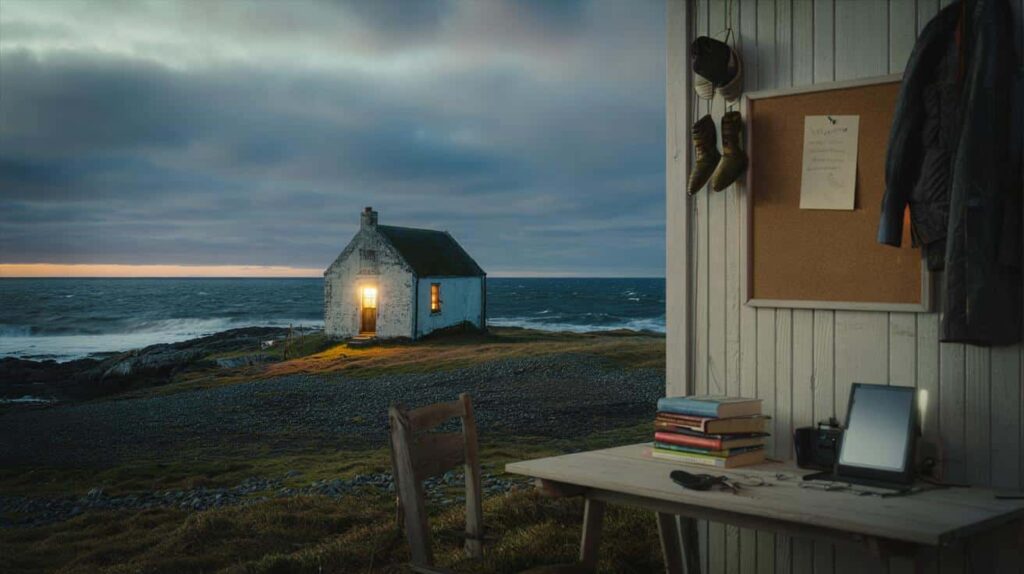
Inside the old stone house, the Wi‑Fi router was unplugged. There was no phone signal, no corner shop, no café to duck into when your thoughts got loud. On the cork board in the kitchen, a hand‑written note from the owners: “Most people love the idea. Few last the winter.”
They weren’t talking about storms, or even loneliness. The thing that breaks people here is far quieter, and it doesn’t show on Instagram.

Why the dream of six months on a remote island hits harder than it looks
The fantasy always starts the same way: sun on the water, stack of books, no emails, no commute. You can almost feel your shoulders drop just imagining it. The job posts that go viral lean right into that: “Caretaker needed on remote island — free house, small salary, endless sea views.”

Thousands apply. Digital marketers, nurses, burned‑out lawyers, remote workers with laptops and a revenge plan against office life. They scroll through drone shots of the coastline and think, This is it. This is where I finally breathe.
Then they hit the one line that looks harmless and skip straight past it: “Must be comfortable with long periods of solitude.”
Take one couple who moved to a tiny island off the Scottish coast for a six‑month lodge‑keeping job. Both worked remote, used to city noise and Deliveroo at 11pm. The first week was euphoric. They posted daily sunset photos, homemade bread, waves crashing against black rock like a movie backdrop.
Week three, the posts slowed. The weather turned. The ferry was cancelled for five days. Their food delivery didn’t make it across the channel. No fresh veg, no visitors, no escape from each other’s habits echoing around the same three rooms.
By week nine, they were barely sleeping. One of them started leaving the radio on at night just to hear another voice. Another admitted they would stand outside in the rain for half an hour, just to feel something different. They finished the contract, but both agreed on the same thing after: the hardest part wasn’t the storm. It was the silence.
We like to think we’re built for isolation because we’re “online” all day. Messages ping, feeds update, group chats never sleep. It feels like company. On a remote island, your notifications don’t mean much when the signal dies with the daylight.
➡️ Goodbye to happiness? The age when it falters, according to science
➡️ Auto technicians explain how keeping the gas tank above half prevents fuel line freeze
➡️ Why indoor temperatures feel different at the same reading
➡️ Heavy snow expected starting tonight
➡️ How changing the first five minutes of your morning can shift your mood for the entire day
➡️ In Pompeii, victims wore woollen clothes in midsummer, shaking up the eruption timeline
➡️ If an ATM keeps your card, here’s the quick move and the little-known button you need to know to get it back
➡️ Why emotional balance can feel unfamiliar at first
Solitude in a city still has a safety net: the option of people. You can sit in a café, walk through a busy park, talk to nobody but still feel soaked in human presence. Out there, solitude is not a mood, it’s the default setting. Your nervous system has to learn a new rhythm.
That’s the requirement most applicants skip over. Not strength, not outdoors skills, not even basic DIY. The real test is whether you can be genuinely alone with your own thoughts for days on end — and not come apart at the seams.
The real checklist before you click “Apply now” on island life
Before you fantasise about quitting your job and heading for the nearest lighthouse, start with a brutally honest self‑audit. Not the polished version you give in interviews. The 2am version. Ask yourself one narrow question: When was the last time I spent 48 hours with no social plans, no scrolling, and no background noise… and felt okay?
If the answer is never, that’s your red flag. Long‑term solitude isn’t something you improvise on arrival. You need a plan. A daily structure. A handful of non‑negotiables that anchor your day: a specific time you walk the same path, a set hour for reading, a practical task like chopping wood or fixing something physical.

On a remote island, routine stops being a productivity hack and turns into survival gear.
Plenty of caretakers and wardens who last the full six months share something in common: they arrive with a project that actually matters to them. Not “I’ll finally catch up on Netflix”, but *I’m going to write three chapters*, learn to paint, map the local bird life, photograph every low tide.
That project becomes a second coastline to pace along when the days blur. One former island warden told me she scheduled her week around a single spreadsheet: tide times, nesting seasons, groceries, even moods. It sounds extreme. It kept her grounded.
On a stormy Atlantic outpost, internet can go down for a week. Soyons honnêtes : personne ne fait vraiment ça tous les jours, but people who cope well pre‑download podcasts, stock offline books, print recipes. They treat boredom like weather: it’s going to arrive, so you dress for it.
What shocks many new arrivals is how loud their inner world becomes once the outside one quiets. Old arguments. Work anxiety. That one choice you made eight years ago that you thought you were done with. On a busy mainland day, those thoughts get drowned out by traffic and meetings. On an island, they have front row seats.
That’s why emotional prep often matters more than practical prep. Talking to former island workers, the pattern repeats: the people who struggle rarely lacked skills. They lacked ways to self‑soothe that didn’t involve shopping, scrolling or socialising.
On a bad day in the city, you can go for a drink, hit the gym, call a friend on the way home. On a bad day on a rock in the sea, your choices shrink to: walk, write, cry, sleep, watch the sky. On a good day, that feels pure. On a rough day, it can feel like being trapped with your own biography on loop.
Learning to be alone without falling apart
If the idea of solitude is the real obstacle, there are ways to train for it before you ever set foot on a boat. Start small and deliberate. Block out one evening a week where you don’t see friends, don’t scroll, don’t fill the silence with podcasts.
It will feel weird at first. That’s the point. That itch to reach for your phone is exactly the muscle you’ll be working on the island. Try a “quiet weekend” once a month: two days where you stay mostly offline, cook, walk, read, and notice how quickly you start inventing distractions.
You’re not testing whether you love being alone. You’re testing whether you can tolerate it long enough to find the bits you might actually love.
New caretakers often repeat the same three mistakes. They underestimate winter, overestimate their appetite for silence, and romanticise how “productive” they’ll be with all that free time. The result is predictable: week four arrives, and they’re staring at a half‑written journal, a pile of unread books, and a WhatsApp chat they can’t stop checking whenever the signal flickers back.
On a deep level, we’re social animals. Expecting six months of monk‑level serenity out of nowhere is a setup. Build lifelines into your plan: scheduled calls with one or two close people, letters to post when the ferry comes, shared photo diaries with someone who gets it. Not performative feeds, just quiet proof that you’re still in the world.
We’ve all had that moment where the house finally goes quiet and, instead of relaxing, your brain starts sprinting through every worst‑case scenario. If that’s you on a Tuesday night in a busy town, multiply it by ten for a gale‑force weekend with no boat and no backup.
“The loneliness wasn’t in my head,” one ex‑island volunteer told me. “It was in the gaps between sounds. Back home, there’s always something — buses, sirens, neighbours. Out there, when the wind dropped, I could hear my own heart beating in the kitchen. Some days, that felt like magic. Other days, it felt like I’d fallen off the edge of the map.”
**Before you sign up, write your own tiny crisis handbook.** Nothing dramatic, just one sheet of paper on the fridge with three columns: what a bad day looks like, what you’ll do first, who you’ll contact if it gets darker than that.
- Bad day symptoms: not sleeping, crying for no reason, obsessively checking the horizon.
- Immediate actions: hot meal, long walk, one practical task you can finish in an hour.
- Support line: one friend, one family member, one professional helpline number that works from your region.
*It feels over the top until the first storm rolls in and you haven’t spoken face‑to‑face to anyone in ten days.* That little plan becomes less of a drama exercise and more like having a spare torch when the power cuts — you hope you won’t need it, but you’re glad it’s there.
The surprising thing a remote island really shows you
Six months on a remote island strips life back with a brutality that looks romantic from a distance. No commute, no flat whites, no small talk in the lift. Your days get simple, then weirdly sharp. Light, tide, hunger, sleep. Weather decides when you leave the house. Your body falls into a rhythm older than your job title.
If you ever do it, the requirement you once skimmed — “must cope with solitude” — will turn into the main storyline. You may find parts of yourself you forgot existed: the version of you that can spend three hours watching clouds, that can sit with a rough memory and not immediately squash it with noise, that feels an almost physical relief when the ferry leaves and takes everyone else with it.
Or you may learn that you are, at heart, a creature of crowds and late‑night corner shops. That’s not a failure. That’s data. Six months on a lonely rock is a crash course in what kind of company you really need, and how much of it has to come from other people.
Either way, the island will show you something your scrolling life struggles to reveal: how you behave when the feed stops, the world shrinks to one horizon, and the only person you can’t mute or block is yourself. That’s the requirement most applicants miss — and the one that, once you’ve met it, quietly rewires how you live anywhere else.

| Point clé | Détail | Intérêt pour le lecteur |
|---|---|---|
| La vraie difficulté | Ce n’est pas la météo ou le confort, mais la solitude prolongée et le silence | Aide à tester si l’on est vraiment fait pour ce type d’expérience avant de s’engager |
| Routine et projet | Mettre en place une structure quotidienne et un projet personnel clair | Offre des repères concrets pour ne pas “dériver” mentalement sur une île isolée |
| Préparation émotionnelle | S’entraîner à être seul, créer des lignes de soutien et un plan pour les mauvais jours | Réduit le risque de craquer au bout de quelques semaines loin de tout |
FAQ :
- Is six months on a remote island really as peaceful as it looks?Sometimes yes, sometimes not at all. There are moments of deep calm, but also long stretches of boredom, anxiety and cabin fever that don’t show on social media.
- Do I need special survival skills to take an island caretaker job?Basic practical skills help, yet most roles include training. What tends to matter more is emotional resilience and the ability to handle solitude without constant distraction.
- Can I work remotely from a remote island?Some people do, but connections are often unstable. Many islands lose internet during storms, so relying on video calls or tight deadlines can be risky.
- How lonely do people actually get?Most report that loneliness comes in waves. The first weeks can feel like a holiday, then deeper isolation hits around week three to six, especially in bad weather.
- How can I know if I’m suited to this lifestyle?Try test runs: offline weekends, solo trips somewhere quiet, less screen time. If you start to enjoy those pockets of quiet rather than dreading them, you’re closer than most to being ready.
