
The first thing the team saw was not the snake, but the silence.
Birdsong stopped. The reeds along the swamp edge trembled, then froze, as if the entire wetland was holding its breath. At the front of the line, her boots caked in red mud, her notebook already damp with sweat, herpetologist Dr. Naledi Moyo raised a hand and everyone behind her stopped dead.
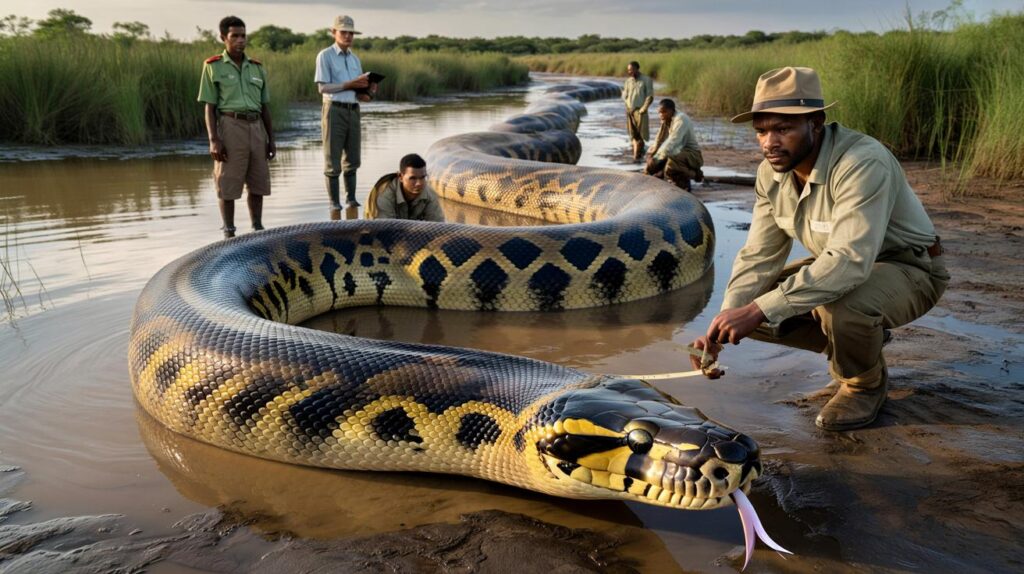
A dark mass lay half-submerged in the tannin-brown water. At first it looked like a fallen log. Then the “log” exhaled. The surface broke in a slow, rolling wave of muscle and scale. Cameras clicked. Someone whispered a single word that ran down the line like an electric current: “Python.”
Only when the tape measure came out did they realize just how wrong their expectations had been.

The day a “legend” turned into data
Local guides in that remote corner of southern Mozambique had been telling the same story for years. A python so large it could “block the path of a pickup truck.” Scientists listened politely, took notes, then went back to measuring the usual three- and four-meter snakes. Folklore has a way of getting bigger with each retelling, and field teams know to keep a little skepticism in their backpack.

On this expedition, the plan was routine: confirm species distribution, tag a few specimens, collect environmental DNA from murky channels. Nothing about the mission log hinted that a record-breaking reptile might be lying in the reeds. Then the guides led them to “that” swamp. You don’t expect a legend to appear in front of you on a Tuesday morning.
When the python finally slid out of the water, it moved with the slow certainty of an animal that has never had to be afraid of anything. The researchers formed a wide semicircle, keeping a respectful distance. This wasn’t a trophy hunt; this was a certified survey under strict wildlife permits, with veterinarians and local rangers on-site.
They recorded GPS coordinates, air temperature, water depth. GoPros whirred. Drones hovered overhead. The first loose estimate put the snake at well over six meters, maybe more, with a weight edging into humanly-unliftable territory. Later, under controlled handling and sedation, the numbers were confirmed and logged with almost ceremonial care. A field myth had just crossed the line into peer-reviewed reality.
An exceptionally large African rock python isn’t just a curiosity for headlines. It’s a living data point that forces science to redraw its comfort zone. For years, textbooks have described these snakes as reaching “up to six meters” on the rare extreme. Many biologists quietly assumed the higher estimates, often quoted by hunters and villagers, were stretched. Now, confronted with a certified specimen that pushes or even surpasses those limits, the conversation shifts.
The discovery adds weight to a growing idea: some African ecosystems still hold individuals that grow larger, older, and more resilient than modern models predict. Climate patterns, prey availability, human disturbance — all feed into these outliers. When one of them shows up, *you’re staring at decades of survival written along every scale*.
How scientists actually measure a giant snake (without turning it into a circus)
On social media, a giant snake is arms outstretched, friends grinning, the animal dangling like a heavy rope. Real science looks completely different. On this expedition, the team followed a strict protocol. First, they observed the python in its habitat, timing its movements, logging its behavior. Then rangers and veterinarians coordinated a safe restraint, using padded hooks, fabric straps, and the kind of practiced choreography that only comes from long experience with dangerous wildlife.
The snake was sedated to reduce stress and risk. Only then did the tape measure appear, stretched from snout to tail-tip, multiple times, by different team members for consistency. Girth at several body points was recorded, along with weight using a hanging scale and robust slings. Every number went into a field tablet, backed up on paper — because nobody wants to lose data like this to a dead battery.
For people used to viral videos, the calm, almost boring repetition of measuring a snake might be surprising. That’s the point. With an animal this large, a rushed move or a careless grip can end badly for everyone involved, the python included. Let’s be honest: nobody really does this every single day. Even seasoned herpetologists can feel their pulse jump when they first lay hands on something that could wrap around a person’s torso.
One of the most common mistakes made by non-scientists is to overestimate size. Distance, mud, fear, even pride all stretch a snake a little longer in the telling. Inflated numbers muddy the scientific record and feed skepticism toward local testimony. This time, careful measurement means that when villagers say, “There’s another one just as big upriver,” their words carry more weight.

The lead scientist on the project, a soft-spoken researcher from the University of Pretoria, later tried to explain the feeling of that day.
“We’ve all read field notes about big snakes,” she said. “But when you place your hands on an animal that has probably been alive longer than your own research career, you suddenly understand what ‘apex predator’ really means. You feel very small, and oddly, very responsible.”
Data collection did not stop at length and weight. The team took non-lethal scale clips for genetic analysis, swabbed the mouth and cloaca for pathogens, and recorded environmental data points like:
- Exact GPS coordinates of the capture site
- Nearby prey presence, from antelope tracks to bird colonies
- Water quality and temperature readings in the swamp channel
- Evidence of human activity: fishing nets, plastic waste, footprints
All of it will feed into models of how giants like this can still emerge and survive in landscapes increasingly carved up by roads and farms.
What a single giant python says about us, not just about snakes
Back in camp that night, as generators hummed and the swamp chorus swelled, the mood was complicated. There was the thrill, of course — you don’t get to confirm a once-in-a-decade discovery every field season. But there was also a quiet unease. A snake that big doesn’t appear out of nowhere. It needs decades of relatively undisturbed habitat, a steady supply of medium to large prey, and the luck to avoid humans armed with machetes and rumors.
The fact that this python existed suggested a small pocket of the landscape was still functioning as it had generations ago. The unspoken question around the mess table was simple: for how much longer?
African rock pythons have a complicated relationship with people. In many rural areas, they’re seen as both threat and asset. They raid poultry coops and occasionally livestock pens, yet they also keep rodent populations down. Stories of snakes attacking humans, while rare, spread faster than any nuanced explanation of ecosystem balance. That’s how you get the legend of the “truck-wide” python in the first place.
The newly documented giant will no doubt feed fresh headlines about “monsters” and “terrifying beasts.” Those stories travel well. What travels less easily is the reality that this animal is not an intruder but a native, a holdout from a time when vast, unbroken habitats could quietly grow such giants without anyone counting or photographing them.
There’s a plain truth at the core of this discovery: **you can’t have record-breaking animals without record-worthy habitats**. A python of exceptional size implies stable prey populations, seasonal flood cycles that still behave roughly as they should, and pockets of land where hunting pressure is low enough for a reptile to reach old age. Strip those away, and you don’t just lose impressive millimeters on a measuring tape. You lose the quiet resilience of a whole food web.
For the scientists who packed up their gear and left that swamp behind, the real work now moves into labs, policy meetings, and conservation plans. DNA sequences may reveal if this snake belongs to a distinct local lineage. Land-use maps might show which nearby farms or roads are inching too close for comfort. **The photo of a human standing next to a record python will get the clicks; the spreadsheets that follow might decide whether such a sight will ever happen again.**
 These zodiac signs are destined for major prosperity in 2026 according to astrological forecasts
| Key point | Detail | Value for the reader |
|---|---|---|
| Certified discovery | Measured by a trained expedition team under permits, with repeated, documented measurements | Readers can trust the size claim is not an exaggerated campfire story |
| Ecological signal | A giant python implies long-term habitat stability and abundant prey in at least part of the region | Shows how one animal can reveal the hidden health of an entire landscape |
| Human-wildlife future | Data from this specimen feeds into conservation planning, conflict mitigation, and genetic studies | Helps readers understand why viral wildlife “records” matter beyond the headline |
FAQ:
- Question 1How big was the newly confirmed African python exactly?Field measurements under sedation recorded a length in the upper range for the species, pushing or slightly exceeding six meters, with a massive girth and weight estimated well above 80 kilograms.
- Question 2Was the snake harmed or killed during the expedition?No. The python was carefully restrained, sedated for safety, measured, sampled for DNA and health data, then released back into its habitat under the supervision of rangers and veterinarians.
- Question 3Are such giant pythons a danger to humans?Attacks on people are extremely rare, though not impossible. Large pythons usually target wild prey like antelope, monkeys, and large birds. Most conflicts happen when snakes are cornered or when people try to handle them.
- Question 4Could climate change be linked to the size of this snake?Scientists are cautious here. Climate shifts can influence prey availability and growth rates, but genetics, habitat quality, and age are also major factors. Long-term studies will be needed to see any clear pattern.
- Question 5Will this discovery change how African pythons are protected?It could. Verified records of exceptionally large individuals provide compelling evidence for preserving remaining intact habitats, and they can help strengthen arguments for protected areas and better wildlife policies.
