Behind the automatic doors and bright aisles, a quiet but brutal reshuffle of France’s food retail sector is underway, and one regional group has decided it can no longer stay tied to a struggling giant.
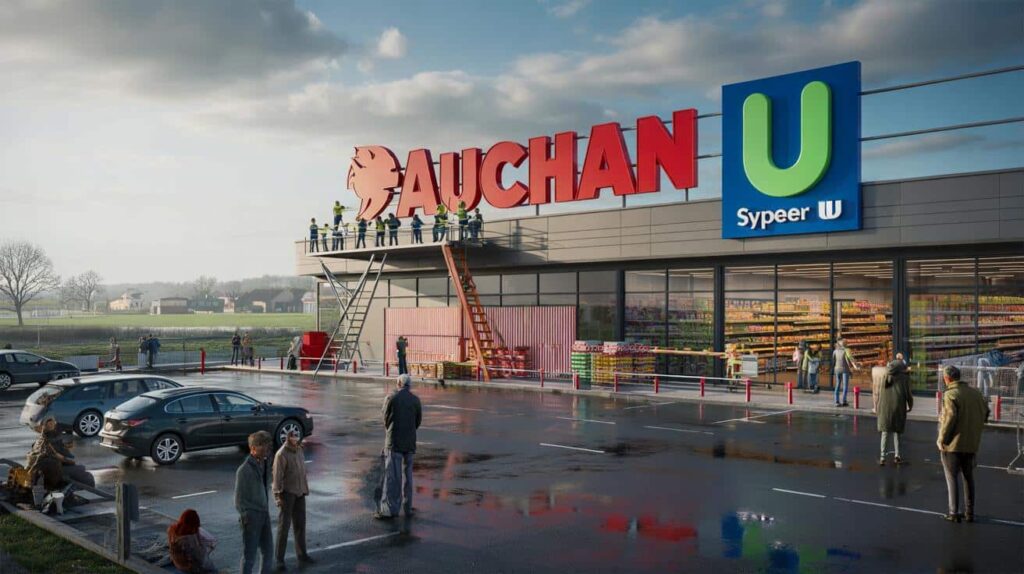
Auchan loses a partner after 27 years
The upheaval centres on Schiever, a mid-sized French retail group based in Avallon, Burgundy. After 27 years partnered with retail giant Auchan, Schiever is walking away and changing banners across its estate.
The decision follows a financially harsh 2024 for brick‑and‑mortar retail. Rising prices have eroded purchasing power. Online players have intensified competition. Some chains adapted. Others, weighed down by debt or misjudged strategies, have been forced into drastic restructuring.

Schiever operates a surprisingly broad portfolio: more than a hundred supermarkets, over a dozen hypermarkets, hundreds of convenience stores, DIY and decoration outlets, sports shops, textile stores, restaurants and logistics hubs. Yet the most visible shift for French households will be the fate of 15 supermarkets and hypermarkets currently carrying the Auchan banner.

Fifteen Auchan‑branded stores managed by Schiever will disappear as Auchan locations and re-open under the Système U banner from March 2025.
For Auchan, this is a symbolic blow. It loses a long-term regional partner at a time when French food retail is already squeezed by consolidation among rivals and an unforgiving price war.
From Auchan to Super U: what changes on the ground?
The stores in question are not closing in the strict sense. They will shut as Auchan outlets, then reopen under banners operated by Système U, primarily Super U and Hyper U. For shoppers, the location remains; the logo, loyalty scheme and product mix change.
Système U, a cooperative of independent retailers and the fourth-largest food distribution group in France, has signed an agreement with Schiever that takes effect in early March 2025. The first wave covers 15 supermarkets and hypermarkets, with a geographical pattern that tells its own story.
Where the 15 stores are located
The transformation is focused on central and eastern France, boosting Système U’s footprint beyond its strongholds in the west. According to sector specialist LSA, the 15 outlets concerned are:
- Avallon, Yonne (Hyper U)
- Cosne-sur-Loire, Nièvre (Hyper U)
- Sens, Yonne (Hyper U)
- Farébersviller, Moselle (Hyper U)
- Tonnerre, Yonne (Super U)
- Châtillon-sur-Seine, Côte-d’Or (Super U)
- La Charité-sur-Loire, Nièvre (Super U)
- Ruaudin, Sarthe (Super U)
- Sennecey, Saône-et-Loire (Super U)
- Gueugnon, Saône-et-Loire (Super U)
- Souppes-sur-Loing, Seine-et-Marne (Super U)
- Semur-en-Auxois, Côte-d’Or (Super U)
Three additional stores from Schiever’s own bi1 chain will also switch to the U cooperative in early March 2025: Saint‑Florentin and Migennes on 1 March, then Cluny in Saône‑et‑Loire a few days later.
| Current banner | New banner | Planned switch date |
|---|---|---|
| Auchan hypermarket | Hyper U | From 5 March 2025 |
| Auchan supermarket | Super U | From 5 March 2025 |
| bi1 supermarket | Super U / Hyper U | 1–9 March 2025 |
For local residents, the stores are not being boarded up. The Auchan sign comes down, and a U sign goes up in its place.
Why Schiever is cutting ties with Auchan
Schiever’s choice is not only about financial pressure. It is also about strategy and trust within the hyper-competitive French grocery market.
In 2023–2024, the sector saw a major shake‑up as parts of the struggling Casino group were carved up between Intermarché, Carrefour and Auchan. For a regional partner like Schiever, those deals signalled a new balance of power. According to its CEO Vincent Picq, the company learned fairly late, and through the press, of Auchan’s alliance with Intermarché.
That episode raised questions about alignment and transparency. Faced with that, Schiever opted to join Système U, attracted by its cooperative model and more decentralised control. In a cooperative, each independent retailer holds a say in strategy, rather than simply executing head office decisions.
Système U’s chief executive, Dominique Schelcher, described the tie‑up as the result of “shared values”, stressing a long‑term focus on human‑scale retail that remains embedded in local territories.

What shoppers can expect from the switch
For British or American readers used to standardised chains, the French system can look unusual. Chains like Système U and E.Leclerc are built around independent store owners, grouped in cooperatives to gain scale on purchasing and marketing.
When an Auchan becomes a Super U, shoppers will typically notice:
- A new loyalty card and points programme.
- Changes to own‑label products, as U-branded ranges replace Auchan store brands.
- Different weekly promotions, especially on fresh products and fuel where applicable.
- Possible tweaks in layout, with more emphasis on local producers and regional specialities.
Staff are usually retained, since the physical store and employer remain Schiever, only the retail banner and central purchasing network change. For many employees, the risk lies less in immediate job losses and more in adjustments to working practices, targets and supplier relationships.
For everyday shopping baskets, the impact will likely be felt in loyalty rewards, private-label ranges and the way promotions are structured.
How this fits into the broader French retail battle
Behind this story sits an intense contest for market share between the big French food retailers: E.Leclerc, Carrefour, Intermarché, Système U and Auchan. E.Leclerc has positioned itself as a price leader. Carrefour leans on its global scale. Intermarché plays the “producers and traders” angle, stressing its role in food manufacturing.
Auchan, once a powerhouse, has struggled for years in France. Its hypermarkets, often in out‑of‑town retail parks, have faced declining traffic. By contrast, cooperatives like Système U have built strength in medium‑sized towns, focusing on proximity and regional roots.
By bringing Schiever into the fold, Système U secures better coverage in areas where it was less present, from the Nièvre to the Moselle via Yonne and Côte‑d’Or. That helps it negotiate sharper prices from suppliers and puts fresh pressure on rivals in those catchment areas.
What this means for consumers worried about prices
French households have been hit hard by food inflation since 2022. Families in smaller towns often depend on a single large supermarket within reasonable driving distance. A change of banner can therefore trigger anxiety: will prices go up or down?
Two broad scenarios can play out for a typical family near one of the affected stores:
- If Système U uses the new outlets to boost its purchasing power, it may push through more aggressive promotions on staples like pasta, milk and cleaning products.
- If integration costs weigh on margins in the short term, some categories could see less discounting while the chain stabilises its operations.
In practice, shoppers often see a mix: introductory “welcome” offers after the rebranding, followed by a period of adjustment as the new store fine‑tunes its assortment and price positioning against nearby rivals such as Intermarché, Carrefour Market or Lidl.
Key terms: hypermarket, supermarket, cooperative
The French debate on retail restructuring can feel technical, so a few definitions help:
- Hypermarket: a very large store, usually on the edge of town, combining a supermarket with a non‑food section (electronics, clothing, household goods).
- Supermarket: a mid‑sized grocery store focused mainly on food and everyday products.
- Cooperative: a structure where independent store owners band together to purchase goods and market under the same brand, while sharing governance and strategy.
For investors and policymakers, these distinctions matter because they reveal where growth is still possible. Hypermarkets in France face structural headwinds, while smaller formats and convenience outlets often prove more resilient in times of crisis.
In the coming months, analysts will watch how quickly the former Auchan stores integrate into the U network, and whether Système U can leverage the move to challenge larger competitors on price and service without sacrificing the local flavour that attracted Schiever in the first place.