
The first thing you notice is the silence on deck. No one is talking, just the slap of waves on the hull and the soft whirr of a tape measure sliding along wet steel-blue skin. The tuna lies there like a submarine set adrift, its great tail fin twitching once, then going still. A marine biologist in a faded cap calls out numbers while another scribbles on a waterproof clipboard, hands shaking just a little. Phones are out, but nobody’s really filming; they all know this isn’t just “content.”
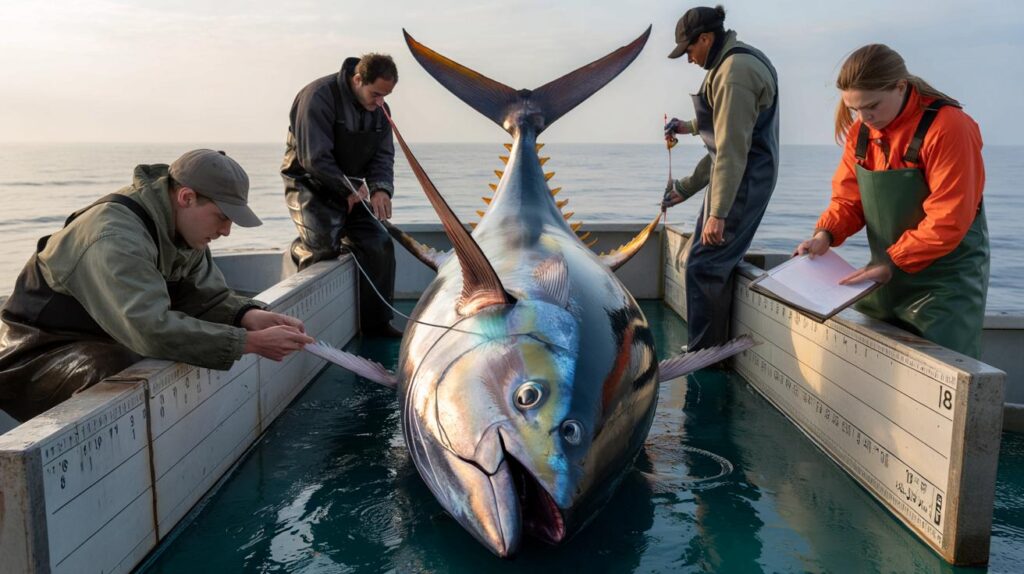
They’ve hauled in one of the ocean’s legends.
The kind most of us only ever see as a slice of ruby meat on a plate.
 A Major Polar Vortex Disruption Is Developing and Experts Say a February Event Like This Is Rare
And this time, every centimeter will be beyond dispute.

The day a giant bluefin broke the silence on deck
They knew something was different the moment the line went tight.
Not the quick, nervous pull of an ordinary fish, but a steady, impossible drag that bent the rod into a question mark and made the winch scream. It took nearly two hours to bring the bluefin alongside the research vessel, the crew taking turns at the harness, backs aching, faces flushed. When the fish finally surfaced, a dark torpedo under the foam, the deck went weirdly quiet.
Everyone had heard stories about giant bluefin.
Seeing one pressed against the hull, longer than most of the people onboard, is another thing entirely.
On most fishing trips, a “big tuna” might weigh 100 kilos and spark a few proud photos. This one was in another category. The research team had been working in a known migration corridor in the North Atlantic, tagging and releasing tuna as part of a long-term population study.
But when this behemoth hit, the project lead, Dr. Ana Morales, ordered the crew to switch to a careful capture protocol used only for exceptional specimens. They deployed a custom cradle at the stern, lined with wet canvas, and flooded it with seawater. The fish was guided in with soft ropes, not gaffs, while one scientist watched its eye for signs of stress.
They weren’t just landing a record. They were handling a data point that could reshape models.
Bluefin tuna sit at the center of a strange tension.
They’re luxury sushi, coastal legends, and climate indicators all at once. That mix makes big claims about their size oddly political, especially when the fishery has a history of overfishing and underreporting. So when this giant arrived at the surface, the team knew raw excitement had to give way to discipline.
They followed peer-reviewed measurement protocols used by international stock assessment bodies: standard fork length, total length, girth at the widest point, body condition scores, sex, and estimated age backed by otolith sampling. Every step had to be replicable and boringly precise.
Because behind the awe, one blunt question lurked: are we seeing the last of the giants, or the return of a species finally catching a break?
How scientists actually measure a sea monster without fudging the numbers
There’s a surprisingly humble hero in this story: a certified measuring tape.
For the bluefin, the team used a rigid, 3‑meter board marked in centimeters, calibrated and photographed with a reference bar before the trip. Once the tuna was sedated in the water-filled cradle, three people lined it up, nose to one end, tail carefully flattened to standard position. Two biologists read the fork length aloud in unison, then repeated the process three times. Any disagreement over 0.5 cm triggered a do-over.
Girth was taken with a non-stretch tape passed under the body at its thickest point. Again, three measurements. No room for “close enough.”
If that sounds obsessive, there’s a reason. Sports fishing records, marketing claims, even old scientific notes are riddled with optimistic guesses and rough deck-side estimates. One famous bluefin from the 1970s was long touted as a 900‑kilo monster. When biologists later re-analyzed the photos using standard length‑to‑weight conversions, the real number looked closer to 650.
On this boat, nobody wanted their fish to become another fishy legend.
So they photographed the tuna against the measurement board from multiple angles, logged GPS position, water temperature, and depth of capture, then recorded video as they called out each metric. The goal wasn’t just proof for headlines. It was an unbroken chain of evidence other scientists could audit if needed.
All this careful fuss might sound over the top until you remember what’s at stake.
International bodies like ICCAT and scientific journals will flatly ignore measurements that don’t follow peer-reviewed standards. Rulers printed on boat rails, “arm-span” estimates, rough dock-side weigh-ins — they all get thrown into the “nice story, unusable data” bin. That means one sloppy moment on deck can erase a fish from the scientific record, no matter how huge it was.
*Protocols are the boring rails that keep the wildness of the ocean from turning into noise on a spreadsheet.*
Let’s be honest: nobody really reads those method sections for fun. But without them, a once-in-a-decade giant is just another blurry myth.
What this one tuna quietly reveals about the ocean we barely know
Measuring a bluefin is one thing.

Turning that body into a story about the ocean’s future is another. On deck, after the last number was called, the team ran a rapid biopsy and clipped a tiny piece of fin for genetic analysis. They inserted a satellite tag near the dorsal fin, sealed with a dash of surgical glue, and monitored gill movement. Then the cradle was tipped, and the fish glided free, disappearing with a single lazy kick.
The real work started once the laptops opened. Fork length, girth, and body condition were run through models that convert size to weight, growth rate, and potential fecundity. This wasn’t clickbait. It was a health check on an entire population.
For years, bluefin stories have swung between doom and miracle. One decade they’re “on the brink,” the next they’re “bouncing back,” depending on which stock and which basin you’re talking about. That emotional whiplash has made a lot of regular people quietly tune out.
This fish cut through the noise. Its confirmed metrics placed it in the top few percent of known wild bluefin, a genuine outlier. According to published age‑length curves, it was probably several decades old — born before many of the students on board.
That means it survived the worst years of industrial overfishing, shifting currents, and changing prey fields. A living archive of every policy decision we’ve made in the past 30 years.
From a management standpoint, **one verified giant** can nudge models that drive quotas worth billions. Bigger, older breeders contribute disproportionately to the next generation. Their presence in the data hints at whether protections are creating “room” for fish to grow old, or whether we’re still removing them before they reach their full size.
There’s also a cultural layer nobody writes into the papers. Standing over a fish that big, you feel small in a good way. That feeling never shows up in charts, yet it quietly shapes how scientists argue for protected corridors, seasonal closures, and traceable supply chains.
We’ve all been there, that moment when a raw, physical fact cuts through the abstract debate and lodges somewhere under your ribs.
How peer-reviewed protocols keep wild stories honest — and why that matters to you
Out on the water, things get messy fast. Lines tangle, fish thrash, the swell rolls under your feet. That’s why good teams rehearse their measurement protocol long before a rare giant ever appears. On this vessel, they practiced with foam models marked at known lengths, timing each step like an emergency drill.
When the real bluefin arrived, everyone already knew their role. One person managed the head and eyes, one handled the tail, one read the numbers, one filmed, one logged data. No shouting, no “wait, what are we supposed to do now?”
That choreography is the quiet difference between “we think it was huge” and “we know it was 3.02 meters fork length, ±0.5 cm.”
There’s a tempting shortcut in ocean stories: skipping the boring details to jump to the drama.
That’s how we end up with viral posts claiming “the biggest bluefin ever caught” with no context, no methods, and a blurry dock photo to prove it. The scientists on this boat have seen those stories too. Some even grew up believing them. That’s partly why they’re so strict now.
They talk openly about the pressure to oversell, especially when funding and public attention are scarce. The trade-off is brutal: polish the narrative a bit, or stick to dry numbers and risk being ignored.
The honest middle ground is where they live — precise on deck, human when they talk to the rest of us.
“People think we’re out here chasing records,” Dr. Morales told me, leaning on the rail as the sun burned a path across the swell. “We’re not. We’re chasing truth we can defend five years from now, when someone who’s never met us is checking our work in a lab on the other side of the world.”
- Length and girth logged using internationally accepted standards
- Multiple measurements taken and averaged rather than guessed
- Photo and video evidence linked directly to raw data files
- Genetic and age samples stored for future re-analysis
- Satellite tags turning one fish into years of movement data
The strange comfort of knowing a giant like this still exists
Back on shore, the story of the bluefin traveled in familiar ways. A shaky clip on social media. A press release with careful language. A preprint uploaded late at night, waiting for anonymous reviewers to poke holes in the methods. At each step, the fish got a little more abstract, a little less like the breathing presence on that cradle.
Yet something stubborn remained. A confirmed, peer-reviewed fact: in this particular stretch of ocean, at this particular moment, a bluefin large enough to reset the mental scale of “big fish” was alive and moving.
For readers scrolling on a train or in line at the supermarket, that might feel distant. Still, there’s a direct line from that deck to your plate. Quotas, certification labels, “sustainably sourced” claims — they all lean on the kind of measurements that were taken that day.
If the data says giants are gone, management tightens. If verified giants appear more often in the record, it can justify cautious optimism, maybe even slight increases in catch. Beneath headlines and hashtags, those centimeter readings quietly ripple into jobs, prices, and what actually ends up at your local restaurant.
The tuna itself has already moved on, somewhere under a skin of chop and light a thousand kilometers from where you’re reading this. Its tag is pinging a faint, digital trail into orbit. Its tissues are frozen in small vials, waiting in a humming freezer.
What sticks is stranger: a shared awareness that the ocean still holds individuals we haven’t fully mapped into our expectations.
That one rare giant, measured well and argued over in sterile PDFs, becomes a small act of resistance against the idea that the wild world is already finished, already known, already shrunk.

| Key point | Detail | Value for the reader |
|---|---|---|
| Verified giant bluefin | Measured using international, peer-reviewed length and girth standards | Confidence that this isn’t just another fish tale or inflated “record” claim |
| Strict on-deck protocols | Rehearsed roles, repeated measurements, full photo/video documentation | Shows how trustworthy ocean data is actually produced, behind the scenes |
| Impact on real life | Data feeds stock models that shape quotas, prices, and “sustainability” labels | Helps you read seafood claims and ocean headlines with sharper, calmer eyes |
FAQ:
- How big can bluefin tuna really get?Verified records put Atlantic bluefin over 3 meters in length and upwards of 600–700 kilos, with historical accounts hinting at even larger, though many old claims lack modern measurement standards.
- Why do scientists care so much about exact measurements?Length and girth feed into growth and population models; even small errors can skew estimates of stock health, which then affect fishing quotas and conservation policies.
- Was this giant bluefin killed or released?On dedicated research trips, the aim is usually tag‑and‑release: the fish is sedated, measured, sampled minimally, tagged, then returned alive, as was the case here.
- Can I actually eat bluefin tuna guilt‑free?That depends on the stock, the region, and the certification; some bluefin populations are rebuilding under tight management, others are still under serious pressure.
- How do I know if a viral “record fish” story is credible?Look for specifics: clear measurements, references to peer-reviewed protocols or recognized record bodies, and photos that include scale or measuring equipment — not just dramatic angles.
