
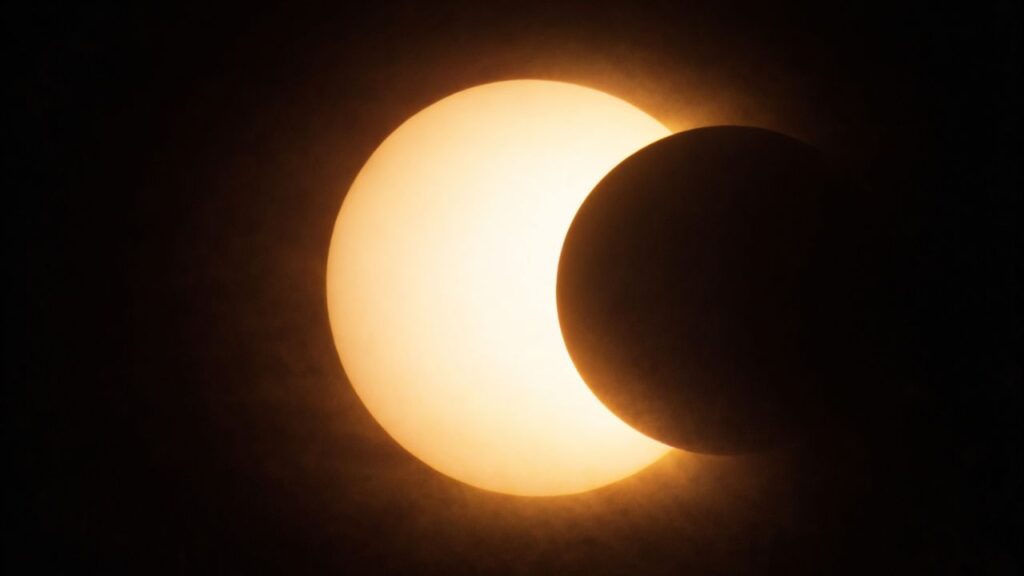
The streets will still hum with traffic, phones vibrating in pockets, coffee machines releasing their familiar hiss. Nothing will feel unusual at first. Then the light will begin to shift. Shadows will sharpen, the air will feel cooler against your skin, and a low, shared murmur will ripple through the crowd as people tilt their heads upward, clutching cardboard viewers and makeshift filters. In the middle of a perfectly normal day, the sky will slowly power down. Not in a blink, not as a quick illusion, but over long minutes that feel stretched and unreal. Scientists already know the exact date. The path is drawn with precision on their charts. The longest solar eclipse of the century is no mystery. What remains unpredictable is how deeply it will affect us.
When noon quietly slips into night
Imagine a city frozen in its lunch-hour rhythm, but lit like early evening. Streetlights flicker on, uncertain. Dogs fall silent. A child pulls at their parent’s hand and asks in a whisper, “Is the sun broken?” That is the mood researchers expect along the narrow track of the longest solar eclipse of the 21st century, already marked on calendars with almost clinical accuracy. For a slim band of Earth, daylight will fold in on itself, and the sky will settle into a deep, unsettling twilight. Stars will appear while emails remain unsent and sandwiches sit half-eaten. For several long minutes, everyday life will feel slightly out of place.
This is not just another fleeting space headline sliding through your feed. The figures behind this eclipse are extraordinary. Astronomers are discussing a period of totality that edges close to the physical limits of this century, approaching nearly seven full minutes of darkness. Many total eclipses barely last two or three minutes. On paper, the difference seems minor. In reality, as the light drains away in slow motion and your pulse quickens, those extra minutes feel immense. Long enough to trace the Sun’s pale corona, to hear laughter fade into silence, and then into a shared, breath-held awe.

The reason for this extended darkness is surprisingly straightforward. The alignment of Earth, Moon, and Sun will be almost perfect: the Moon slightly closer to Earth, our planet near its farthest point from the Sun, and the shadow racing along near the equator where Earth’s spin is fastest. This rare geometry allows the Moon’s shadow to linger. The path of totality will cut across continents like a precise blade, creating a narrow corridor where daylight collapses. Maps already show exactly where this prolonged night will fall, while areas just a few hundred kilometres away will see only a partial eclipse. A small distance will mean a completely different experience, a reminder of how thin the boundary is between routine daylight and something that feels almost mythical.

Experiencing the eclipse, not just observing it
Knowing the eclipse is coming will be easy. Everyone with a phone will know. The challenge will be organising your life around those few minutes so you are not watching from a supermarket car park. Start with one practical step: mark the date and the precise moment of totality for your location, or your chosen destination, with reminders the day before and an hour before. Then decide early whether you will travel into the path of totality or remain outside it. Because the gap between 99% and 100% is absolute. At 99%, it is merely an oddly dim afternoon. At 100%, the world seems to drop through a trapdoor.
Many people learned this lesson during past eclipses. In the United States in 2017, thousands stopped just short of the totality line, convinced they were close enough. Traffic snarled, detours multiplied, hotel prices soared. Many watched in frustration as a stubborn sliver of sunlight refused to disappear. Those who crossed fully into totality still describe it as if it is happening now. One family in Oregon planned their entire holiday around two minutes of darkness, camped overnight, and watched their children fall silent as the Sun vanished. Years later, they remember not the equations, but the goosebumps, the birds settling uneasily, and the roar of the crowd when the corona flared into view.
The longest eclipse of the century will intensify both the wonder and the disruption. Flights along the path will fill. Small towns will prepare for waves of visitors. Hotel rates will quietly multiply. If you want those extended minutes of darkness, planning must begin well before the headlines start shouting “once in a lifetime”. That is the paradox of this event: it is timed to the second, yet felt as something raw and uncontained. The science is orderly. The human response rarely is.
 Goodbye Hair Dye for Grey Hair: The Conditioner Add-In That Gradually Restores Natural Colour
Preparing simply, without overcomplicating the moment
The most effective way to experience this eclipse is almost unremarkable in its simplicity. Choose a location within the path of totality, commit to it, and clear the day of unnecessary distractions. That might mean leaving the city for an open field, or opting for a small town instead of a packed public event. Think ahead about three basics: where you will sit, what you will see, and how your body will react. A chair, an extra layer for the sudden chill, proper eclipse glasses, and perhaps one camera or phone are enough. The goal is not the perfect image. It is to create space to feel what is unfolding overhead.
A common mistake is turning the eclipse into a content sprint. Multiple screens, tripods, live streams, constant messages. Then totality arrives, and your attention is locked onto a device while the most remarkable sky of your life hangs above you. The temptation is real. Go in with a simple rule: live it first, share it later. If you plan a time-lapse, set it up early and forget about it. If children are with you, prepare them the day before. Explain that the sky will darken, the Sun is not broken, and the light will return. Fear fades quickly when there is a story ready.
This balance of science and emotion is the quiet core of the experience. To make room for it, strip the moment down to essentials:
- Before totality – Notice the shifting light, the strange shadows, the behaviour of birds.
- During totality – Put devices aside for at least half a minute. Look up, breathe, feel your heartbeat.
- Afterward – Write one sentence about how it felt, focusing on what changed inside you.
We all recognise moments when the ordinary suddenly feels delicate: a family dinner, a bus ride, a quiet walk at dusk. This eclipse can be one of those moments if you allow it. Not as a dramatic turning point, but as a brief reminder that the universe runs on precise mechanics that still move us deeply.
A shadow that lingers long after the light returns
Once the corona fades and traffic resumes, the longest solar eclipse of the century will survive in conversations, in unsteady videos, and in stories told to children too young to remember clearly. Some will treat it as a simple achievement and move on. Others will carry those minutes quietly for years, a private measure of wonder. That is the subtle force of an event whose date is fixed, yet whose emotional weight is unknown. It arrives on a schedule, like a meeting, but leaves behind something closer to a dream. And perhaps that is why it resonates so strongly in a world already overflowing with noise.

| Point clé | Détail | Intérêt pour le lecteur |
|---|---|---|
| Durée exceptionnelle | Totalité flirtant avec ~7 minutes, bien plus que la moyenne des éclipses | Comprendre pourquoi cet événement sort du lot |
| Préparation pratique | Choix d’un lieu sur la ligne de totalité, anticipation des transports et de l’hébergement | Maximiser ses chances de vivre l’éclipse dans les meilleures conditions |
| Expérience humaine | Gestion des émotions, choix entre filmer ou ressentir, partage avec proches | Transformer l’éclipse en souvenir marquant, pas juste en photo de plus |
