
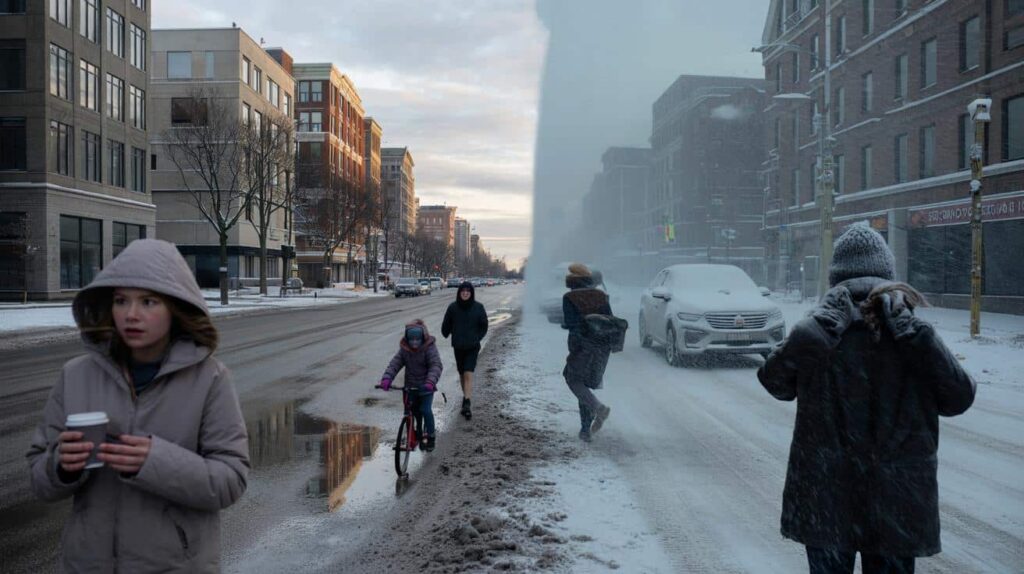
The first sign wasn’t on a satellite map, but in a parking lot. A woman in Milwaukee zipped her light jacket against a drizzle that felt more like late March than deep winter, coffee in hand, wondering if this was it — if winter had just quietly skipped town. Kids were biking with no gloves, joggers in shorts passed heaps of gray snow that never really piled up. The air had that soft, wrong warmth that makes you glance at the sky as if it’s hiding a secret.
Meteorologists say it is. And that secret is starting to crack open faster than they’d hoped.
When winter pretends to leave — and comes back swinging
Across much of North America and Europe, forecasters have been watching models flip from mild to menacing in just a few runs. One day, early February looked cool but manageable. A few updates later, and the maps were blushing deep blue and purple, classic signs of an Arctic air mass spilling south.

For many meteorologists, the phrase on their screens is blunt and slightly alarming: **Arctic breakdown**. That’s the moment when the locked-up cold around the pole stops behaving, and starts leaking into the mid-latitudes at speed.

You can already trace it in the data. Temperatures in parts of Scandinavia plunged with a sharpness that surprised local forecasters. In Canada, cold pools are deepening just north of the Prairies. In the US, long-range charts are hinting at a sharp drop in the central and eastern states that wasn’t there a week ago.
One private weather firm described it simply: “The faucet is about to turn on.” That’s meteorologist code for, “You thought this was over? It isn’t.”
Behind the scenes, this story is all about the polar vortex and the fragile belt of winds that circles the Arctic. When that belt weakens or gets twisted by atmospheric waves higher up, cold air that usually stays neatly stacked over the pole can start to wobble south.
This winter, a sudden warming event high in the stratosphere helped jolt that system. The breakdown that was forecast for mid or late February is now jumping ahead on the calendar. *Weather doesn’t like being told it’s running late.*
How to live through a fast-track Arctic snap without losing your mind
The first practical move isn’t dramatic at all: treat the next 10–14 days like a countdown. Not a panic timer. A prep window.
Check the boring things that only matter when they fail. Drafty windows? Throw on plastic film, towels, whatever you’ve got. Car fluids and battery? Get them checked before the mornings turn bitter. Gloves with holes, kids’ boots a size too small, that one coat with the broken zipper — this is the week to fix or replace, not the day the windchill hits -20.
Energy habits matter too, and not in an abstract way. Lowering the thermostat a single degree ahead of the cold spell and sealing one or two leaks can be the difference between a manageable bill and a lump in your throat when the invoice lands.

We’ve all been there, that moment when the forecast shifts and you realize your cozy denial just turned into an extra $200 in heating costs. Let’s be honest: nobody really does this every single day. But starting now, with one or two deliberate steps, beats scrambling when the first Arctic gust hits your face.
There’s also the mental side of a suddenly harsher winter, especially after a weirdly soft January. People feel cheated by the season. The early crocuses, the bike rides, the terraces that reopened for a weekend brunch — all of that feeds the shock when the deep freeze snaps back.
“These rapid pattern flips are exactly what we expect in a warming climate,” explains Dr. Lena Ortiz, a climate scientist who studies Arctic–midlatitude connections. “Warmer background conditions don’t cancel out cold. They stretch the rubber band, so when it snaps, it snaps harder.”
- Layer your information: follow one trusted local forecaster, one national outlet, one app.
- Prep a simple cold kit: extra blankets, power bank, non-perishable food, flashlight.
- Plan for the vulnerable: check on elderly neighbors, friends who live alone, outdoor workers.
- Adjust routines: schedule travel and appointments around the worst days of the freeze.
- Protect pipes and pets before the cold hits, not after the first freeze warning.
A fragile winter, a restless Arctic, and what it says about us
This early February Arctic breakdown isn’t “just another cold snap” for many scientists watching the high latitudes. It’s another line in a pattern that feels less like noise and more like a new rhythm: winters that start soft, then lurch into sharp extremes. Warmer-than-normal ocean waters, patchy snow cover, and a more agitated polar vortex are all part of the same canvas.
For people on the ground, that grand climate picture shows up in small, intimate ways. A parent rethinking the walk to school. A farmer worrying about winter wheat. A delivery driver calculating if their old tires can handle black ice on roads that were bone dry 48 hours earlier.
This kind of weather whiplash also chips at something quieter: our sense of what a season is supposed to feel like. Winter used to mean a reliable string of cold weeks, a certain rhythm of storms, a rough script you could trust. Now, in many places, it plays more like a streaming series with sudden plot twists — a thaw episode, a blizzard special, a surprise cliffhanger warm spell.
That uncertainty breeds a low-level anxiety many don’t name, but feel in their bones. Planning becomes trickier. Budgets stretch. Traditions shift. The Arctic, far away on the map, ends up rearranging living rooms and routines.
At the same time, there’s a strange clarity that arrives when a real cold front finally moves in. People look up from their screens and actually smell the air again. Neighbors offer a ride, share salt for icy steps, swap tips on the best cheap thermal socks.
An early, sharper-than-planned Arctic breakdown is not just a technical forecast update. It’s a reminder of how tightly we’re all wired into a climate system that’s wobbling in new ways. The question isn’t only, “How low will the temperature go?” It’s also, “How quickly can we adjust — practically, emotionally, collectively — when the season we thought we knew, suddenly doesn’t behave?”
 Meteorologists warn February could begin under an Arctic regime never observed in recent history
| Key point | Detail | Value for the reader |
|---|---|---|
| Fast-developing Arctic breakdown | Colder air spilling south earlier than models suggested | Helps you understand why the forecast suddenly turned sharply colder |
| Practical prep window | 7–14 days to tune up homes, cars, and routines | Reduces stress, surprise costs, and last-minute scrambling |
| Climate context | Weaker polar vortex linked to a warming background climate | Gives meaning to extreme swings and helps you talk about them with others |
FAQ:
- Question 1What exactly is an “Arctic breakdown”?It’s when the cold air usually trapped around the North Pole shifts southward in a big way, as the polar vortex and jet stream weaken or wobble. That “breakdown” of the usual pattern lets Arctic air pour into North America, Europe, or Asia.
- Question 2Does an Arctic breakdown mean climate change has stopped?No. A warming planet can still produce intense cold snaps. What’s changing is the background conditions and the way the jet stream behaves, which can make these swings more dramatic and less predictable.
- Question 3How far ahead can meteorologists really see this coming?Signals often appear 10–20 days in advance in long-range models, but timing and intensity can shift quickly. The recent concern comes from those models suddenly aligning on a stronger, earlier cold surge.
- Question 4What should I focus on at home before the cold hits?Think in three layers: keep the heat in (seal drafts, curtains, doors), protect essentials (pipes, car, pets), and have a simple backup plan (blankets, food, light, a place to go if power fails).
- Question 5Will this be the last big cold of the season?Nobody can say with certainty. Late-season cold waves are still possible into March in many regions, even after a mild winter overall. The safest mindset is to treat this as one serious chapter, not necessarily the final one.
