
On a gray Tuesday morning in late January, London woke up confused. People zipped their coats a little higher, checked their weather apps twice, then stepped into air that felt oddly wrong for the calendar. The forecast said mild. The wind said something darker was moving in from the north.
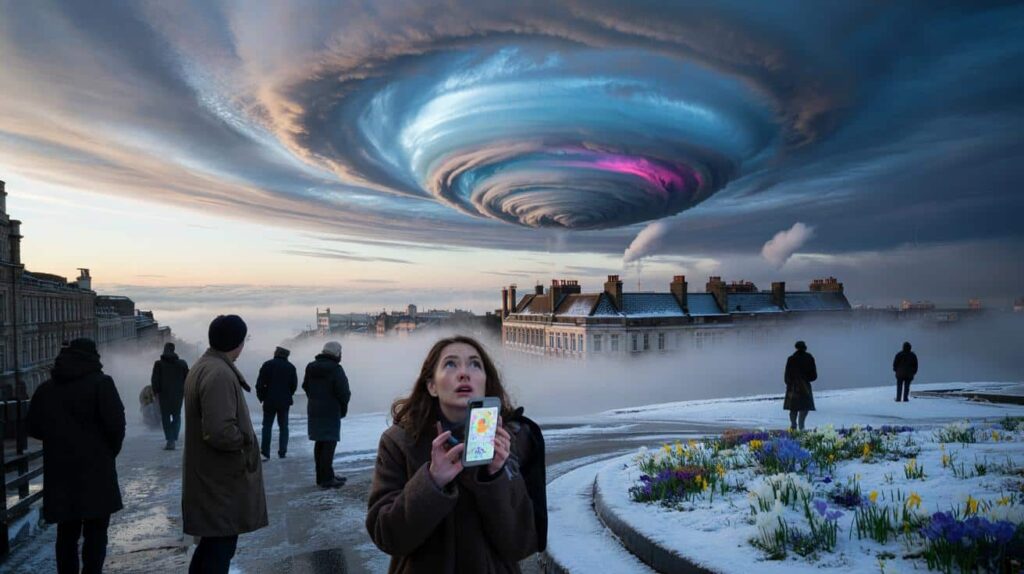
On social media, winter watchers shared bizarre maps glowing purple over the Arctic, while TV forecasters used phrases that felt out of place on daytime news: “disruption”, “collapse”, “stratospheric shock”. Scientists call it a sudden stratospheric warming. Everyone else just calls it: what on Earth is going on with February?
Some meteorologists think this could flip our weather patterns like a table being turned.
 Meteorologists warn early February is shaping up to trigger a rare Arctic destabilization event
And nobody sounds entirely sure how bad that flip could be.

When the Arctic stops playing by the rules
Above the North Pole, around 30 kilometers up, there’s a band of screaming-fast winds spinning like a winter halo. It’s called the polar vortex, and most years it quietly does its job, trapping bitter cold over the Arctic and letting the rest of us pretend winter has limits. This year, that halo is wobbling. Models hint at a disruption in early February that could punch through the atmosphere, right down to the surface where we live and commute and pay heating bills.
For most of us, that sounds abstract until you’re scraping ice off a car you didn’t expect to be frozen.
We’ve seen this movie before, just not with quite the same strange script. In February 2018, a similar Arctic disruption helped unleash the “Beast from the East” across Europe. Trains froze in place in the UK, schools closed from Dublin to Warsaw, and gas supplies were suddenly tight enough for government warnings. That event was tied to a sudden stratospheric warming too – a kind of atmospheric plot twist where the air high above the Arctic heats rapidly, flipping wind patterns on their head.
Now, charts shared in meteorological circles whisper about another twist, with shades of 2018, mixed with a dose of climate-era weirdness.
What unsettles scientists this time is not just the disruption itself, but its messy context. The oceans are running hot after months of record-breaking warmth, El Niño has been shaking the global weather system, and long-term Arctic sea ice decline is changing how heat and cold move around the planet.
Put bluntly, our climate is like a Jenga tower that’s already missing a few blocks. An Arctic shock in February lands on a system that’s less stable than it used to be, and models struggle to keep up. Some show deep cold plunging into Europe or North America. Others spread the chill thinner, replaced by stormy, wet chaos. The only consensus right now: normal is off the table for a while.
How to live with a forecast full of “maybe”
When meteorologists start using words like “uncertainty range”, there’s a temptation to shrug and carry on. But there is a quiet, practical way to move through the next few weeks: think in scenarios, not certainties. Check a trusted weather source once a day, not every hour. Look not just at the temperature, but at trends: is the ten-day outlook sliding colder, windier, snowier, or stubbornly mild?
Then do the small, boring things that winter veterans swear by. Bleed that radiator you’ve been ignoring. Dig out the thicker gloves now, not mid-snowstorm. Charge the battery pack you tossed in a drawer last summer. Tiny steps, big peace of mind.

We’ve all been there, that moment when a “chance of flurries” turns into whiteout conditions on the school run. Part of the frustration comes from expecting weather apps to behave like train timetables. They can’t. They were never built for that level of control.
Let’s be honest: nobody really updates their emergency kit every single day. But this coming February, the smartest move is to treat the forecast like a sliding scale of risk instead of a promise. Think, “If the Arctic disruption hits hard, I’ll be glad I stocked up on food for three days and checked on that elderly neighbor.” If it doesn’t, you’ve just got a few extra cans of soup. Not exactly a tragedy.
Meteorologists themselves are walking this tightrope in public. They know the stakes when they choose a word like “disruption” on live TV.
“People hear ‘polar vortex’ and think Hollywood,” a senior European forecaster told me this week. “But what really keeps us up at night is the mismatch between what the atmosphere is doing and what the models still struggle to see. February could be a wake-up call for how we talk about new extremes.”
- Short-term: Expect forecasts to flip more than usual as the disruption unfolds.
- Medium-term: Higher odds of cold snaps, ice, and messy storms in late February.
- Long-term: Growing evidence that a warming Arctic is destabilizing old winter patterns.
*The uncomfortable truth is that weather is becoming a story of probability, not clear-cut predictions we can plan barbecues around months ahead.*
What this strange February might be telling us
There’s a bigger, quieter question humming under the talk of Arctic shocks and sudden stratospheric warming: how do we live a normal life when the background weather keeps tilting off script? This February disruption, whatever shape it finally takes, is a reminder that the climate conversation is no longer abstract. It’s not just about 2050 or polar bears on distant ice. It’s about whether your child’s bus runs safely in the morning, whether your city fails gracefully during a cold snap, whether your home feels like a shelter or a trap.
You don’t need to be a scientist to feel that something is off when crocuses bloom early, then get buried under late snow. You just need to look out the window and trust your own memory of winters past.
These sudden Arctic shifts are like warning lights on the dashboard. The car still moves, but you’d be foolish to ignore them. So maybe the invitation, as February looms with its hard-to-read skies, is to talk about this out loud. Ask local officials what plans exist for cold waves and blackouts. Notice how your own street reacts when extreme weather hits.
And share stories with friends or online: the odd thaw, the early blossom, the snow that comes out of nowhere. Individually they’re anecdotes. Together they start to map the new world we’re quietly entering, one disrupted winter at a time.

| Key point | Detail | Value for the reader |
|---|---|---|
| Arctic disruption risk | Sudden stratospheric warming could weaken or displace the polar vortex in early February | Helps you anticipate unusual cold snaps, storms, or pattern flips |
| Forecast uncertainty | Models struggle with a warmer ocean, El Niño, and rapid Arctic change | Encourages you to treat forecasts as probabilities, not guarantees |
| Practical preparation | Small steps like checking heating, storing basics, and supporting vulnerable neighbors | Reduces stress and increases safety during potential extreme weather |
FAQ:
- Question 1What exactly is an Arctic disruption and how is it different from a “polar vortex” event?
- Question 2Could this February’s disruption cause another “Beast from the East” style cold wave?
- Question 3How far ahead can meteorologists really see these stratospheric warming events coming?
- Question 4Is climate change directly responsible for these disruptions, or just changing their impacts?
- Question 5What are three simple things I can do this week to feel more ready for extreme winter swings?
