
The first thing you notice is the silence.
No cars, no kids shouting on the sidewalk, just that muffled, cottony quiet that only arrives when cold air has pressed itself over a city like a lid on a pot. Your breath feels heavier, almost metallic. The kind of cold that bites the inside of your nose before you even lock your front door.
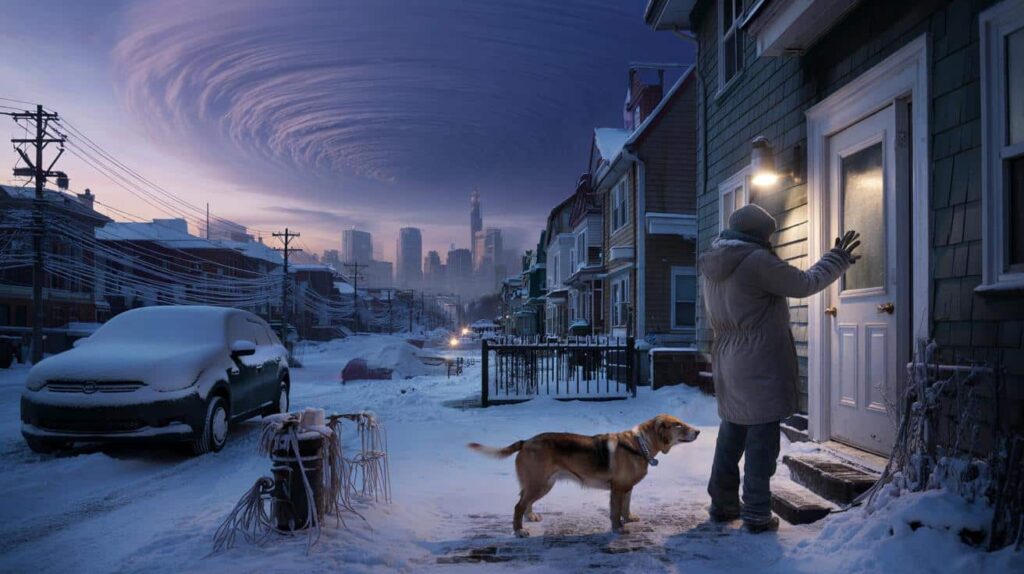
On the weather app, the map is bleeding shades of deep purple and electric blue, a swirling bruise over the Northern Hemisphere. The words “polar vortex anomaly” look strangely clinical for something that can freeze pipes, ground planes, and turn your daily walk into a survival exercise.
This isn’t just a regular February chill.
Something about this one is off.

A polar vortex that doesn’t behave like February
On the satellite images, the polar vortex usually looks like a tidy ring of cold air spinning neatly around the Arctic, far above our heads, almost abstract. This time, the ring is warped and stretched, like someone tugged it down toward the mid-latitudes and refused to let go. Meteorologists have been watching this twist since January, eyes locked on models that keep flashing the same message: this burst of Arctic air is arriving late, sharp, and strange.

**February is supposed to be the slow climb back toward light.**
This year, it’s feeling more like a winter encore no one asked for.
In Chicago, a school district is already drafting remote-learning plans “just in case.” In Warsaw, transit operators are checking backup generators and fuel stocks. Across parts of the US, Canada, and Europe, people are buying thermal socks and windshield de-icer like they did during the historic cold waves of 2014 and 2021.
Forecasters talk about “anomalies” in numbers: 15 to 25°C below seasonal averages in some regions, wind chills that could freeze exposed skin in minutes, systems that resemble outbreaks more typical of January’s deepest dark. The detail that quietly alarms seasoned forecasters isn’t just the depth of the cold. It’s the timing. February usually signals a weakened vortex. This one is doubling down.
So what went wrong upstairs, high above the jet stream? The polar vortex lives in the stratosphere, around 15 to 50 kilometers above us, a sprawling whirl of icy air that normally keeps the cold locked over the Arctic. When that whirl destabilizes—through sudden stratospheric warming events, shifts in atmospheric waves, or changes linked to sea ice and snow cover—it can split or sag.
That sag is what sends frigid air spilling south into cities that thought they were inching toward spring. Some researchers point to background warming of the Arctic and changing snow patterns as accomplices in these breakdowns. Others urge caution, saying the data is still noisy. What’s clear is this: the “rules” of winter no longer feel fixed. The calendar is losing its grip on the climate.

What you can actually do as the vortex drops
So you’ve seen the headlines, scrolled through the maps, and maybe felt that familiar mix of dread and low-level curiosity. The question isn’t “Will this be historic?” but “How do I get through the next ten days with minimal chaos?” Start small and physical. Walk through your home like a detective of cold.
Check for drafts along windows with the back of your hand. Slide an old towel or rolled-up blanket against the gap under your door. Open the kitchen sink cabinet so pipes get a bit more warmth. If temps are projected to crash well below freezing, let faucets drip slightly overnight to keep the water moving. It feels old-fashioned, because it is. Cold doesn’t care how modern your life is.
We’ve all been there, that moment when you realize you own three scarves, but none of them are actually warm. Panic-buying gear in the middle of a cold snap almost always leads to disappointment. Plan your layers instead of your outfits. Thin base, insulating middle, windproof outer shell. Wool for warmth, synthetic for sweat. Cotton? That stays home.
Let’s be honest: nobody really checks their car emergency kit every single day. Still, throwing a blanket, phone charger, basic snacks, and a scraper into the trunk takes less time than complaining about the cold on social media. Many people also forget about their pets. Shorten walks, wipe paws to avoid ice melt burns, and create a quiet, warm corner for them inside. You’ll feel better, and so will they.
“From a pure numbers standpoint, this kind of February Arctic outbreak is rare,” says a climatologist from a northern European institute. “But rare doesn’t mean impossible. The climate dice are being loaded. Events that once shocked us now show up on the models more often. What changes next isn’t only the air above us, but how prepared we are on the ground.”
- Check trusted local forecasts twice a day, morning and evening.
- Charge power banks and keep them in a known, easy-to-grab spot.
- Layer clothing, not just jackets: base, mid, and shell.
- Protect pipes with insulation or simple towels in exposed areas.
- Keep a “cold wave basket” ready: gloves, hats, candles, flashlight, snacks.
Living with weird winters from now on
There’s a strange feeling that comes with stepping outside into brutal cold while your social feeds are full of stories about global warming. On the surface, the two seem to clash. The science says they don’t. A warming planet can hold more moisture, bend jet streams, and set up the atmosphere for wilder swings. Some winters will feel disappointingly tame. Others, like this one, will feel personally hostile.
*The rhythm of the seasons is turning jazzy, syncopated, a little off-beat.* We’re living inside that new tempo now. Not just as victims of the weather, but as witnesses, and, uncomfortably, as contributors.
 Meteorologists warn early February is shaping up to trigger a rare Arctic destabilization event
| Key point | Detail | Value for the reader |
|---|---|---|
| Polar vortex anomaly | Unusually strong and displaced Arctic air intrusion in February, dropping temperatures far below seasonal norms | Helps you understand why this cold spell feels harsher and “out of sync” with the calendar |
| Practical preparation | Simple home, clothing, and car checks reduce risks from frozen pipes, power cuts, and exposure | Gives you concrete actions that turn anxiety into control |
| Changing winter patterns | Warming background climate linked to more erratic, sometimes extreme winter behavior | Places this event in a bigger story, so the shock becomes context, not just fear |
FAQ:
- Question 1What exactly is the polar vortex that everyone is talking about?
- Answer 1The polar vortex is a large-scale circulation of extremely cold air high in the stratosphere above the poles. When it’s strong and stable, the cold stays locked up north. When it weakens or becomes distorted, lobes of that icy air can spill south, bringing intense cold to North America, Europe, or Asia.
- Question 2Why is this February event being called an anomaly?
- Answer 2Because the vortex is behaving with a strength and reach that are more typical of mid-winter peaks in January. By February, the vortex usually starts to relax. This time, it’s intensifying and sagging south later than usual, sending unusually severe cold into regions that expected a slow warm-up.
- Question 3Is this extreme cold a sign that global warming is fake?
- Answer 3No. Long-term global warming refers to rising average temperatures over decades, not the absence of cold weather. A warmer Arctic and shifting atmospheric patterns can actually disrupt the polar vortex, making these wild cold outbreaks more likely in some regions, even as the planet’s overall temperature climbs.
- Question 4How long can a polar vortex cold wave like this last?
- Answer 4Most surface cold outbreaks tied to vortex disruptions last from a few days to about two weeks in any one region. The stratospheric disturbance itself can linger longer, but the worst of the ground-level cold usually comes in one or two sharp waves, sometimes with short thaws in between.
- Question 5What should I focus on at home before the temperatures drop?
- Answer 5Prioritize warmth, water, and power. Seal drafts, protect vulnerable pipes, and stock basic food and medications. Prepare layers of clothing and blankets, charge devices and power banks, and think about anyone around you who might struggle more than you do: older neighbors, outdoor workers, people without stable housing. Cold is physical, but resilience is social.
