
The morning sky looked normal at first glance: a slab of low, gray cloud, the kind of February ceiling that makes coffee taste a bit better than it really is. Yet on the radar screens glowing in a quiet forecast office, nothing about this week’s weather chart felt normal. Over the North Atlantic, the jet stream — that roaring river of air that usually steers winter storms — was already bending, sliding, and snapping into its spring position.
Meteorologists leaned closer to their monitors, half fascinated, half uneasy.
Because this realignment wasn’t supposed to happen yet.
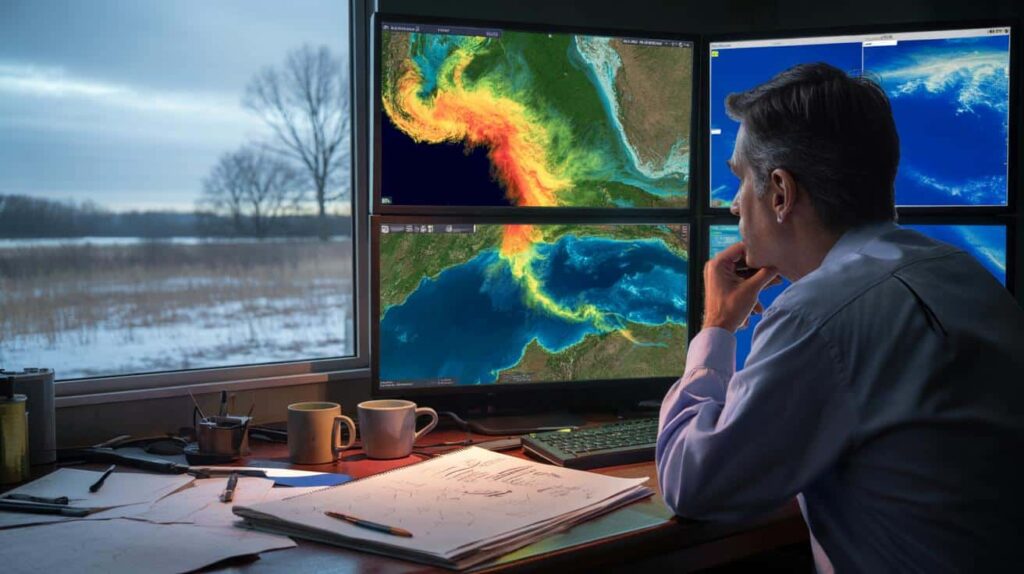
What an early jet stream shift really means for our winter
Across North America and Europe, meteorologists are watching the upper atmosphere behave like a season that’s running ahead of schedule. The jet stream, which usually stays locked in a tight, cold pattern through much of February, is starting to arch north, flatten, and wobble like it tends to do in late March. For professionals used to reading these maps almost by instinct, the patterns feel subtly off, like a familiar song played just a little too fast.
This isn’t just a curiosity for weather geeks. It changes the script for the rest of winter.
Think about what you’ve probably already noticed outside your window. Daffodils poking through thawed soil three weeks early. Ski resorts quietly closing side slopes because the base is shrinking. Farmers in parts of France and the U.S. Midwest reporting buds swelling on fruit trees while snow is still on the long‑range forecast.
Those little stories all connect to the same invisible culprit: an upper atmosphere that has stopped behaving like deep winter.
Forecasters from the UK Met Office to the U.S. National Weather Service are flagging the same thing in their discussions — the jet stream is loosening its usual winter grip, and it’s doing it early.

At roughly 9–12 kilometers above our heads, the jet stream forms where cold polar air slams into warmer subtropical air. In a typical February, that contrast is sharp, like a clean line on a map. This year, satellite and reanalysis data show that gradient weakening faster than usual, helped along by a warmer‑than‑normal Arctic and lingering El Niño heat in the Pacific.
When that temperature divide softens, the jet meanders north and south, splits into branches, or shifts into its springtime track.
That’s when we swap the classic “straight‑shot” winter storm trains for a mashup of surprise warm spells, heavy rain, and messy, localized snow events.
How to live with a sky that can’t decide on a season
For people on the ground, the question isn’t just “why is this happening?” but “what do I actually do with this information?” The clearest move is to treat February less like a locked-in winter month and more like a wildcard shoulder season. That means layering your plans the way you layer your clothes.
Think short‑range rather than seasonal: pay more attention to 3–5 day forecasts and less to that old idea that “February is always the coldest.”
When the jet stream repositions early, the weather can pivot sharply in a week.
We’ve all been there, that moment when you confidently stash the heavy coat in the closet after a freak 18°C afternoon, only to get slapped by a late snow two days later. With the jet in transition, that swing is much more likely. The emotional trap is thinking a warm spell means winter is over, and planning your life around that illusion.
Let’s be honest: nobody really tracks the upper‑air pattern every single day.
So the practical move is to build “wiggle room” into travel dates, outdoor events, even home repairs that depend on dry weather.

“People think an early jet stream realignment means winter is canceled,” a senior forecaster at a European weather center told me this week. “What it really means is that winter stops being predictable in the way we’re used to. You get more extremes packed into shorter bursts.”
- Check regional forecasts, not just appsApps simplify, but regional forecast discussions often say explicitly when the jet is shifting or splitting. That’s your early warning that patterns may flip.
- Watch for rain‑on‑snow alertsWith milder air riding along the new jet path, heavy rain over existing snow can trigger flash floods, even if temperatures feel pleasant.
- Use “weather windows” strategicallyHome projects, travel, and fieldwork are safer when planned inside clear 48‑hour windows rather than locked in weeks before.
A February that feels like March — and what it quietly tells us
What makes this year’s jet stream story unsettling isn’t just the strange timing. It’s the way it fits into a longer line of early seasonal shifts that many of us have started to sense without needing a chart. Gardeners who now plant earlier, then panic when a rogue frost bites. City workers who switch between salting roads and clearing drains in the same week. Parents who send kids to school in gloves Monday and T‑shirts Friday.
*When the high‑altitude winds jump ahead of the calendar, daily life starts to feel a step out of sync too.*
Climatologists are careful not to pin a single jet stream quirk solely on climate change, yet the backdrop is hard to ignore. Warmer oceans, an Arctic losing its cold “anchor,” and more frequent El Niño phases all nudge the atmosphere toward earlier transitions and more erratic behavior. The fact that meteorologists from different continents are all flagging an “unusually early” realignment this February is a puzzle piece that fits a bigger picture.
Not proof on its own, but another nudge in the same direction: seasons that blur at the edges, starting sooner, ending later, wobbling more in the middle.
There’s also a strange psychological layer to this. When February starts to behave like a teaser trailer for spring, people relax, spend more time outside, drop their guard around storms. Then a late‑season cold plunge or intense rain band rides the rearranged jet and catches communities off‑balance. Emergency planners in some countries now talk openly about “shoulder‑season complacency,” a very modern risk.
The plain truth is that our habits are still wired for the old, steadier calendar, while the atmosphere has already moved on.
How fast we adjust may decide whether this early‑realigning jet becomes just another interesting chart… or a series of avoidable crises.

| Key point | Detail | Value for the reader |
|---|---|---|
| Early jet stream realignment | Upper‑air winds are shifting to a spring‑like pattern weeks ahead of the usual schedule | Helps explain strange February weather and sudden warm or wet spells |
| More volatility, not less winter | Expect sharper swings: mild rain, then brief cold snaps, rather than a smooth slide into spring | Encourages flexible planning for travel, events, agriculture, and daily routines |
| Short‑range focus | 3–5 day forecasts matter more when long‑term patterns wobble | Reduces the risk of being caught by floods, ice, or late snows after warm spells |
FAQ:
- Question 1What exactly is the jet stream, and why does it matter for my daily weather?The jet stream is a fast, narrow band of wind high in the atmosphere that steers storms and separates cold and warm air masses. When it shifts, your local weather can flip from calm to stormy or from cold to mild much faster than usual.
- Question 2Is this early realignment proof that climate change is speeding up the seasons?Scientists avoid saying one event is “proof,” but they do see this as consistent with a warming climate: weaker temperature contrasts, more erratic jets, and earlier seasonal transitions. It’s one piece in a larger pattern of shifting seasons.
- Question 3Should I expect less snow for the rest of this winter?Not necessarily. You may actually see fewer but more intense snow events, with heavy, wet snow clustered into short windows. The early jet shift raises volatility, so surprise late storms remain very possible.
- Question 4How can I use this information in a practical way, beyond just being curious?Use it to think in “weather windows”: look 3–5 days ahead for travel, outdoor work, and events. Be especially alert for rain‑on‑snow warnings, flood advisories, and sharp temperature drops after warm spells.
- Question 5Does this affect only North America and Europe, or other regions too?The most noticeable impacts this February are across the North Atlantic and adjacent continents, yet the jet stream is a global system. Changes in one branch can ripple into altered monsoon timing, storm tracks, and heat patterns in other regions over the coming months.
