
At 10 a.m. on a Tuesday, the salon is already humming. The youngest person in the room is at least 55, scrolling her phone with foils in her hair. Near the mirror by the window, Marie, 63, is frowning at her reflection. Her hair is fine, the kind that slips out of clips and loses volume in an hour, and she’s staring hard at the color. “I look tired,” she murmurs to her hairstylist, not quite blaming the lighting, not quite blaming age.
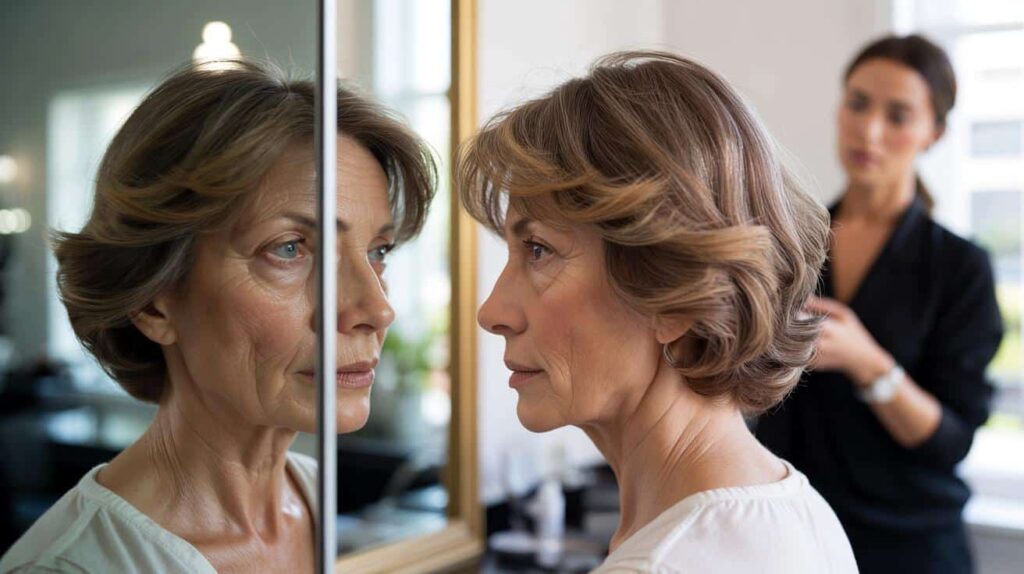
The stylist steps back, head slightly tilted, and says quietly: “It’s not your face that’s aging you. It’s your color.”
That sentence hangs in the air like a secret.

Why some hair colors suddenly age fine hair after 60
When you have fine hair after 60, color doesn’t just sit on top. It shapes your whole expression. A shade that looked soft at 45 can suddenly make your skin look dull, hard, or drawn at 65. The texture has changed, the density has changed, and your natural contrast – between skin, eyes, and hair – has shifted.
Hairstylists see this every day: a woman walks in asking for “the same color as usual,” but the mirror quietly says the opposite. The right color lifts the face. The wrong one pulls it down.
Take the classic solid dark brown. On Anna, 40, it looked polished and intense. On Anna, 68, with ultra-fine hair and a softer jawline, the exact same shade suddenly felt heavy. The roots looked harsh against her scalp. Her under-eye shadows seemed deeper.
Her stylist took before-and-after photos: same woman, same hairstyle, just a different color. The old, uniform brown flattened everything. After lightening and softening the tone, her eyes popped, her skin looked less lined, and her features felt less strict. It was like watching someone quietly turn the brightness up on her whole face.
The explanation is part science, part illusion. As we age, skin loses pigment and luminosity, and fine hair gets more transparent and fragile. When the color is too strong, too flat, or too cold, the contrast becomes brutal. It draws the eye to fine lines, hollow areas, and shadows.
A good stylist reads not only your natural shade, but your skin undertone, your eye color, and your hair density. A “young” color on thick hair at 30 can become a “hard” color on fine hair at 60. Same formula, completely different effect.
The 3 hair colors that age the face the most on fine hair after 60
The first shade hairstylists quietly warn about on fine hair after 60 is the very dark, almost black brown. On paper it sounds elegant. On a color chart, it looks glossy. On real, delicate hair and softer skin, it often reads as severe.
Dark pigment on fine hair creates a helmet effect. You see the scalp through, especially at the crown, which makes the hair look even thinner. The face looks framed by a rigid outline, especially around the eyes and mouth. The overall result: more contrast, more visible wrinkles, less softness.
The second aging trap: ultra-ashy blondes and cool “silver” shades that are too flat. A hint of ash can be chic. A full head of icy, matte blond on fine hair, with already cool-toned skin, can quickly look lifeless. The rosiness drains from the cheeks, the lips look paler, and the texture of the skin stands out more.

One stylist told me about a client who absolutely wanted a Scandinavian platinum. She was 70, with porcelain skin and fine, fragile hair. The color itself was technically perfect, but once rinsed and dried, her stylist watched the blood rush from the client’s face. The color and the skin were fighting each other.
The third color that often betrays fine hair after 60 is the fully uniform, box-dye red or mahogany. On a young, dense mane, those tones can be fiery and lush. On delicate hair, they tend to reflect too much orange and red in the wrong places: around redness on the cheeks, veins, or age spots.
Fine hair also absorbs and releases pigment faster. Strong reds fade irregularly, leaving dull coppery lengths and brighter roots. The result is patchy and restless, and that visual noise can make facial features seem more tired. *A flat, loud color on fine hair rarely feels forgiving on an older face.*
What hairstylists actually recommend instead
The pros repeat it like a mantra: softness, dimension, and light. Not drama. For fine hair after 60, the safest path is a color that’s one to two shades lighter than your natural base, with subtle variations. Think airy chocolate with warm caramel threads instead of ink-black. Think sandy beige blond with a few sunshine ribbons rather than an icy block.
A simple method many stylists use is “halo lightening”: they gently brighten the hairline around the face – the bangs, the temples, the top strands – while keeping a slightly deeper shade at the back. This creates a soft frame that opens up the eyes and lifts the cheekbones without screaming “I colored my hair.”
There’s also the question of shine. Fine hair tends to look flatter and more transparent with age. A slightly warmer tone often brings it back to life. Not orange, not brassy, but a hint of gold, honey, or beige. Hair that reflects light will always look thicker and healthier than a matte, opaque shade.
Many women cling to a very dark or very cool color because it’s what they’ve always done. Or because they’re scared that “going lighter” means going completely blond. It doesn’t. The change can be very subtle. One stylist described it as “turning the volume down” on the color, rather than switching channels.
“After 60, with fine hair, color should feel like a soft filter on your face, not like a costume,” says Paris-based hairstylist Léa D. “The question I always ask is: does this shade soften your features, or does it underline every line around your eyes?”
- Avoid very dark, almost black brownsThey harden facial features and highlight scalp transparency on fine hair.
- Skip ultra-ashy, icy blond blocksThey drain warmth from the skin and exaggerate texture and shadows.
- Be careful with flat, intense redsThey can emphasize redness and fade unevenly on delicate strands.
- Choose softer, dimensional tonesOne to two shades lighter than your natural color, with fine highlights or lowlights.
- Prioritize shine and warmthGolden, beige, or honey reflections bring light back to the face and movement to fine hair.
Learning to age with your color, not against it
There’s a quiet shift that happens when you stop chasing the hair color you had at 30 and start choosing the one that suits you at 60, 70, or 80. The mirror becomes less about “looking younger” and more about looking rested, alive, and in harmony with your face today. That doesn’t mean surrendering. It means updating the script.
We’ve all been there, that moment when you look at an old photo and realize your hair was doing you no favors, even though the color was technically “perfect”. Age makes us more aware of this. Every shade choice now has a stronger impact, especially on fine hair that leaves less room for error.
| Key point | Detail | Value for the reader |
|---|---|---|
| Soften extreme shades | Avoid very dark browns, flat icy blondes, and strong box reds on fine hair after 60 | Reduces hard contrast that deepens wrinkles and shadows |
| Add dimension | Use subtle highlights, lowlights, or a lighter halo around the face | Creates movement and the illusion of thicker, more voluminous hair |
| Respect skin undertone | Choose warm or neutral tones instead of overly cool, matte shades | Brightens the complexion and softens facial features |
FAQ:
- Question 1Which hair color makes fine hair look thicker after 60?
- Answer 1Soft, slightly lighter shades with subtle highlights work best. A warm chestnut with caramel touches or a beige blond with delicate lowlights adds depth, so the hair looks fuller and less transparent at the roots.
- Question 2Can I keep dark hair after 60 if my hair is very fine?
- Answer 2Yes, but go for a medium chocolate or soft espresso instead of near-black. Ask your stylist for a lighter contour around the face and a few tonal variations so the color doesn’t look like a flat, harsh block.
- Question 3Are grey and white hair always aging?
- Answer 3No. Natural grey can be incredibly flattering when toned and glossy. The aging effect comes from yellowing, dullness, or a cut that doesn’t suit the texture. Glosses and silver shampoos can refine the shade and add shine.
- Question 4How often should I color fine hair after 60?
- Answer 4Most stylists suggest every 6 to 8 weeks for soft coloring, or up to 10 weeks if you’re blending grey with a low-maintenance technique. Let’s be honest: nobody really does this every single day.
- Question 5What should I ask my hairstylist to avoid a “hard” color?
- Answer 5Tell them you want a luminous, soft result with dimension, not a solid block. Mention you’d like one to two shades lighter than your natural color, a gentle face-framing lightening, and tones that warm and brighten your skin instead of cooling it down too much.
