<strong>Chapo.
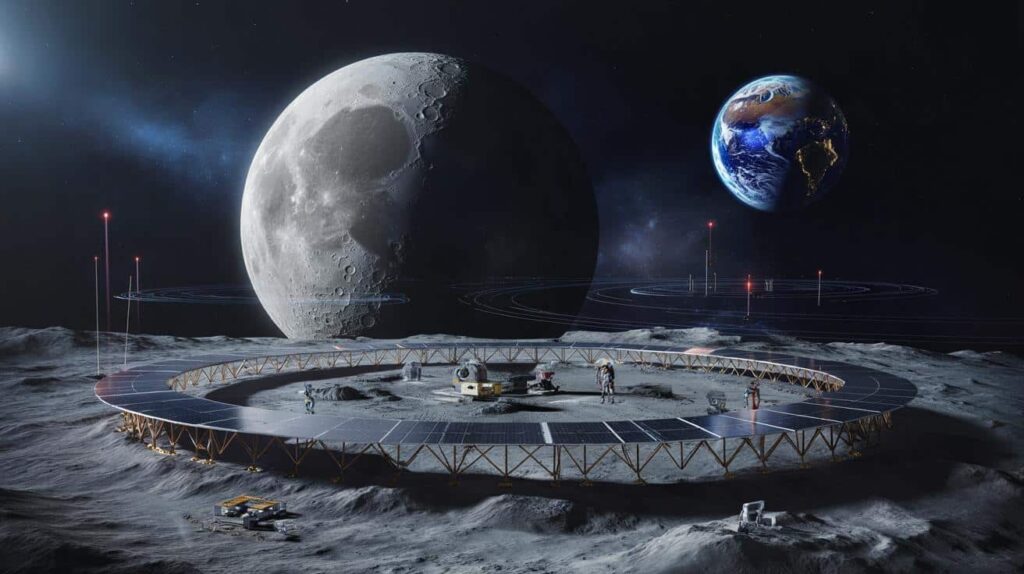
A Japanese construction giant wants to turn the Moon’s equator into a colossal power plant beaming energy back to Earth.
It sounds like science fiction, yet engineers have already drawn up plans for a “Luna Ring”: a continuous band of solar panels wrapped around the Moon and wired to send clean electricity to the planet that gave birth to the idea.
 Africa splitting apart isn’t sudden, but one visible change is already happening beneath the surface
A radical proposal from a very real company
The concept comes from Shimizu Corporation, a major Japanese engineering and construction group known for audacious futurist projects. On paper, the Luna Ring would be a vast belt of solar arrays circling the Moon’s equator and feeding power to Earth 24 hours a day.
Shimizu first unveiled the idea a decade ago as a long‑term vision. In current discussions among space and energy analysts, a target around 2035 is often floated as the earliest plausible moment when the first functional segment could exist, assuming aggressive investment and rapid technical progress.
The Luna Ring aims to turn the Moon into a constant, weather‑free solar farm, visible from Earth but controlled from it.
How a 10,000‑kilometre lunar solar belt would work
The proposal imagines a chain of solar cells stretching thousands of kilometres along the lunar equator. In some documents, Shimizu sketches a length of roughly 10,920 kilometres, with the active band of panels up to 40 kilometres wide in places.
That equatorial band is not chosen at random. The equator receives relatively stable sunlight as the Moon slowly rotates. Combined with the absence of clouds and atmospheric scattering, the panels could collect a much larger share of the Sun’s energy than equivalent installations on Earth.
Instead of sending that power down a cable, the Luna Ring would convert electricity into microwaves or laser beams. These beams would then be directed at giant receiving stations on Earth—rectangular “rectennas” or circular arrays up to 20 kilometres wide—where the energy would be converted back into electricity and fed into national grids.
Guidance beacons placed on the Moon would keep the transmission beams precisely locked on to vast antennas on Earth.
From lunar dust to construction materials
Shimizu’s vision relies heavily on using the Moon’s own raw materials. Lunar soil, known as regolith, is rich in oxygen, silicon, aluminium and other elements that can, in principle, be refined into metals, glass, and cement‑like binders.
Under the concept:
- Water and cement would be manufactured from lunar soil and extracted oxygen.
- Metals for structural frames and tracks would be smelted locally.
- Only lighter, high‑value components such as electronics and hydrogen fuel would be launched from Earth.
- Most of the construction, including panel assembly and maintenance, would be done by tele‑operated and semi‑autonomous robots.
Human workers would remain on Earth, piloting machines via high‑bandwidth links, at least in early phases. Over time, more autonomous systems could take over routine tasks like dust cleaning, inspection and repair.
Why put solar panels on the Moon instead of Earth?
Solar power on Earth already competes with fossil fuels on cost. So why look to the Moon at all? Supporters say the physics offers three major advantages.
Near‑continuous sunlight
The Moon has no weather. No clouds drift across the panels. No storms knock out infrastructure. The lunar day lasts about 14 Earth days, followed by 14 days of night, but a belt around the equator, combined with energy storage, could be managed to provide a very high effective capacity.
More importantly, when electricity is transmitted as microwaves to multiple ground stations scattered around the globe, power can be directed to whichever region is currently in darkness or facing a demand spike.
A mature Luna Ring could, in theory, send solar power to any point on Earth, at any hour, regardless of local weather.
Higher efficiency per square metre
Without an atmosphere, sunlight hitting the Moon is about 30% more intense than the same beam at Earth’s surface. Solar cells there can be designed without worrying about wind, rain, or corrosion, allowing lighter and potentially more efficient structures.

There is also no competition with agriculture or cities. Vast lunar areas can be dedicated to energy production without displacing people or ecosystems.
Is a 2035 Moon power station remotely realistic?
On paper, yes. In practice, the hurdles are formidable. Shimizu has a track record of headline‑grabbing megaprojects that never left the drawing board: a floating self‑sufficient botanical city, a huge underground urban network, artificial lakes in deserts, even a space hotel concept.
The Luna Ring sits in that same family of ultra‑ambitious ideas. To move from concept art to hardware by 2035, several breakthroughs would be needed:
- Reliable, low‑cost lunar landing and cargo transport.
- Industrial‑scale robotics that can function for years in abrasive lunar dust.
- Efficient, safe microwave or laser power beaming over thousands of kilometres.
- International agreements on spectrum use, orbital safety and liability.
- Trillions of dollars in staged investment over multiple decades.
None of these are impossible, but the combination is daunting. Many space engineers see 2035 as a date for small‑scale demonstration rather than a full belt around the Moon.
Safety, politics and who controls the switch
Beaming gigawatts of power raises obvious safety questions. The microwave intensities proposed for space‑solar systems are usually kept low enough for aircraft and birds to pass through without damage, but people living near receiving stations may be sceptical.
International law is another major issue. The Moon is governed by treaties that ban national appropriation. A privately managed energy belt wrapping the lunar equator would force governments to clarify who owns the hardware, who bears responsibility for accidents, and how access is priced.
Control of a global, space‑based power source would be as much a geopolitical question as a technical one.
What “limitless” lunar energy really means
Supporters sometimes describe the Luna Ring as offering “unlimited” energy. In strict terms, the output would still be bounded by panel area, efficiency, and transmission losses. The sense of “limitless” comes from the fact that sunlight at the Moon’s distance will keep flowing for billions of years, and no fuel is burned.
Engineers model scenarios where multiple lunar power belts, coupled with orbital solar farms, supply a large share of human electricity demand late in this century. These models assume complementary storage on Earth, smart grids that can absorb fluctuating inflows, and a mix of terrestrial renewables and nuclear capacity.
Key concepts worth unpacking
What is wireless power transmission?
Wireless power transmission in this context means converting electricity into radio waves or laser light, beaming it through space, and collecting it on a rectenna—an array of antennas linked to diodes that turn the wave back into direct current.
Experiments on Earth have already sent kilowatts over kilometres with decent efficiency. Scaling that up to gigawatts over tens of thousands of kilometres, while keeping the beam tightly aimed and safe, is one of the central engineering puzzles for any lunar solar belt.
Lunar dust: the tiny enemy of big plans
Lunar regolith is razor‑sharp, electrostatically charged and clings to everything. For a solar belt, that dust could degrade panel performance, jam mechanical joints, and obscure optical equipment.
Designers propose self‑cleaning surfaces, electrostatic dust shields, and swarms of cleaning robots. Simulations run by researchers show that even a small decline in panel performance from dust can significantly cut total output, so maintenance strategies become just as crucial as launch vehicles or power electronics.
What a first step might look like
Before anything resembling a 10,000‑kilometre ring, a pilot project is far more likely. That might involve a few hundred metres of panels near a lunar base, beaming tens of kilowatts to a single small rectenna on Earth or in orbit.
Such a demonstration could validate key technologies: lunar resource processing, robotic construction, and safe microwave targeting. Even if a full equatorial belt never materialises, those capabilities would feed into other space‑based solar projects and support future human missions.
In that sense, the Luna Ring sits somewhere between grand fantasy and early blueprint. It asks whether, by the 2030s, humanity is ready not just to visit the Moon again, but to wire it into the planetary energy system as a silent, shining partner.