
Out in the Afar Desert, in northern Ethiopia, the air wobbles with heat and the ground looks strangely wounded. Cracks run through the baked earth like veins on a tired hand. A shepherd walks past them with his goats, barely glancing down. For him, it’s just the way the land has always been: harsh, unpredictable, alive beneath his feet.
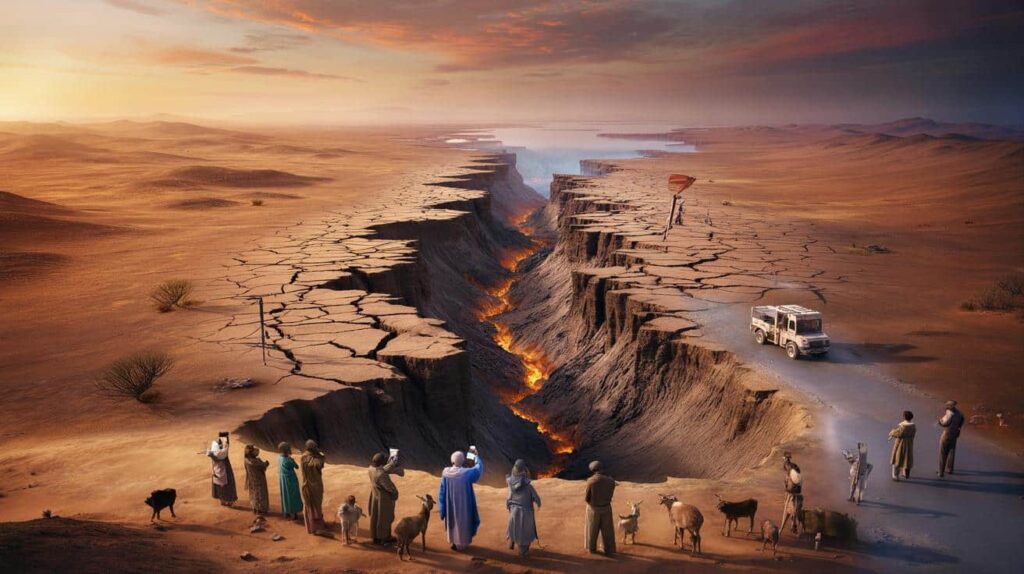
For geologists watching from satellites and field camps, though, this landscape is a live experiment. Something huge is unfolding here, at human speed and geological speed all at once.
Africa is literally being pulled apart.

Africa’s invisible wound you can actually see
If you scroll quickly through your feed and stumble on a video of a gigantic crack tearing through African soil, it looks almost fake. A deep, jagged trench opens across a road in Kenya, swallowing tarmac like paper. People stand around its edge with phones in hand, half fascinated, half worried.

That scene, filmed near Mai Mahiu in the Rift Valley, has circled the world. It’s messy, full of dust and confusion, and yet it points to something strangely precise: a continent in slow motion, splitting along a line scientists have been mapping for decades. One road, one farm, one house at a time.
The Mai Mahiu crack made headlines in 2018, after heavy rains exposed and widened a fracture that had been lurking beneath the surface. Locals woke up to find land where they’d walked the day before torn like fabric. Some geologists said the dramatic chasm was mainly erosion from water. Others pointed out that the spot aligns with the East African Rift — a vast zone where the African Plate is stretching and thinning.
For once, a process that usually stays hidden in math models and seismology charts was suddenly Instagram-ready. A geologic story millions of years in the making played out in a few days of viral video.
The East African Rift runs thousands of kilometers from the Red Sea down toward Mozambique. Underneath, the planet’s mantle is pushing hot rock upward, gently inflating the crust until it cracks. Two huge pieces are slowly peeling away: the Nubian Plate to the west and the Somali Plate to the east.
As they drift, new space opens up. Magma begins to creep in. The crust becomes more like ocean floor than traditional “land.” That’s why many geologists say this is the birth of a future ocean basin. It’s not sci‑fi. It’s plate tectonics doing what it has always done: tear, flood, reshape.
The slow birth of a new ocean, step by step
To really grasp what’s happening, it helps to think less in years and more in stages. Scientists describe rifting like a three-act play. First, the crust stretches and forms faults — long, straight fractures that drop blocks of land down to form valleys. Then volcanism ramps up: fissures open, lava flows, new crust is created. Eventually, if the process keeps going, seawater finds its way in.
Along the East African Rift, all three acts are overlapping. The Afar region, where Ethiopia, Eritrea and Djibouti meet, is already so thin and low that the Red Sea has begun to nose its way in geologically. It’s the kind of place where you can stand on land and still feel like you’re walking across the floor of a future seafloor.
One of the clearest “proofs” lives in a single, astonishing event. In 2005, a 60‑kilometer‑long crack opened in Ethiopia’s Afar Desert in just a few days. Scientists later realized it was caused by magma intruding into the crust, prying it apart from below. This wasn’t a surface landslide or just rain washing soil away. It was the tectonic plates themselves shifting, caught in the act.
GPS stations now scattered across Ethiopia, Kenya and neighboring countries quietly track this movement day and night. Some sections of the rift are widening by a few millimeters each year. Not dramatic to the naked eye, yet on geological scales, that’s a sprint. *We all underestimate what “a few millimeters a year” can do when you stretch it across millions of turns of the calendar.*
The “new ocean” idea comes straight from comparing this rift with older, better-known scars on the planet. The Red Sea and the Gulf of Aden, both nearby, started the same way: continental crust stretched, thinned, split, and eventually filled with seawater. Today they’re fully flooded ocean basins, with mid-ocean ridges quietly manufacturing new seafloor.

If the East African Rift follows that script, the Somali Plate will one day break off from the rest of Africa. A long, narrow ocean could open from the Red Sea down through Ethiopia and Kenya, into Tanzania and beyond. Scientists talk about timelines of 5 to 10 million years. That’s far beyond any human plan, yet close enough that we’re catching the opening scenes. Let’s be honest: nobody really thinks in millions of years when they check the weather or flip on the news.
The viral video, the quiet data, and how to read both
When that Kenyan crack went viral, many people reacted the way we all do when a crazy clip pops up on our phone at midnight: we shared first, then asked what it really meant. If you want to separate drama from genuine science in these moments, there’s a simple routine. Look for three things: location, context and source.
Location means checking if the footage really sits in a known rift zone. Context means asking what triggered the visible damage — heavy rain, an earthquake, long-term subsidence. Source means looking for geologists or scientific agencies commenting on the event, not just distant accounts repeating the same caption.
A common trap is to treat every crack in the ground as proof that Africa is suddenly “breaking up” this week. That’s not how tectonics works, and deep down, we know it. The rift has been developing for tens of millions of years and will keep going long after we’re gone. The emotional jolt comes from seeing something that’s normally too slow for us suddenly rush into our timeframe.
That doesn’t mean the fear is silly. For people living along the rift — farmers, herders, families in growing cities like Nairobi and Addis Ababa — the land’s movement is not an abstract map. It’s a question of roads to repair, houses to reinforce, volcanic alerts to follow. Headlines fade. Cracks in a field don’t.
Scientists who study the rift usually sound less like disaster narrators and more like calm translators. They know the sight of a road torn in two feels apocalyptic, yet their data often tells a quieter story: tiny motions, long patterns, slow hazards. That’s why many of them have started to engage more openly when viral videos appear, jumping onto TV, radio and social media to explain what’s real and what’s hype.
“Rifting is dramatic up close,” one geophysicist told me, “but on human timescales, it’s mostly a story of adaptation, not apocalypse.”
- Check the map: Is the footage from East Africa’s known rift areas (Ethiopia, Kenya, Tanzania, Mozambique)?
- Check the trigger: Was there heavy rain, an earthquake or volcanic activity reported at the same time?
- Check the voices: Are local scientists or geological surveys commenting, or only anonymous accounts?
- Think long-term: Ask what this means over decades — infrastructure, urban planning, risk — not just this week’s panic.
A continent in motion, and a story we’ll keep telling
Once you see Africa as a continent in motion, those satellite photos and shaky smartphone clips start to feel like pages from the same diary. On one page, a shepherd walking past a crack that’s been deepening for years. On another, a researcher downloading GPS data that quietly confirms: the land moved a fraction of a centimeter again this month.
We’re watching, almost in real time, how an ancient supercontinent breaks and reshapes itself. The same kind of process that split Africa from South America, that opened the Atlantic, is now teasing apart two African plates under our noses. The difference this time is that there are cameras everywhere.
There’s an emotional undertow to that knowledge. The rift runs through places that are already on the front line of climate stress, political tension, and rapid urban growth. Thinking about a “future ocean” can feel both majestic and unfair when your biggest worry is the next harvest or the next election.
Yet this slow tectonic story can also be a kind of anchor. The ground has always moved; we’re just getting better at seeing it. The challenge now is to connect the big, patient timescale of geology with the quick, nervous timescale of our daily lives. To plan cities that can handle tremors. To tell stories that respect the science without feeding panic. To pass on the idea that a splitting continent is not the end of the world, just the world doing what it has always done, under our feet.

| Key point | Detail | Value for the reader |
|---|---|---|
| East African Rift | Vast zone where the African Plate is stretching into Nubian and Somali plates | Helps you understand why Africa is “splitting” and where it’s happening |
| Future ocean | Rifting may eventually allow seawater to flood in, creating a new ocean basin in 5–10 million years | Places viral headlines in a realistic timescale, reducing unnecessary fear |
| Judging viral clips | Check location, context and scientific sources before sharing dramatic videos | Gives you a simple method to spot hype vs. genuine geologic signals |
FAQ:
- Is Africa really splitting into two continents?Yes, the East African Rift is gradually separating the Nubian and Somali plates, a process that could eventually create a new, smaller continent to the east.
- Will a new ocean actually form in Africa?Most geologists think so, but only over millions of years, as rifting continues, the crust thins, and seawater eventually floods in.
- Is the viral video of the big crack in Kenya proof of this breakup?It shows surface damage along a rift zone, partly worsened by rain and erosion, but it sits within a much larger tectonic process already mapped by scientists.
- Should people living in East Africa be worried right now?Not about the continent splitting in our lifetime, but they do live with real risks like earthquakes, volcanism and ground subsidence that require monitoring and planning.
- Can scientists predict exactly when the “new ocean” will appear?No, they can only estimate broad windows (millions of years) based on current spreading rates and comparisons with older rifted margins like the Red Sea and Atlantic.
