The first thing most people noticed was the silence.
On a dusty Texas backroad, families stepped out of pickup trucks, kids balancing on coolers, cardboard eclipse glasses already crooked on their noses. On a nearby ranch, three helicopters had just landed, disgorging guests in linen shirts and logoed caps, escorted toward a white tent glowing with air-conditioned light and a private viewing deck facing the sky.
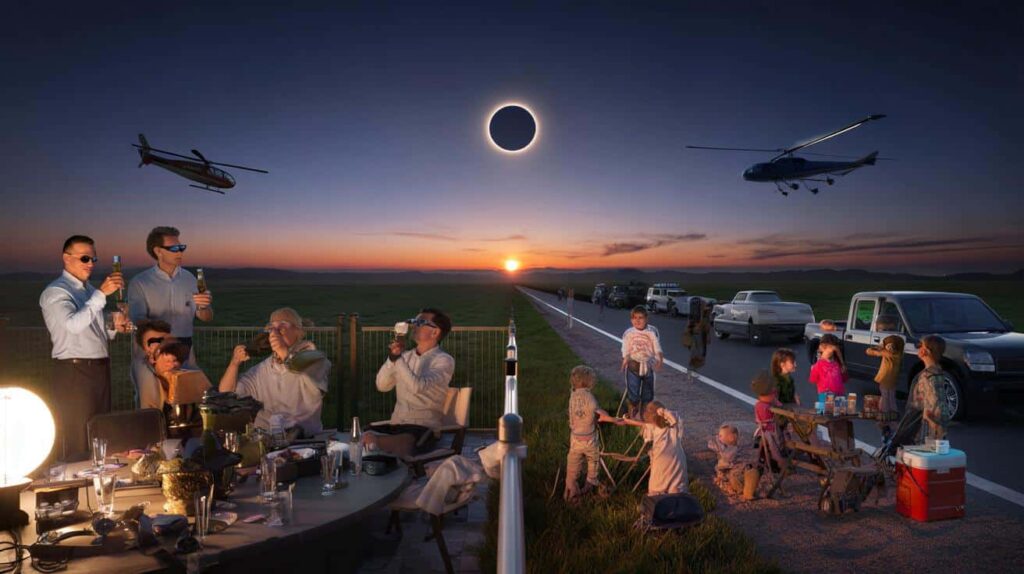
Same horizon, same sun, same moon.
Not the same experience.

As the so‑called eclipse of the century promises nearly six full minutes of daytime darkness, a strange tension is building. Ordinary sky‑watchers are packing camp chairs and gas-station snacks. Luxury travel agencies are quietly selling seats on private yachts and charter jets at prices that look like phone numbers.

One celestial event. Two very different worlds.
The eclipse everyone will see… and almost no one will really access
On paper, this eclipse is the most democratic show on Earth.
The moon doesn’t care about your passport, your income, your follower count. It just slides in front of the sun and, for a few heart‑stopping minutes, day turns into night. Streetlights flicker on. Birds go quiet. People forget their phones and just stare.
Yet along the path of totality, from remote deserts to narrow bands of coastline, a new kind of map has appeared. A map of VIP terraces, “platinum” viewing decks, and invitation‑only parties perched exactly where the eclipse will last the longest.
The sky is free. The front row is not.
Take a look at what’s happening in a handful of small towns directly under the six‑minute shadow.
Months before the big day, motel rooms were snapped up by tour operators. Basic double rooms that usually go for $89 a night are now reappearing online bundled into “eclipse experiences” at $900 a head, complete with branded lanyards and access to a fenced‑off field.
Local residents tell stories that all sound eerily similar. Parks that were once open to anyone now “partnered” with event companies. Rooftops that hosted neighborhood barbecues now reserved for corporate clients. One farmer in Mexico describes being offered a year’s income for a single afternoon’s exclusive access to his land.
The sun will dim for everyone. The prime minutes are being monetized.
Behind this scramble lies a basic, uneasy logic.
Totality isn’t spread evenly along the eclipse line. In some places, darkness will last less than two minutes. In a few rare spots, it will stretch past six. That tiny difference is pure gold to organizers selling “the longest eclipse of your life” to people who already collect rare experiences the way others collect fridge magnets.
Astronomers compare it to front‑row seats at the Olympics, except the stadium this time is the sky. Add social media pressure, a booming luxury travel sector, and a planet hooked on “once‑in‑a‑lifetime” content, and you get what researchers are quietly calling “celestial gentrification.”
We’re watching a universal event being sliced into tiers, like boarding groups on a plane.
How to watch without a black card – and what traps to dodge
If you don’t have a private jet on standby, your strategy looks different.
The key is to think like a local, not like a brochure. Pull up the eclipse path map and look beyond the famous spots everyone is talking about. A few kilometers off the “Instagram towns”, there are smaller villages, secondary roads, school yards, church parking lots where the duration will be almost the same.
Call or email town halls and local astronomy clubs.
Ask where residents usually gather, not where the glossy packages point you. Often, volunteer groups set up community viewing zones with safe glasses and open access, funded by small donations instead of VIP wristbands.
The longest eclipse doesn’t have to be the most expensive.
There’s another side to this story that stings a bit.
Plenty of people went all‑in on big promises from travel agencies, only to realize later that “six full minutes” can quietly turn into “three to five minutes depending on weather and traffic”. Hidden in the fine print: shuttle delays, last‑minute location changes, extra fees for actual line‑of‑sight.
Try to be gentle with yourself if you’re feeling the FOMO already.
We’ve all been there, that moment when you look at glossy drone footage and think, “My little spot on the side of the road will never compete with that.” Yet some of the most powerful eclipse memories come from imperfect places: a supermarket parking lot, a half‑cloudy field, the balcony of a cramped apartment.
Let’s be honest: nobody really does this every single day.
Astronomer Lina Ortega told me, “I’ve chased eclipses from cruise ships and from gas stations. The awe doesn’t care about your budget. The richest view is simply the one where you can look up, safely, with people you care about.”
- Arrive the day before
Beat the big‑money convoys and tour buses by sleeping close to your chosen spot, even if it’s a basic hostel in the next town. - Bring your own shade and water
High‑end areas will have tents and catering. Your roadside spot won’t. A cheap folding chair and plenty of drinks can change everything. - Use certified eclipse glasses
No need for designer gear. Basic, certified viewers from reputable sources protect your eyes as well as any VIP kit. - Keep an analog backup plan
Road closures for private events can appear overnight. Screenshot maps, print directions, and have two or three nearby locations ready. - Watch the sky, not the screen
Set your camera once, then let it go. *The rarest luxury these days is to be fully present for six whole minutes.*
Who owns the sky when the lights go out?
Walk through this quietly in your mind.
A strip of Earth, just a few dozen kilometers wide, slips into twilight in the middle of the day. On one side of a temporary fence, people in branded caps sip champagne and count down on synchronized watches. On the other side, families lean against car hoods, sharing sandwiches, passing a single pair of cardboard glasses from hand to hand.
Both groups gasp at the same second when the last bead of sunlight disappears. Both fall silent when the temperature drops and the stars switch on. The difference is everything that happened before and after that moment: the price of access, the pressure to prove you were “there”, the feeling that nature has been turned into a premium product.
Some experts argue that the money pouring into eclipse tourism helps small towns, funds science outreach, pays for infrastructure that will last. Others see a troubling rehearsal for future space events: asteroid flybys, commercial moon landings, suborbital flights sold first to those who least need another miracle.
The next time the sun goes dark in the middle of the day, will the best view be something you can still stumble into with a tank of gas and a little luck? Or will it be one more thing in a glass box, sold in limited edition, while the rest of us press our noses against the window and look up from wherever we’re allowed to stand?
| Key point | Detail | Value for the reader |
|---|---|---|
| Path of totality is being commercialized | Prime locations along the six‑minute zone are increasingly fenced, ticketed, and bundled into luxury packages | Helps you anticipate price hikes and access limits instead of being surprised last minute |
| Alternatives exist outside the VIP bubble | Nearby towns, community spaces, and local clubs offer nearly identical viewing times without premium costs | Gives you practical options to experience the eclipse without overspending |
| Preparation beats exclusivity | Early arrival, simple gear, flexible plans, and safe viewing methods matter more than elite venues | Maximizes your actual experience of the eclipse, wherever you are on the map |
FAQ:
- Question 1Will I “miss out” if I’m not in the exact six‑minute zone?
- Answer 1
You’ll still witness the core of the eclipse. A spot with 3–5 minutes of totality can feel just as overwhelming as a 6‑minute site, especially if you’re relaxed and not squeezed into a crowded, over‑managed area.
- Question 2Are the expensive eclipse packages scientifically better?
- Answer 2
Not really. They may offer slightly longer totality or clearer horizons, plus comfort and services, but the physics of the eclipse is the same. What changes is the level of convenience and exclusivity.
- Question 3How early should I book accommodation along the path?
- Answer 3
As early as you realistically can. Prices tend to jump once media coverage intensifies. Consider staying just outside the “hot” towns and driving in a short distance on the day.
- Question 4Can local communities refuse privatization of viewing spots?
- Answer 4
Yes, and some already do. City councils and landowners can decide to keep parks and fields open, or negotiate community benefits when working with tour operators.
- Question 5Is it safer to join an organized event or go on my own?
- Answer 5
Organized events can offer structured parking and crowd control. Going solo lets you avoid congestion and high costs. As long as you use proper eye protection and respect local rules, both options can be safe.