
You turn off the light, roll onto your side, and wait for your brain to slow down. Instead, it speeds up like a browser with 37 tabs open. That thing you said three years ago at a party suddenly feels louder than the cars outside. The message you didn’t answer. The life you didn’t choose. The fantasy you’ll never admit to anyone.
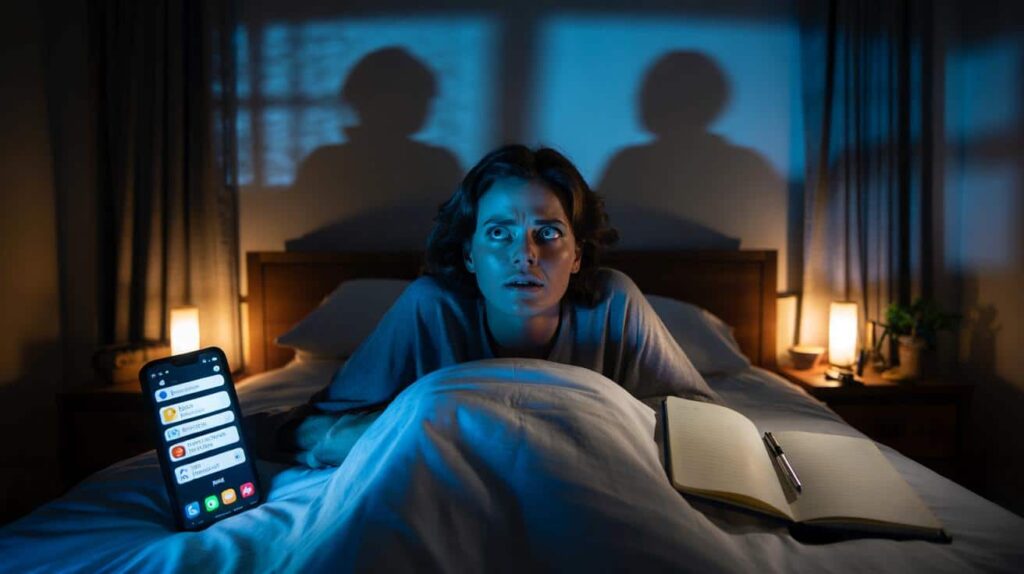
Your chest feels tight so you call it “anxiety” and scroll on your phone, looking for breathing exercises and soothing sounds. Anything, as long as you don’t have to look directly at what your mind is throwing at you.
Some psychologists say what’s visiting you in the dark isn’t just anxious noise. It’s guilt you’ve pushed down and desires you’ve buried so deep you barely recognize them.

And once you see that, you can’t unsee it.

What if your 3 a.m. thoughts aren’t random at all?
There’s a particular silence that only exists after midnight. Streetlights, fridge hum, someone laughing faintly outside. And beneath that, your own voice, suddenly uncensored.
During the day, you’re busy being productive, helpful, normal. You have tasks, meetings, kids, Netflix, noise. At night, you run out of distractions and your brain finally has the floor. That’s when the repressed stuff sneaks out wearing the mask of “overthinking”.
You replay a conversation with your partner, but the real thought underneath is: “Am I secretly unhappy?” You obsess about a work email, but the raw question is: “Do I even want this job or am I just scared of wanting something else?”
Take Lena, 34, who kept waking up at 2:47 a.m. every night. Her mind would latch onto small worries: forgetting to sign a school form, a slightly annoyed text from her boss. She told her doctor she had “terrible anxiety”.
During therapy, a different picture appeared. Lena was having recurring, vivid daydreams about leaving everything and moving to another country alone. She also felt a heavy knot of guilt about how distant she’d become from her younger brother since their father died. None of this showed up during the day.
At night, those buried truths used any excuse to knock on the door. A late invoice became a symbol of “I’m losing control”. Her brother’s unread message glowed like a tiny red alarm. The content looked irrational. The emotional roots were not.
Psychologists have a simple way to explain this: when you’re tired, your mental filters loosen. The rational manager in your brain clocks off, and the backstage crew of feelings walks out under the spotlight.
What you label as “overthinking” is often your mind trying to bring unfinished emotional business to the surface. Guilt about people you’ve hurt or neglected. Desires that clash with how you think you’re supposed to live. Regrets about chances you didn’t take.
Calling all of this “just anxiety” can be soothing. It sounds neutral, almost medical. Guilt and desire are messier. They ask questions about your values, your choices, your secret self. Some nights, it’s easier to stare at the ceiling than answer.

Meeting your hidden self without blowing up your life
One concrete gesture changes everything: instead of wrestling with your thoughts in bed, get up and write them down, unfiltered, like you’re emptying a bag. Nothing fancy. A cheap notebook, the notes app on your phone, whatever.
Describe the exact thought keeping you awake, then gently ask, “What does this really point to?” Not philosophically. Plainly. “I’m scared my relationship is dying.” “I miss the person I was before kids.” “I want something I’m ashamed to want.”
Sometimes the first answer feels staged. Stay with it for a minute or two. The second or third sentence is often the one that stings. That sting is your clue.
Most people do the opposite. They try to shut the thoughts down. Sleep podcasts, doomscrolling, a quick drink, anything to blur the edges. Short term, it sort of works. Long term, the thoughts come back stronger, like kids who’ve been ignored all day.
There’s also a common trap: turning reflection into self-attack. You notice guilt and instantly punish yourself in your head. You notice desire and immediately judge it as “selfish”, “ridiculous” or “immature”. That’s usually the moment your nervous system goes into alarm mode and your “overthinking” spirals into a full-blown drama.
A softer approach isn’t weakness, it’s strategy. You’re not there to fix your entire life at 3 a.m. You’re just there to listen honestly for once. *Not every thought is a command. Some are just information about what hurts and what’s hungry inside you.*
Psychologist and author Esther Perel puts it this way: “The quality of our lives is determined by the quality of our questions.” Nighttime overthinking changes when you stop asking, “How do I shut this up?” and start asking, “What is this trying to show me?”
- Question the label “anxiety”
Before you say “I’m anxious”, ask: “Is there guilt here? Is there a desire I’m hiding from myself?” - Turn thoughts into sentences on paper
Writing slows the mental tornado and reveals patterns you can’t see when everything is spinning in your head. - Distinguish fantasy from intention
You can have a wild desire or dark thought without needing to act on it. The point is to acknowledge it, not to obey it. - Repair in small, real-life moves
If guilt keeps you awake about someone, send a short message tomorrow. Not a novel. Just, “Thinking of you. Can we talk soon?” - Get support when it’s heavy
If what surfaces at night feels overwhelming or dangerous, this is the moment to involve a therapist, not a late-night TikTok rabbit hole.
Living with what your nights are trying to tell you
Once you start hearing your night-thoughts as messengers, they lose a bit of their power and gain a bit of their usefulness. You stop seeing yourself as someone broken by anxiety and more as someone haunted by unfinished conversations, unlived versions of yourself, and stories that never found closure.
There’s a quiet courage in admitting, even only to yourself: “I feel guilty about this”, or “I secretly want that”. It doesn’t mean blowing up your relationship or quitting your job overnight. Often, it just means letting reality be less tidy than your Instagram bio. Let’s be honest: nobody really does this every single day.
Some people will read this and feel a strange relief, like someone turned on a bedside lamp. Others will close the metaphorical curtain and go back to calling everything “stress”. Both reactions are human. What you do with your overthinking is nobody’s business but yours.
Your nights are already telling you what your days try to ignore. The real decision is whether you’ll keep trying to sleep through it, or open your eyes a little earlier and listen.

| Key point | Detail | Value for the reader |
|---|---|---|
| Night overthinking has a hidden core | Many “anxious” loops are fueled by repressed guilt and unspoken desires rather than random worry | Helps you stop feeling defective and start understanding what your mind is actually pointing to |
| Writing at night changes the script | Externalizing thoughts and asking “What does this really point to?” reveals the deeper issue | Gives a simple, practical tool to calm spirals and access honest self-awareness |
| You can listen without blowing up your life | Acknowledging guilt and desire doesn’t force drastic decisions, just more aligned small actions | Reduces fear of facing inner truth while opening space for gradual, realistic change |
FAQ:
- Is all nighttime overthinking about guilt and desire?
No. Sometimes it really is plain anxiety, chronic stress, or a nervous system on overdrive. The point is that part of what you call “overthinking” can also be a sign of unresolved emotions you’ve pushed aside.- How do I know if it’s repressed guilt?
Notice if the same person, event, or unfinished conversation keeps showing up in different costumes. If your thoughts circle around “I should have…” or “I failed…”, there’s usually guilt underneath the generic “I’m worried”.- What if my hidden desires scare me?
That’s common. You don’t have to act on every desire. You can acknowledge it, explore where it comes from, and decide how to live with it in a way that fits your values and responsibilities.- Can this replace therapy?
No. Self-observation at night can be a powerful starting point, not a full solution. If your thoughts include self-harm, deep hopelessness, or past trauma, a professional is the right person to bring into the room.- What’s one small thing I can do starting tonight?
Set a 5-minute timer, sit up, and write the truest sentence you can about what’s really on your mind. Stop when the timer rings. Close the notebook. Go back to bed. Tomorrow, read it in daylight and see what it’s actually asking from you.
