
At first, all you see is white. A vast, flat glare of Antarctic ice, so bright it hurts your eyes even behind tinted goggles. The wind scrapes your jacket, a dry, relentless hiss, while a cluster of orange tents trembles in the distance like they’re afraid to be there. Then someone points to a hole in the ice, a narrow, dark throat drilled three kilometers down. “That,” a glaciologist mutters through a frozen scarf, “is 34 million years of history.”
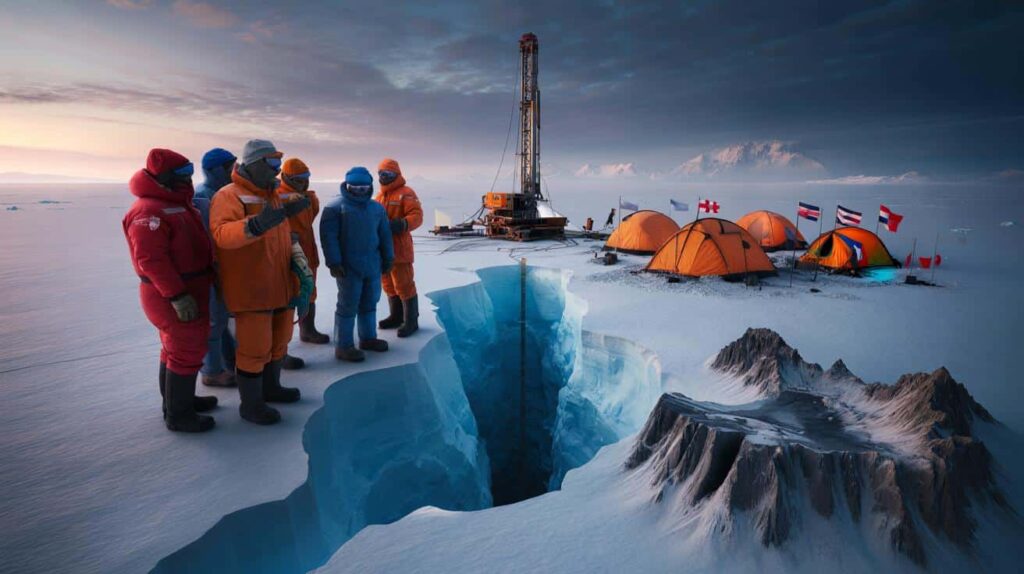
Down there, beneath the crushing ice, lies a world older than the human species. An ancient landscape, frozen in place since before our ancestors even walked upright. Forests turned to fossils. Rivers carved into rock and then sealed away.
The drill stops, and in the strange silence, a bigger question rises to the surface.

A hidden continent under our feet
The first 3D maps of this buried world look almost fake. On the researchers’ screens, Antarctica’s ice peels away like a translucent curtain, revealing mountains, valleys, even what seems like the ghost of an old coastline. The continent we know as a dead white desert suddenly looks alive.
This frozen landscape dates back roughly 34 million years, to the moment Earth tipped into a deep freeze and Antarctica became the ice-locked pole we recognize today. Before that, it was a place of forests and flowing water, with temperatures closer to present-day Patagonia than the Moon-like cold we picture now.
Now that this lost world is mapped, the question echoes through labs and ministries alike: what do we do with it.
Scientists didn’t stumble on this by chance. They combined ice-penetrating radar, satellite data and gravity measurements, feeding them into supercomputers that patiently reassembled the shape of the rock beneath the ice. The result: a fossilized landscape the size of a small continent, preserved like a time capsule under up to 4 km of ice.
Geologists say the erosion patterns look “fresh”, as if rivers had only recently stopped carving their way through. Biologists see something else: the potential traces of long-gone ecosystems, maybe microbial life still hanging on in isolated pockets. Politicians, energy companies and mining lobbies, for their part, see strategic value and possible resources.
This is where the clash begins, quietly at first, in meeting rooms and conference calls far from the creaking ice.
The logic seems straightforward. If this landscape has been sealed since the dawn of the Antarctic ice sheet, it’s a unique archive of Earth’s climate. Sediments and fossils down there might reveal how our planet flips from green to frozen, what triggers tipping points, and how oceans and atmospheres respond.
For climate scientists desperately trying to predict the next hundred years, that information feels priceless. One Antarctic researcher compared it to “finding a full medical record of a patient just before a heart attack”. Instead of guessing from fragments, we could read the story straight from the source.
Yet every core sample, every drilled cavity, also risks disturbing a system that’s been undisturbed for tens of millions of years.
Dig for knowledge, or draw a line?
On one side of the debate, a familiar argument rises: explore, sample, understand. The idea is to drill deeper, not for oil or gas, but for sediments, fossils, trapped air bubbles, maybe even traces of unknown organisms. Controlled, clean, internationally supervised. *Purely for science*, as the phrase goes.
The proposed method looks like a high-tech medical procedure. Hot-water drilling to open a narrow shaft. Sterilized equipment to avoid contamination. Robots and subglacial probes to move under the ice without human boots ever touching that ancient ground. The promise: minimal footprint, maximal knowledge.
For many researchers, not accessing this archive would feel almost like negligence.
Yet the moment you open a door, you can’t fully decide who walks through it. We’ve all been there, that moment when a small exception slowly becomes the new rule. The Antarctic Treaty, signed in 1959, made the continent a place of peace and science, banning military activity and resource exploitation. But it didn’t imagine a 34‑million‑year‑old “new world” hidden below.
Already, some countries quietly fund mapping projects that skirt the edges of the treaty. Not drilling, just “surveying”. Not mining, just “assessing potential”. The language is cautious, but the subtext is loud: if there are critical minerals or rare earths under that ancient landscape, who gets to say no.
Let’s be honest: nobody really reads the fine print of international agreements every single day.

Environmental groups argue that any physical intrusion, even in the name of science, crosses a line. Their fear is simple: the first drill becomes the precedent that allows the second, then the third, until “scientific access” becomes a legal backdoor for commercial projects. Once logistics are in place, bases are built, and routes are carved through ice, the barrier between research and resource extraction can thin out frighteningly fast.
There’s another layer to their concern. This fossil landscape is more than just rocks and sediment; it’s a rare case of planetary memory left untouched. Like a library where no pages have been torn out, no margins scribbled over. Some ethicists now argue that such perfect archives deserve a status close to a nature reserve of time itself.
In that view, the most respectful act isn’t to open the book. It’s to stand guard over it closed.
How to protect what we can’t see
One emerging idea is radical in its simplicity: declare the buried landscape a “no‑go heritage zone” before anyone ever sets foot on it. No drilling. No physical access. Only remote sensing from the surface and satellites allowed. In a way, it would extend the logic of UNESCO World Heritage to something humanity will probably never visit.
To support that, legal teams are pushing for an update to the Antarctic Treaty system. The goal would be to carve out an explicit category for “deep-time protected areas” under the ice, with strict, verifiable rules. Think of it as drawing invisible borders on a map that only specialists can read, yet that bind every country.
The method is bureaucratic, slow, a bit dry. Yet this is how new global norms often begin.
On the practical side, researchers suggest a compromise: before any drill touches that ancient ground, the scientific community should agree on a strict “minimum necessary sampling” principle. That means small, targeted cores instead of wide access; sharing all data openly instead of letting nations keep secrets; and publishing a clear accounting of every intrusion.
People who’ve worked in polar campaigns know how easy it is to get carried away. Once the helicopters, ships and heavy equipment are on site, the temptation grows to “take just one more sample, just in case”. So the real safeguard may not be a heroic promise, but a boring spreadsheet that lists what’s allowed, what’s done, and what’s off‑limits.
Cold, structured transparency, rather than warm, vague intentions.
The ethical conversation is slowly catching up with the technology. Philosophers, Indigenous leaders from polar-adjacent regions, and climate activists are being invited into panels that used to be limited to glaciologists and geophysicists. One of them summed it up during an online forum:
“We’re not just deciding what to do with an old piece of rock,” she said. “We’re deciding how our species behaves when faced with a temptation nobody has ever had before: the chance to open a perfectly sealed chapter of Earth’s history, just because we can.”
Some groups are calling for a simple checklist before any action under the ice:
- Is there a non‑intrusive way to get similar data?
- Will the results be openly shared with all countries?
- Does this action increase pressure for future exploitation?
- Have local and global communities been consulted meaningfully?
- Can we clearly say why this must be done now, not later?
A mirror held up to our future
The buried world under Antarctica won’t go anywhere tomorrow. The ice above it is thick, the logistics brutal, the technology still expensive. Paradoxically, that delay gives us something rare in global politics: time to think before acting. To decide whether this is a story of restraint, or one more chapter in the long saga of “we found something, so we used it”.
There’s a quiet irony here. That ancient landscape might hold clues to how past climates collapsed or stabilized, information that could help us survive the century ahead. At the same time, every attempt to reach it risks speeding up the race, the rivalry, the human noise that already strains the polar regions.
Maybe the real value of this 34‑million‑year‑old secret isn’t just the data locked inside it. Maybe it’s the uncomfortable question it forces us to ask: when do we finally decide that some doors, even the most fascinating ones, are better left barely open.
The ice is thick, but our window for deciding how we want to behave on a changing planet feels much, much thinner.

| Key point | Detail | Value for the reader |
|---|---|---|
| Ancient Antarctic landscape | A 34‑million‑year‑old world preserved under kilometers of ice, mapped by radar and satellites | Helps you grasp how dramatic Earth’s climate shifts can be over deep time |
| Global ethical clash | Scientists, governments and activists are split between exploring for knowledge and preserving it untouched | Gives context to future headlines about Antarctic treaties, drilling and polar politics |
| Choices before action | Proposals range from strict “no‑go” zones to tightly controlled sampling with full transparency | Offers a lens to reflect on how humanity might treat other fragile frontiers, from deep oceans to space |
FAQ:
- Is there really a “hidden world” under Antarctic ice?Not in the fantasy sense of forests and animals still alive, but there is a vast fossil landscape of mountains, valleys and river systems preserved beneath the ice, formed before Antarctica froze over around 34 million years ago.
- Could there be unknown life down there?There may be microbial life in subglacial lakes and sediments, adapted to darkness and pressure. Larger organisms or ancient forests are extremely unlikely to survive, though their fossils or chemical traces could still be present.
- Is anyone trying to mine under the Antarctic ice?Direct mining under the ice is not underway and would be very difficult with current technology. The Antarctic Treaty bans mineral resource exploitation for commercial purposes, although some countries are quietly studying geological potential.
- Why do scientists want to drill into this ancient landscape?They hope to recover sediments and data that reveal how Earth’s climate changed when Antarctica froze, which could sharpen models for future sea-level rise and global warming scenarios.
- Can ordinary people influence what happens next?Indirectly, yes. Public pressure, media attention and support for strong environmental protections all shape how governments negotiate updates to polar treaties and how much funding goes to low-impact research versus more intrusive projects.
