The elevator cage shuddered once, then began its long, metallic descent. Above, the desert sky shrank to a pale coin as the doors rattled shut, leaving only the dim glow of instrument panels and the rasp of someone’s breath inside a gas mask. At 300 meters, the soldiers joked. At 800, they fell silent. By 2,000 meters, only the hum of the winch and the click of Geiger counters dared to speak.
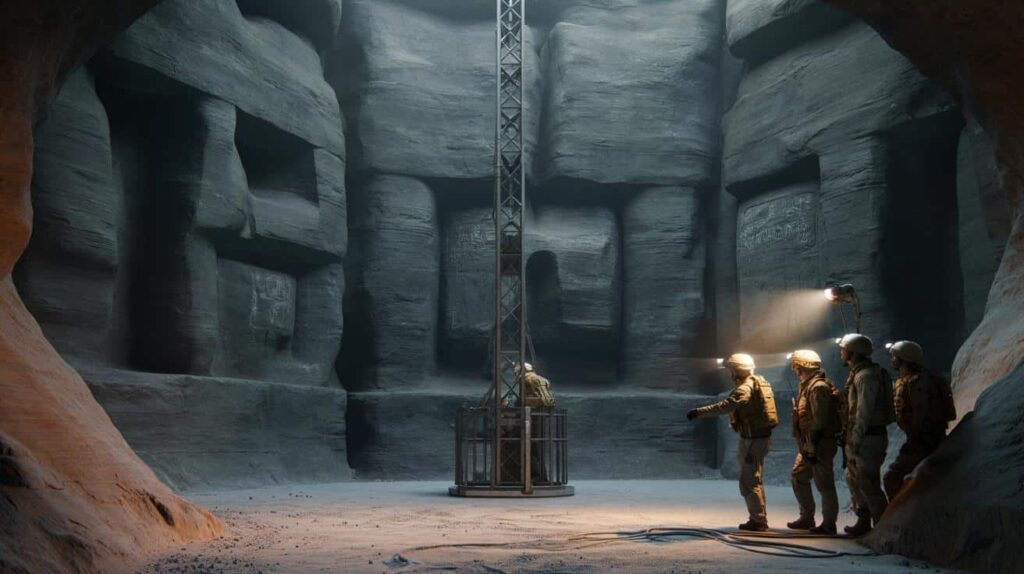
When the digital gauge finally froze at 2,670 meters below the surface, the youngest officer swore he felt the earth itself… change.
They were there for a routine military survey.
What they found tore a hole in history.

What the military really found at 2,670 meters
The official report calls it a “subterranean anomaly intersecting a deep-drilling shaft in a restricted training zone.” The soldiers who were there use another word: structure. Not rock. Not crystal. Something laid out. Aligned. Carved.
They stepped out onto a ledge carved into an impossible void, their helmet lamps cutting cones of white into a chamber that should not exist in solid bedrock. Smooth walls. Repeating angles. Grooves that caught the light like inscriptions worn by time and pressure that no mine could survive.
One of them reached out and touched the surface.
It was warm.
The drill that opened this pocket—an industrial monster designed for ballistic tests—had been chewing through dense granite for weeks in a remote military zone. Engineers expected nothing but solid rock. No cavities. No water. Certainly no architecture.
When the pressure sensors spiked and the bit broke into empty space, protocols kicked in. The army sealed the perimeter, citing “subsurface instability” and “potential gas hazards.” Locals, who had heard the grinding day and night, suddenly heard nothing at all. One officer later leaked that the first camera they lowered lasted only forty-three seconds before the feed cut into static and a strange, low-frequency hum.
That’s when the special unit was called in.
Not geologists. Not miners. A mixed team with one historian quietly added at the last minute.
From the first images, the anomaly shattered the rulebook. Human-made structures, as archaeology teaches, sit within the first few dozen meters of sediment. Maybe a few hundred in special fault zones. Beyond that, geology takes over, crushing and folding anything fragile into oblivion.
Yet at 2,670 meters, the instruments read angle-true corridors and right-angled recesses, with textures that did not match any known mineralization patterns. The historian on site reportedly whispered a single phrase when the first scans came through: “This looks planned.”
If that’s true, either our timeline of civilization is vastly wrong, or someone—or something—learned to build in a way we never imagined… and far earlier than our textbooks dare to suggest.
The quiet war between drill cores and museum labels
There’s a small ritual most museum visitors never notice. In the back rooms, away from glass cases and gift shops, curators decide which objects “fit” the story the institution tells. The rest go into drawers. Or boxes. Or that vague destination of “further study” that can last decades.
Now picture the military walking in with samples from 2,670 meters down: a shard that looks worked, a core of stone showing repetitive, unnatural grooves that match no known drilling pattern, micro-traces of alloys that shouldn’t survive at such pressure.
The scientist in you would want to lay them out on a table under a bright lamp. The guardian of the official narrative would instinctively reach for the nearest filing cabinet.
We’ve all been there, that moment when reality doesn’t line up with the story you’ve been told your whole life. In the 1960s, miners in Oklahoma pulled out a strange metallic object from Ordovician rock dated at over 300 million years old. In South Africa, workers found tiny metal spheres with etched grooves embedded in layers of pyrophyllite estimated at 2.8 billion years old. Each time, the same dance happened. Fascination. Denial. Reclassification. Storage.
None of those cases ever involved the army sealing off an entire drilling site with armed guards and silence clauses. According to a retired geophysicist who worked on a European deep-bore project, the language in those military notices is “classic containment behavior”: lock it down, own the data, release only what can be dismissed.
Nothing galvanizes control instincts faster than something that cannot be explained in a press release.

From the academy’s perspective, the stakes are brutal. If objects or structures can be found almost three kilometers below the surface, then either the crust has moved in ways we don’t fully understand, or intelligent activity on Earth predates our species by an unthinkable margin. That implication alone knocks the legs out from centuries of carefully layered chronology.
Archaeological dogmas are not just theories; they are careers, exhibition budgets, school textbooks, and a web of political and religious comfort zones. *Truth doesn’t travel alone; it drags consequences behind it.*
Let’s be honest: nobody really rewrites their entire field because of one drill core and a handful of classified photos. Which is exactly why the things that don’t fit tend to disappear before anyone has the chance to compare notes.
How these finds get buried twice: in rock and in bureaucracy
If you talk to people who’ve worked at the edge of geology, you start hearing the same simple method: watch for anomalies that keep coming back. The military team at 2,670 meters followed a protocol that sounds almost mundane. First, stabilize the cavity with resin injections. Then, lower multi-spectrum cameras along a grid pattern. Map any reflectivity that suggests metal or worked stone. Sample edges, not centers.
The result, according to two separate sources who claim to have seen the interim report, was a 3D model of a chamber with parallel recesses and a central, slightly raised platform. They also mentioned fine dust on the floor that didn’t match the surrounding rock—something lighter, more granular, like eroded ceramic or… ash.
None of this proves a lost civilization. It proves that the military found something they could not file under “normal geology.”
The tragedy is not that anomalies happen. Nature is wild. Outliers exist. The tragedy is how quickly they are domesticated by paperwork. A young researcher who questions a radiocarbon date or a stratigraphic layer risks sounding “unserious.” A curator who suggests that a drilled object from a coal seam might not be a hoax risks their next grant.
That’s why so many stories from the field begin with, “Don’t quote me on this, but…” The emotional load is real. People in these systems love knowledge, they’re not cartoon villains. They just live with deadlines, budgets, and a constant pressure not to rock boats that fund their labs.
The deepest mistake is not skepticism. The deepest mistake is weaponized skepticism that only ever points in one direction: toward protecting what’s already been printed.
“Every time we found something where it ‘shouldn’t’ be,” a former museum registrar told me quietly, “the question was never ‘What is this?’ It was ‘How fast can we make this stop being a problem?’”
- First, the label changes
Ambiguous objects are relabeled as “unprovenanced” or “context unknown,” which instantly lowers their research priority. - Then, the location shifts
They move from display to storage, from storage to off-site, from a digital catalog to a spreadsheet on one person’s hard drive. - Finally, the trail cools
Once an object is no one’s job, it slowly vanishes from seminars, conferences, and footnotes. After a decade, it’s effectively invisible.
The 2,670-meter discovery is on track for the same quiet burial—only this time, the vault door is wearing camouflage paint.
What it changes for us, far above the drill site
Go back, just for a second, to that image: a handful of soldiers in a steel cage, descending into blackness not to fight an enemy, but to brush dust off an impossible floor. Somewhere above them, a general is checking his watch. Somewhere even higher, a museum board is approving a new exhibition on “The Dawn of Civilization” that starts, yet again, in Mesopotamia and Egypt, neat and tidy.
Between those two worlds, a thin cable connects funding, fear, curiosity, and silence. The deeper the drill went, the more that cable began to hum with tension. Because if the official story cracks, millions of us will ask the most dangerous question in any society: “What else have you not told us?”
| Key point | Detail | Value for the reader |
|---|---|---|
| Depth vs. dogma | Structure-like features at 2,670 meters clash with standard archaeological timelines | Encourages you to question how “settled” historical narratives really are |
| Institutional filtering | Museums and labs quietly sideline anomalous finds through labels and storage | Gives you a lens to read exhibitions and official statements with more nuance |
| Military control of data | Classified drill sites and sealed reports limit civilian scientific debate | Helps you understand why some discoveries surface in rumors long before in journals |
FAQ:
- Question 1
Is there public proof that a structure exists at 2,670 meters?- Answer 1
Current evidence is fragmentary and mostly comes from leaks: descriptions from alleged participants, references in anonymized geophysical data, and timing of unusual military notices around a deep-drill site. There is no fully open, peer-reviewed dataset yet, which is exactly what fuels both skepticism and curiosity.
- Question 2
Could natural geological processes create something that looks like a structure?- Answer 2
Yes. Geology can mimic order: columnar basalt, crystal lattices, and fracture patterns all form straight lines and repeat shapes. The key issue here is the combination of regular geometry, warm surfaces, and foreign dust reported together. That cluster of anomalies is what has some experts whispering about non-natural origins.
- Question 3
Why would the military be involved in an archaeological-type discovery?- Answer 3
Deep drilling for weapons testing, bunkers, or resource mapping often falls under defense agencies. When something unexpected appears in a classified zone, the first question is about security and secrecy, not history. Military control of the site then shapes what the public and academic world are allowed to see.
- Question 4
Do museums really hide objects that don’t fit the narrative?- Answer 4
“Hide” is a strong word, but there is a quiet triage. Pieces that confuse existing timelines or lack clear context tend to be deprioritized. They go into storage, rarely get exhibited, and almost never headline funding proposals. Over decades, that process feels a lot like disappearance.
- Question 5
What can an ordinary reader do with this kind of information?- Answer 5
You don’t need access to drill sites to matter. You can support independent researchers, read beyond standard textbooks, visit museum reserves on open days, and ask gentle but firm questions about provenance and dating. Curiosity, when shared widely, is one of the few tools that can pull buried truths—at any depth—back toward the light.