
At 11:42 a.m., the street just… pauses. Cars slow, conversation dips, and a strange twilight rolls in as if someone’s dimmed the world’s brightness slider. The air cools a notch. Birds go quiet. A kid on a scooter stops mid-push, staring up at the sky he’s been told not to look at. For the longest solar eclipse of the century, day is about to turn into night, not in a poetic way, but in a literal “where did the sun go?” way.
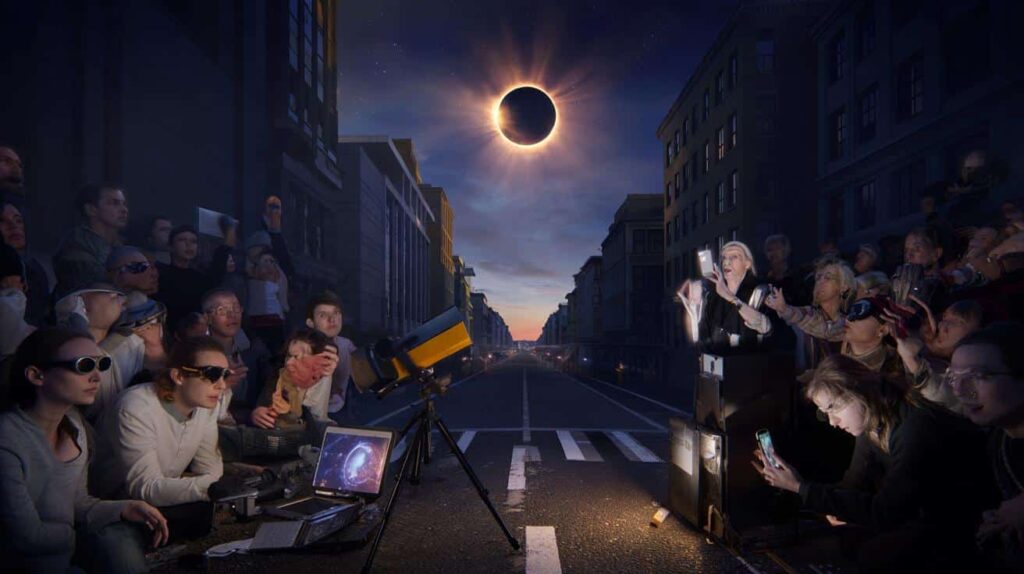
On balconies and rooftops, people shuffle between excitement and unease. Eclipse glasses in one hand, phone in the other. Some are watching a rare cosmic alignment. Others are reading TikTok threads about omens, disasters and “end-times signs.”
Somewhere between the shadow on the ground and the noise online, tension is rising.

When the sky goes dark, the rumors light up
Solar eclipses have always split people into two camps: the ones who grab telescopes and the ones who grab their gods. This time, with the longest eclipse of the century, that divide feels sharper. Across the path of totality, from crowded cities to small rural villages, local authorities are bracing for a wave of superstition-fueled anxiety.

From temple bells to conspiracy livestreams, the eclipse is being framed as a sign, a warning, a curse, depending on who you ask. Scientists talk about orbital mechanics. Street posters talk about bad luck, failed crops and doomed babies. The sky will go dark for a few minutes. The unease might last a lot longer.
In one coastal town already under the shadow’s predicted path, schools have sent home leaflets telling parents to keep children indoors. Not for safety from the light, but from “negative energies.” A local radio presenter is running a special “eclipse protection” segment, playing chants between calls from listeners worried about miscarriages, accidents and “broken destinies.”
Meanwhile, an observatory just 20 kilometers away is preparing public viewing sessions with filtered telescopes and free glasses. Their hotline is flooded, not with booking requests, but with people asking if the blackout means the planet is “resetting” or if satellites will fall from the sky. That’s the strange contradiction of 2026: high-precision NASA maps in one tab, viral apocalypse threads in the next.
Scientists are sounding the alarm not about the eclipse itself, but about its social aftershocks. They’ve seen this pattern before: when something rare and visually overwhelming happens in the sky, old beliefs suddenly feel new and urgent. People start linking random events to the cosmic show — a power cut here, an earthquake there, a bad week at work — and a story forms.
This is how myths are born in real time, live-streamed and algorithm-boosted. Eclipses trigger an ancient response in our brains: when the sun disappears, the rules feel suspended. *Anything could happen, so everything feels possible.* That tiny crack in certainty is where panic, superstition and opportunists rush in.

How to stay grounded when the sun disappears
There’s a surprisingly practical way to keep a clear head during the eclipse: plan your few minutes of darkness like you’d plan a big event. Decide where you’ll be, who you’ll be with, and what you actually want to do in that short window. Watch the light change on the buildings. Listen to how the city hum shifts. Pay attention to your own body — the goosebumps when day slips into shadow.
Giving those minutes a shape helps your brain stay here, in your own street, instead of drifting into abstract fears about “omens” and “signs.” Treat it like a weather phenomenon you’re consciously observing, not a moral verdict being delivered from the sky.
A lot of people will feel guilty for being scared, as if fear itself is irrational or childish. It isn’t. When the sun vanishes in the middle of the day, every part of you is wired to feel that something is wrong. The trick isn’t to suppress that feeling. It’s to notice it, name it, and not let someone else weaponize it for clicks, cash or control.
Watch out for one classic trap: the long, dramatic thread or video that starts with “They aren’t telling you the truth about this eclipse.” Your nervous system is already on edge, so your guard drops. Let’s be honest: nobody really reads the sources under those posts every single day. That’s how irrational claims sneak in and start to feel plausible.
“Eclipses don’t cause chaos,” says Dr. Lina Ortega, a solar physicist working on public outreach for this event. “People do. The sky just gives us the excuse.”
- Check the sky, then check the source: Enjoy the spectacle, but when you read a dramatic claim, look for where the information comes from — is it a space agency, a university, or an anonymous account?
- Limit doom-scrolling during totality: Keep your phone in your pocket for those few minutes. Experience the eclipse first, post about it later.
- Talk, don’t isolate: If you feel anxious, say it out loud to someone near you. Shared awe dilutes private fear.
- Know the basic facts: The eclipse is caused by the Moon passing exactly between Earth and the Sun. No ray, no curse, no “cosmic punishment” involved.
- Respect beliefs without feeding panic: You can let people follow their rituals while gently steering conversations away from threats and guilt.
The longest shadow, the hardest questions
When the longest solar eclipse of the century stretches its shadow across several countries, it won’t only be the sun going dark. Old worries about fate, punishment and control are going to surface again, dressed in modern clothes and wrapped in viral videos. Some communities will ban weddings that day. Some will close markets. Some will organize mass prayers or meditations. Others will host eclipse parties on rooftops with playlists and pizza.
The same event, two entirely different stories: curse or curiosity, fear or wonder. That split tells us more about us than about the sky. How ready are we, really, to live in a world where science explains almost everything, while our hearts still crave mystery and signs? When the light returns and the birds start singing again, the bigger question will linger: what kind of story did we choose to tell ourselves while the world went dark for a moment?

| Key point | Detail | Value for the reader |
|---|---|---|
| Cosmic event vs social reaction | The eclipse is fully explainable by orbital mechanics, but human responses range from awe to panic. | Helps you separate real risk from emotional noise and online drama. |
| Role of media and algorithms | Superstitions and doomsday narratives spread faster during rare events, amplified by platforms. | Encourages more critical consumption of eclipse-related content. |
| Practical grounding strategies | Planning your viewing, naming your fear, checking sources, talking with others. | Gives you concrete tools to experience the eclipse with curiosity instead of anxiety. |
FAQ:
- Question 1Is the longest solar eclipse of the century more dangerous than a normal eclipse?Not at all. The “longest” refers to how long totality lasts in some locations, not to any extra risk. The only real physical danger is staring at the sun without proper eye protection outside the brief total phase.
- Question 2Can eclipses cause earthquakes, wars or bad luck?No scientific evidence links eclipses to natural disasters or human conflict. People sometimes connect events that happen around the same time, but correlation isn’t causation.
- Question 3Should pregnant women avoid going outside during the eclipse?No. This belief exists in several cultures, but modern medical studies don’t support it. If it feels more comfortable to stay indoors, that’s a personal choice, not a medical requirement.
- Question 4Why do animals act strangely when day turns to night?Many animals rely on light cues. Birds may go quiet, insects may start their “night” routines, and pets might seem confused. They’re just responding to the sudden change in light, not sensing a cosmic disaster.
- Question 5How can I talk to superstitious relatives without disrespecting them?Start by acknowledging their feelings and traditions. Then gently share simple facts — like how scientists can predict eclipses to the second — and invite them to watch the event with you, turning it into a shared experience instead of a debate.
