
The first real snow always looks gorgeous from the window.
But the charm disappears the second you open the door and feel your foot slide on a thin, invisible layer of ice on the steps. You grab the railing, your heart jumps, and you suddenly remember: you forgot to buy de-icing salt.
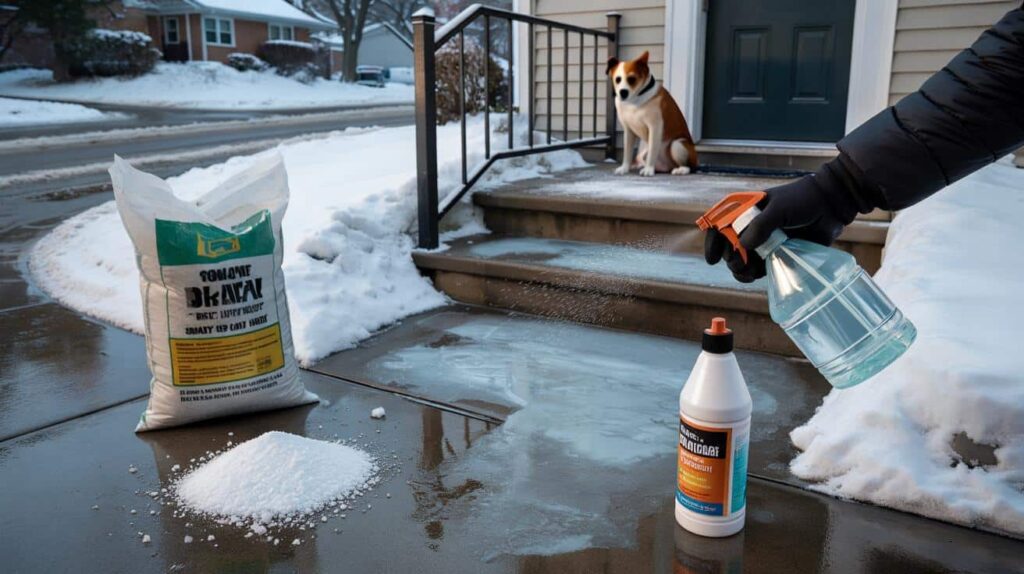
You rummage under the sink, push aside cleaning products, think about that bag of salt you used up last winter. The sidewalk is freezing over, the dog is waiting by the door, and the driveway is a trap.
Right there, next to the laundry detergent, a very ordinary container catches your eye.
And that’s where the small winter “hack” lives.

Why classic road salt is quietly wrecking your winter
Everyone talks about spreading salt as if it’s the only civilized way to face an icy sidewalk.
Yet anyone with a car, a garden, or a pair of leather boots knows the flip side: white crust on the floor mats, rims gnawed by rust, plants turning brown in March.

Road salt eats away at concrete, corrodes metal and seeps into the soil.
It works, yes, but at a cost that lingers long after the snow has melted.
Cities spread millions of tons of rock salt every year.
That salt doesn’t just vanish when the sun comes back. It runs toward rivers, settles into groundwater, and lands on your front step with every splash of slush.
You can see the results by just walking down a winter street.
Crumbling stairs, flaking rails, and those sad, bare strips along the curb where plants give up year after year.
We all accept it as part of winter, like chapped lips and wet socks.
But not all icy patches need to be doused with the same harsh stuff.
Salt works by lowering the freezing point of water.
The problem is that it only truly shines above certain temperatures and starts to lose effectiveness when the cold becomes extreme. At the same time, it penetrates tiny cracks in concrete, then expands as water refreezes, breaking your steps from the inside.
On top of that, pets lick their paws, kids kick slush around, and that same salt ends up in kitchens, cars, and living rooms.
Plain truth: most of us pour far more salt than needed, just “to be safe,” and the damage quietly accumulates, year after year.
The surprising household product that melts ice faster than salt
The unsuspecting hero hiding in your house right now?
Ordinary rubbing alcohol.
Sprinkled or sprayed on thin ice, isopropyl alcohol (70% or 90%) helps dissolve it faster than classic salt on many residential surfaces.
Mixed with a bit of water and a drop of dish soap, it turns into a fast-acting de-icing solution that doesn’t chew up concrete in the same brutal way.
Instead of tossing handfuls of salt, you can pour this mix into a spray bottle, aim at steps, locks, car doors, and short paths.
For a normal home entrance, a small bottle goes a surprisingly long way.
Picture a typical early morning: you’re already late, the street plow passed in the night, pushing a shiny ridge of ice toward your driveway. Your front steps are a smooth, glassy film.
You grab the rubbing alcohol you usually reserve for first-aid or cleaning screens.
In a bowl or an old watering can, you mix roughly two parts rubbing alcohol, one part water, add a small squirt of dish soap, and stir.
You pour it slowly along each step.
You can almost hear the ice cracking and softening in seconds, especially the thin, stubborn layer that salt often takes ages to attack.
While the neighbor drags out a half-empty salt bag, you’re already scraping slushy ice instead of hard glass.
So why does this simple product work so well?
Isopropyl alcohol has a much lower freezing point than water, around -89 °C. When you spread it over ice, it mixes with the thin layer of water on the surface and stops it from staying solid.

That means ice begins to loosen and dissolve instead of bonding tightly to your stairs.
You still need to scrape or push it away, but the physical effort drops dramatically.
On top of that, you’re not adding another load of chloride to your soil or your dog’s paws.
*You’re using something already in your cupboard, in a targeted way, instead of blanketing the ground with corrosive crystals.*
How to use rubbing alcohol on icy sidewalks without messing things up
The basic method is simple.
For home use, mix in a large bowl or bucket: about 2 cups of rubbing alcohol, 1 cup of water, and a small squirt of dish soap. Stir gently.
Pour the mixture into a spray bottle for steps, door handles, and tight corners, or into a small watering can for larger patches of ice.
Spray or drizzle a thin layer over the ice, wait a minute or two, then break up the softened layer with a shovel or stiff broom.
You don’t need to flood the area.
The goal is to loosen the bond between the ice and the ground, not create a slippery lake.
There are a few things people tend to get wrong when they first try this.
The first is overdoing it. When we’re stressed and afraid of slipping, we tend to think “more is safer”.
If you soak your steps with alcohol, you’re just wasting product and potentially creating a greasy-feeling surface.
A light, even layer works best, especially on packed snow that has turned into ice.
Another classic mistake: treating this like magic.
It’s a great helper, but you still need to shovel, sweep, or scrape. Let’s be honest: nobody really does this every single day of winter, but even a quick pass after work keeps the ice from turning into an armor you’ll battle for weeks.
“I stopped buying big bags of salt two winters ago,” says Claire, a homeowner who lives on a sloped street. “I keep a spray bottle of alcohol mix by the door. I don’t use it on the whole sidewalk, just on the spots where we always slip. My steps look better, and my dog stopped limping in February.”
- Keep a labeled bottle by the door – A simple spray bottle marked “De-icer” saves you from rummaging under the sink on icy mornings.
- Use it on thin ice, not deep snow – Shovel or push away the bulk of snow first, then treat the packed, shiny layer.
- Test a small area
- Combine with sand or grit – A quick spray plus a sprinkle of sand gives both melting power and grip.
- Store away from kids and flames – Rubbing alcohol is flammable, so treat it with the same respect you give to cleaning products.
Rethinking how we walk through winter, one step at a time
This little rubbing-alcohol trick won’t replace municipal road crews or giant salt trucks.
It’s not meant for highways, huge parking lots, or heavy snowfalls.
But on the human scale of a front step, a path to the garbage bins, a short stretch of private sidewalk, it shifts the equation.
You’re suddenly using what you have, using less of it, and causing less damage over time.
You might still keep a small bag of salt for emergencies, or for the coldest, iciest stretches when you’re away for days.
Yet your daily reflex starts to change: shovel a bit earlier, treat only the slippery sections, avoid blasting every square meter with harsh crystals.
The environment benefits, your concrete lasts longer, your car rusts a little slower.
And that everyday fear of falling on black ice becomes a bit easier to manage with a simple mix you can prepare in two minutes, half-awake, coffee in hand.
Next time you open the door on a frozen morning, look at your steps with slightly new eyes.
Ask yourself: do I truly need a thick layer of salt, or would a smart, targeted gesture do the job?
We’ve all been there, that moment when you catch yourself on the railing and feel ridiculous and relieved at the same time.
Those tiny winter scenes shape how safe we feel in our own homes.
Maybe the real winter tip isn’t just about melting ice faster.
Maybe it’s about reclaiming a bit of control in a season that loves to surprise us.

| Key point | Detail | Value for the reader |
|---|---|---|
| Use rubbing alcohol mix | 2 parts rubbing alcohol, 1 part water, a squirt of dish soap | Quick DIY de-icer with products you already own |
| Apply lightly, then scrape | Spray on thin ice, wait a minute, break up slush with a shovel or broom | Less physical effort and faster clearing in the morning |
| Reduce salt dependency | Reserve road salt for rare, extreme conditions | Protects concrete, plants, pets, and nearby water sources |
FAQ:
- Question 1Can I use any type of rubbing alcohol to melt ice on my sidewalk?Most household isopropyl alcohol (70% or 90%) works well. Higher concentrations act a bit faster, but 70% is usually enough for home entrances and steps.
- Question 2Will rubbing alcohol damage concrete or paving stones?Used occasionally and in small amounts, it’s generally gentler than repeated heavy salt use. Test a small hidden area first if you’re worried about a special coating or decorative stone.
- Question 3Is this method safe for pets and plants?Small, targeted use is typically less aggressive than road salt on paws and soil, but pets should not lick puddles of alcohol. Avoid soaking garden beds and keep the mix on hard surfaces only.
- Question 4Does the alcohol mix work in very low temperatures?Yes, alcohol has a much lower freezing point than water, so it stays effective when classic salt begins to struggle. On extremely cold days, you may need to reapply on stubborn spots.
- Question 5Can I prepare the mix in advance and store it?Yes, you can keep it in a tightly closed spray bottle or container by the door. Shake briefly before use, store away from flames and heat sources, and clearly label the bottle so nobody confuses it with regular cleaner.
