
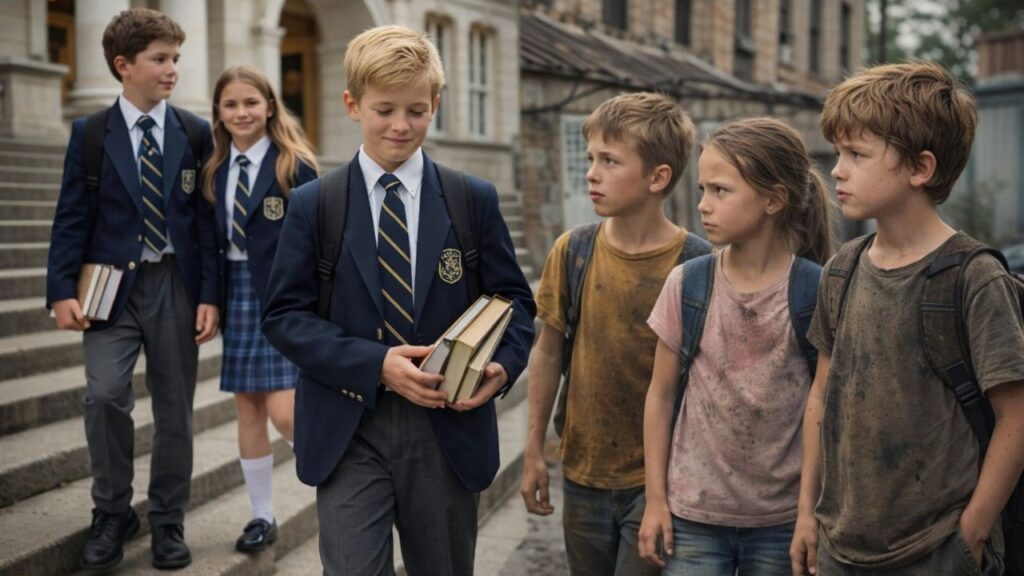
On one sidewalk, children in slightly worn uniforms squeeze past each other, backpacks repaired and reused, shared headphones buzzing faintly. Across town, beyond a tall brick wall and a perfectly trimmed hedge, other kids step out of polished cars. They wear blazers that cost more than some families’ monthly rent. Their schools boast smart boards, language labs, theatres, rowing clubs. Meanwhile, public-school classrooms share three broken laptops, and teachers wait years for a pay rise.
When Education Stops Being a Ladder and Starts Acting Like a Filter
Walk through any major city on a weekday morning and the class divide is written at the school gates. Public schools spill over with children, siblings clinging to hands, parents in work uniforms hurrying to shifts. Private school entrances feel quieter and controlled. Fewer buses, more cars. Fewer students, more branded sports bags.
This contrast doesn’t fade after the bell rings at 9 a.m.
It quietly shapes who ends up running things two decades later.

In the United Kingdom, only about 7% of children attend private schools. Yet these institutions produce roughly half of the country’s top judges, along with a striking share of MPs, senior journalists, and CEOs. Similar patterns appear in the US, Australia, and parts of Africa and Asia. A very small group, usually from the wealthiest families, keeps showing up at the top of systems said to reward “merit”.
This isn’t because they’re born smarter.
It’s because they start from a different line.
When schools charge thousands, sometimes tens of thousands, per year, everything changes. Class sizes shrink. Libraries grow. Music rooms fill with instruments instead of dust. Teachers are paid better, supported more, and stay longer. At the same time, state schools juggle overcrowded rooms and frozen budgets.
The outcome is simple: money quietly purchases opportunity. It buys attention from teachers, access to powerful alumni networks, and the confidence that comes from always seeing people like yourself in charge. Call it “school choice” if you like, but at scale it becomes a sorting machine for privilege.
When education works this way, it stops being a shared public good.
It turns into an inheritance.
Related Reads and Ongoing Debates
- Parents should need a license: society is paying the price for unqualified parenting
- Towards Mars and beyond: how AI is reshaping rocket propulsion
- A magnetic force powerful enough to lift an aircraft carrier: is France hiding the future of energy?
- CES 2026: a visual revolution is coming to our screens
- If an ATM keeps your bank card, try this unexpected step before calling the bank
- They invented artificial intelligence: Sam Altman and the rise of ChatGPT
- Elite universities reserving seats for foreigners spark backlash from local students
- Is banning junk food ads protecting children or turning the state into a nanny?
If Private Schools Were Phased Out, What Would Really Change?
People often imagine banning private schools as a radical upheaval. In reality, it could begin with a straightforward rule: any school leading to a recognised diploma must be free at the point of use and funded publicly. If you prepare students for official exams, you operate under the same system, rules, and funding per child.
Over time, private institutions would be absorbed into a single, well-resourced public network.
The walls would fall, both physically and socially.
Finland offers a real-world example. In the 1970s, the country gradually reduced most private schools, integrated them into a common public system, and removed fees. Today, Finnish education is known for small achievement gaps between rich and poor students. Teachers are highly trained, respected, and fairly compensated.
No system is flawless, but the lesson is clear.
They chose to build one strong school system for everyone instead of allowing wealth to buy an escape route.
The common objection arrives quickly: “Private schools reduce pressure on public ones.” It sounds reasonable until you notice that these schools also draw away top teachers, large sums of money, and political protection. The result is a dual structure: one system for decision-makers’ children and another for everyone else.
 Goodbye Hair Dye for Grey Hair: The Conditioner Add-In That Gradually Restores Natural Colour
Politicians may not study league tables daily, but they do notice where their own children spend most of their week. When their families are insulated behind private gates, urgency to fix public schools weakens.
Remove that escape, and suddenly improving public education becomes personal.
Facing the Fear, and What Parents Can Do Now
Speak with parents and the same quiet anxiety surfaces. Many don’t love private schools; they feel cornered. “I believe in fairness,” they say, “but I want my child to be safe, noticed, and supported.” The first step is recognising that private education isn’t only a personal decision. It’s a collective choice about the society we tolerate.
One practical action is simple: talk openly, online and at school gates, about funding levels, class sizes, and support for your local state school. Naming the issue is the start of shifting it.
The fear that “my child will fall behind if I don’t pay” is understandable. Wanting the best for your child doesn’t make you selfish. The trap lies in believing that “the best” can only be bought.
A healthier perspective is this: your child’s future is tied to the quality of every child’s education. Societies with smaller education gaps see lower crime, better health, and stronger social trust. That’s not idealism; it’s practical self-interest.
We’ve all felt it: walking through a glossy open day, hearing polished speeches about “holistic learning”, and quietly comparing it to crowded classrooms and peeling paint.
Looking Past the Shine
- Question the marketing: brochures rarely show exclusion rates, bursary limits, or narrow social circles.
- Ask blunt questions: who is admitted, who is pushed out, who cleans the floors, and who owns the building?
- Support mixed classrooms: back catchment policies and funding models that follow need, not influence.
- Watch for soft segregation: streaming, elite clubs, and “invitation-only” groups can recreate private logic inside public schools.
- Back teachers, not brands: fair pay, training, and conditions in public schools matter more than any logo on a blazer.
A World Where Your Surname Doesn’t Choose Your Classroom
Imagine a country where politicians’ children eat lunch alongside kids whose parents clean their offices. Where future surgeons, bus drivers, and software engineers once sat in the same maths class. Where you can’t buy smaller classes and better labs while another school fundraises for printer ink.
This world doesn’t happen by accident.
It comes from choices that trim a few privileges and lift millions of children.
Banning private schools feels extreme only because we’ve normalised the idea that wealth can opt out of the common good. We don’t accept private fire brigades that protect only rich homes or streetlights that shine on selected pavements. Education is just as essential.
The real question isn’t whether we can afford to integrate private schools.
It’s how long we accept a system that quietly tells children they were born on the wrong side of the gate.
You may not see private schools disappear overnight. Change is slow. Still, every conversation that treats education as a shared right, every vote for fair funding, every parent who resists buying advantage, stretches what feels possible.
The debate isn’t really about buildings or fees.
It’s about whether some doors stay locked unless your parents can pay for the key.

Key Takeaways
- Private schools deepen inequality: they concentrate resources, networks, and attention among a wealthy minority, reframing education as a structural issue rather than a personal choice.
- Integration is achievable: countries like Finland show that absorbing private schools into a public system is a political decision, not a fantasy.
- Parents hold real power: open discussion, voting, and backing public-school funding reshape what becomes acceptable and possible.
