
Saturday mornings downtown feel unusually still, as if the city is pausing to think. Traffic lights continue their routine, glowing red and green, yet nothing moves. There are no engines humming, no horns blaring, no taxis squeezing through tight gaps. Instead, a father carefully pedals past with his toddler on a tiny bike, a teenager cruises by on a scooter, and a couple strolls hand in hand along an avenue once dominated by cars.
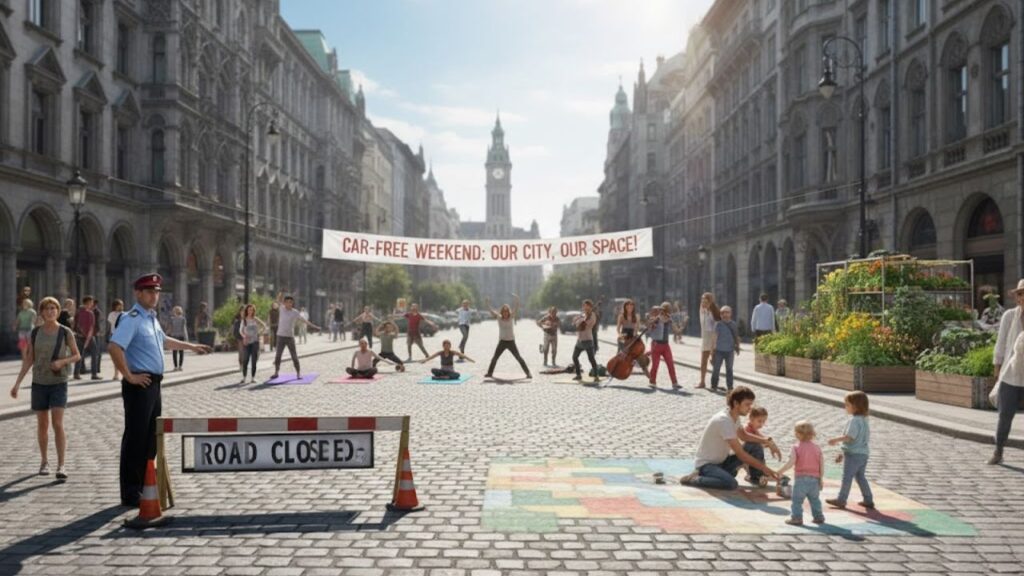
Nearby, a delivery driver in a white van gestures angrily at a police officer, pointing toward a sign that reads “Road closed to traffic – weekend pedestrian zone.”
On one side of the street, someone records the moment for TikTok. On the other, an elderly woman shakes her head, murmuring that the city has “lost its mind.”

The mayor calls it the future.

The streets suggest the argument is only beginning.
When Cars Disappear and Streets Belong to Walkers
The announcement landed abruptly. Every weekend, from Friday night to Sunday evening, large sections of the city’s main roads are closed to cars. There are no quick exceptions, no temporary stops, and no slipping through with hazard lights. The asphalt transforms into a shared open space linking shops, cafés, and apartment buildings.
During the first weekend, pedestrians moved cautiously, almost apologetically, as if stepping into forbidden territory. By the third weekend, children were drawing chalk hopscotch right in the middle of what had once been the busiest lane.
Market Street offers one of the clearest examples. Previously, pedestrians hugged the walls while buses and SUVs rushed past, side mirrors brushing close to shopping bags. Now, a florist has rolled her stand into the former bus lane, surrounded by tulips and eucalyptus.
An ice-cream cart stands where taxis once queued. A pop-up band plays near a crosswalk, plugging their amps into a nearby bar. According to early city figures, foot traffic has risen by 30% over two weekends. Retailers are divided: a shoe shop reports higher sales, while a car parts store says regular customers have stopped coming.
The logic behind the move is simple. The city wants cleaner air, fewer accidents, quieter weekends, and to gently encourage people to walk more. Urban planners reference studies linking walkable areas to better health and stronger local economies. Residents along these roads say they can finally open their windows without breathing exhaust fumes.
Still, what feels like fresh air to some feels like a burden to others. Delivery workers, caregivers, and people with limited mobility see a policy that looks neat on a map but clashes with the reality of daily life.
- They Invented Artificial Intelligence: Sam Altman, The Tech Prodigy Behind ChatGPT
- A €2.4 trillion potential gold rush: the unlikely new ally guiding miners where to drill
- The snow leopard is as beautiful as it is cunning
- From February 8, pensions will rise, but only for retirees who submit a missing certificate
- The shocking reason a famous French chef says yogurt cake is ruining French pastry
- From fishing grounds to missile zones, how China is sacrificing marine life for military dominance
- Elderly hygiene revolution: why skipping daily showers could keep you stronger
- Angoulême Comics Festival: why keeping NordVPN handy matters on public Wi-Fi
When a Bold Policy Meets Everyday Reality
On paper, the plan appears orderly: block the roads, reroute traffic, install signs, send emails, and let people adjust. In practice, it feels like a live experiment. Drivers make sudden U-turns, and pedestrians struggle to interpret new signs taped over old ones.
The traffic department has created a ring road around the pedestrian zone to absorb diverted vehicles. Traffic lights were reprogrammed overnight, and digital boards flash new routes in orange. Volunteers known as “weekend mediators” now stand at busy corners, answering questions and absorbing frustration.
Lena, a nurse working weekend night shifts, has become a symbol of the backlash. She once crossed downtown in ten minutes to reach the hospital. Now, those ten minutes are spent circling the outskirts, stuck in diverted traffic.
A nearby bakery faced a different problem. Its early-morning flour delivery never arrived during the first weekend because the driver couldn’t locate the new loading zone. The city later admitted its professional driver maps were “not quite ready,” a phrase that translated into empty shelves during the morning rush.
 Goodbye Hair Dye for Grey Hair: The Conditioner Add-In That Gradually Restores Natural Colour
The real strain lies where comfort, equity, and habit intersect. Residents who live centrally or work remotely often welcome the change. They walk, enjoy quieter streets, and share photos of children playing where buses once passed. For them, the closure feels like a gift.
For those who rely on cars for work or caregiving, it feels like a penalty. A clear class divide emerges: higher-income residents adapt more easily, while lower-income workers face longer commutes and higher fuel costs. Closing a road takes one vote; reshaping decades of car dependence takes far longer.
Staying Sane During Car-Free Weekends
Those adjusting best treat weekends as if they live in a different city. They plan routes on Friday night, not Saturday morning. Errands are grouped together instead of scattered across the day. Some families alternate between “car weekends” and “walking weekends.”
Others rediscover distances they once overestimated. A walk assumed to take 20 minutes often turns out to be closer to 12. Public transport use on the edges of the zone has increased, with drivers parking farther out and walking the rest.
There is also an emotional cost that planning documents rarely capture. You can design detours, but not the frustration of sitting in traffic because the direct route is suddenly closed every Saturday. Many residents inside the zone describe feeling trapped when new rules disrupt familiar routines.
The city has tried to soften the impact with temporary permits for caregivers, marked loading areas, and a hotline for confused residents. In reality, few people read the full guide. Most just want a clear answer to one question: “Can I drive here or not?”
One regular summed it up simply: “On weekdays, these streets belong to cars. On weekends, they belong to us.”
- Check the weekend traffic map on Friday evening
- Set aside one no-car day to explore nearby areas on foot or bike
- Help elderly neighbors with one heavy errand each week
- Use side streets for loading within short time windows
- Share ride costs for longer detours, especially for night workers
A City That Walks and Argues at the Same Time
As weekends pass, the initial shock fades into habit. Children already see scooter races on former avenues as normal. Café owners lobby for larger terraces, while drivers quietly memorize new routes. The debate continues, just in a different tone.
Online, opinions swing between “best idea ever” and “a war on cars.” On the ground, reality is more layered. People adapt, complain, breathe cleaner air, lose time, save time, and walk more, sometimes willingly, sometimes not.
The city is gathering data on air quality, noise levels, foot traffic, and business revenue. Charts will follow, reducing complex habits to percentages. What those charts cannot capture is the sound of a Saturday afternoon: children shouting, musicians tuning guitars, cups clinking on café tables, and the notable absence of engines.
For some, that quiet is relief. For others, it signals that cars no longer feel welcome.
The experiment may expand, retreat, or evolve after the next election. It may lead to more bike lanes or partial reopenings. Or it may simply blend into daily life, like traffic lights once did.
What remains certain is that every closed road raises a larger question: what kind of city do we want outside our front door? One built for speed, or one shaped by footsteps. There is no single answer, only thousands of routines adjusting to a bold line of yellow paint on the asphalt.

Key Takeaways at a Glance
- Weekend closures reshape habits: Main roads go car-free from Friday night to Sunday evening, changing daily routines
- Benefits and burdens differ: Walkers and central businesses gain, while some workers lose time
- Adaptation requires small actions: Planning routes, sharing rides, and supporting vulnerable neighbors help ease the transition
