The first time the path of Comet 3I Atlas appeared on a sky chart, it resembled a fragile crack etched across the solar system. A narrow arc arriving from deep space, grazing the inner planets, then slipping back into darkness.
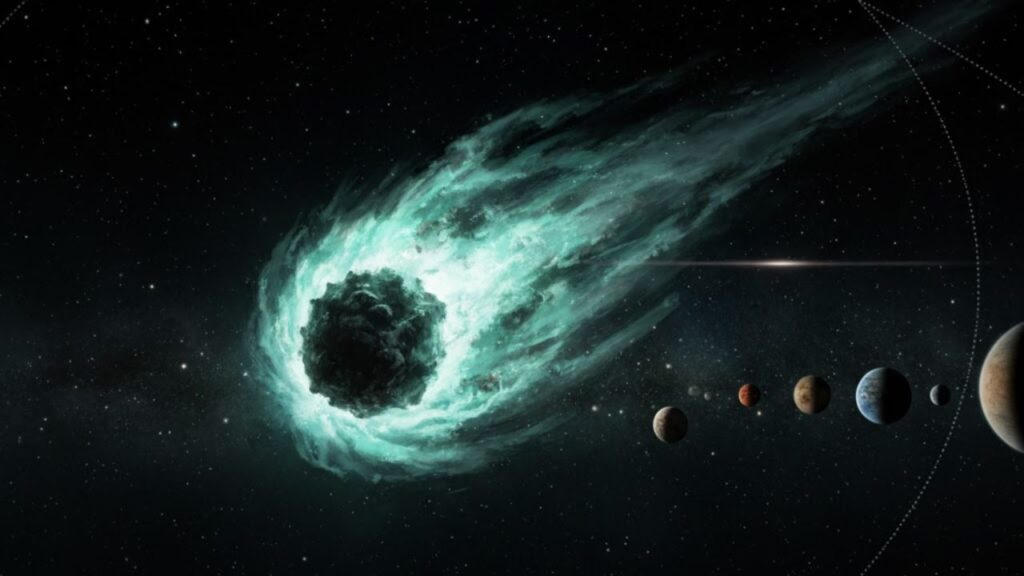
Astronomers describe its passage with neat equations and orbital simulations. Yet the reality feels far less orderly. This icy body does not belong here. It is not bound to the Sun and has no long-standing ties to our cosmic neighborhood.
We are watching a visitor rush through our backyard at immense speed, carrying unknown material from somewhere far beyond familiar space. That uncertainty is what unsettles researchers most.

When a Comet Refuses to Follow Familiar Paths
Most comets are products of our own system. They trace elongated loops around the Sun, returning after centuries or millennia, like distant relatives making rare appearances.

Comet 3I Atlas breaks that pattern. Its orbit is hyperbolic, an open curve rather than a closed loop. That single detail reveals something crucial: the object is not gravitationally tied to the Sun.
It will approach, pass through, and leave forever. A one-time guest arriving from beyond the mapped boundaries of our solar system.
The idea may sound familiar. In 2017, ‘Oumuamua swept through the inner solar system, sparking debate over its unusual shape, rotation, and composition. Two years later, 2I/Borisov followed, the first unmistakably comet-like interstellar visitor, releasing gas and dust as expected.
Now, 3I Atlas becomes the third confirmed interstellar object, reinforcing a pattern that once seemed purely theoretical.
From Rare Hypothesis to Repeated Reality
For decades, interstellar visitors existed mainly as thought experiments. Today, they are appearing with surprising frequency, like unexpected guests at a quiet gathering.
The concern among scientists is not impact risk. 3I Atlas poses no threat to Earth, passing at a safe distance. The deeper unease comes from how late earlier objects were detected, how incomplete the data remains, and how much may cross our region of space unnoticed.
No system surveys the entire sky every night with perfect precision. When the numbers are examined closely, an uncomfortable conclusion emerges: if three such objects have already been found in a short span, many more are likely slipping past unseen.
Tracking a Fast-Moving Phantom
On paper, identifying an interstellar object seems straightforward. Astronomers observe it over multiple nights, chart its position, and calculate its orbit.
If the object’s speed exceeds the Sun’s escape velocity—about 42 kilometers per second near Earth’s orbit—it cannot be bound to the solar system. This is how 3I Atlas was recognized. Its motion did not match that of a typical comet arriving from the distant Oort Cloud.
In reality, the process is far messier. Observations are affected by cloudy skies, limited viewing windows, and uncertain brightness predictions.
Many discoveries rely on chance. A wide-field survey such as ATLAS or Pan-STARRS happens to be pointed in the right direction at the right moment. A slight change in timing or position, and the object could pass unnoticed.
For every interstellar comet detected, many others may remain invisible—too faint, too fast, or traveling far from the regions most surveys focus on.
 Goodbye Hair Dye for Grey Hair: The Conditioner Add-In That Gradually Restores Natural Colour
The Limits of Our Watchful Eyes
Here, the calm tone of scientific analysis begins to falter. Accepting that most interstellar visitors go undetected raises an unsettling question: what else is passing through?
3I Atlas appears to be a typical icy comet. Yet the methods used to find it might not reveal darker, denser, or more unusual objects—those with low reflectivity or unfamiliar structures.
When scientists acknowledge that catalogs of near-Earth objects are incomplete, they are admitting that our view of the sky is partial. Despite advanced technology, much of space is still observed through narrow gaps.
Between Scientific Curiosity and Subtle Unease
The practical response to discoveries like 3I Atlas has been clear: expand sky surveys and keep them running continuously. Projects such as ATLAS, Pan-STARRS, the Zwicky Transient Facility, and the upcoming Vera C. Rubin Observatory are being refined to flag anything moving unusually fast or along unexpected paths.
Suspicion is increasingly automated. Algorithms sift through enormous volumes of images, identifying faint points of light that shift just a little too quickly. Each detection triggers urgent follow-up observations before the object fades or disappears into solar glare.
Behind the data lies a quieter human effort. Researchers often work late into the night, sorting through noisy signals, hoping a faint streak is not merely a technical error or satellite trail.
The most common failure is not missing something obvious, but dismissing strange, dim signals as unimportant. Many potentially interstellar objects have been lost before their paths could be confirmed.
Among observers, a recurring emotion surfaces: pride in discovery mixed with regret over what might have been missed.
A Solar System Open to the Galaxy
Interstellar visitors are no longer rare theoretical possibilities. Multiple confirmed detections suggest a steady flow of material through our region of space.
- We detect only what our instruments allow
- Coverage depends on weather, software, and funding
- Each discovery raises more questions than answers
Comet 3I Atlas will likely fade into records as another small body with an unusual origin. Yet its path introduces a subtle fracture in the comforting idea that space around us is empty and predictable.
With three interstellar objects identified in a short time, the solar system begins to resemble a busy crossroads rather than a quiet cul-de-sac. The gaps in our observations become harder to ignore.
The reality is simple and unsettling. The solar system is open. Matter enters, crosses familiar orbits, and leaves again without notice.
3I Atlas is merely one traveler briefly caught in our instruments’ view. The more troubling question is how many others pass through unseen, moving silently through the space we consider home.

| Key point | Detail | Value for the reader |
|---|---|---|
| Interstellar nature of 3I Atlas | Hyperbolic orbit and excess speed show it comes from beyond the solar system | Helps you grasp why this comet is fundamentally different from “regular” comets |
| Detection limits | Current surveys only catch a fraction of fast, faint objects crossing our skies | Gives perspective on how much we may be missing above our heads |
| Implications for our cosmic neighborhood | Multiple interstellar visitors in a short time hint at a constant flow of unknown objects | Invites you to rethink the solar system as a porous, dynamic place, not a sealed bubble |