On a rainy Thursday in late October, the parents’ WhatsApp group at Roosevelt Middle School suddenly erupted. Screenshots, voice notes, and urgent messages flooded the chat. Report cards had just landed in inboxes, but instead of the familiar grid of A’s, B’s, and C’s, parents saw something unexpected: “Resilience: 7.3/10,” “Collaborative Mindset: 6.2/10,” “Future Leadership Potential: 8.9/10.” There was no math grade. No English grade. Only AI-generated personality scores drawn from classroom behavior and digital activity.
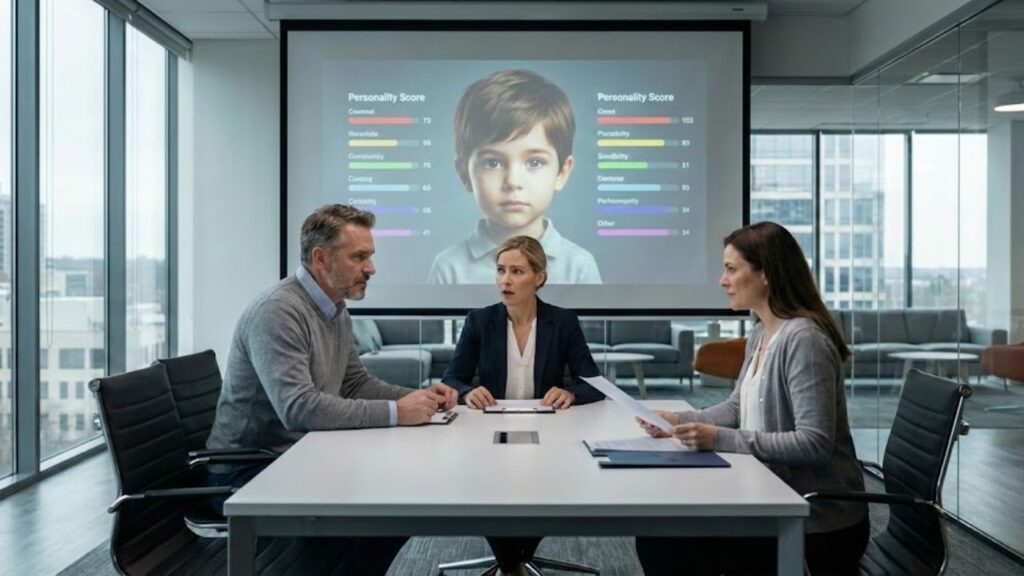
Across kitchens and parked cars in the district, parents scrolled first in silence, then in anger.
One message finally cut through the chaos: “So an algorithm just decided who my kid is?”

When Algorithms Step In and Grades Step Out
The first schools experimenting with AI-based personality scoring did not announce it loudly. These systems slipped quietly into pilot programs, wrapped in reassuring phrases that looked harmless on slides: “holistic evaluation,” “future-ready profiles,” and “beyond academic metrics.”

Parents only realised the shift once the numbers that once defined school life — 92%, B+, 4.0 GPA — disappeared from report cards.
In their place appeared colorful dashboards claiming to assess whether a child was “risk-averse,” “emotionally steady,” or “highly conscientious.”
At a suburban high school in Colorado, sixteen-year-old Jayden opened his “Learner Profile” on a school-issued tablet. He ignored the badges and pastel charts and stopped at a single line: “Innovation Propensity: 4.1/10.”
Jayden had always believed he was creative. He writes music at night and fills notebooks with sketches. His mother, Carla, recalls how he went quiet at dinner before pushing his plate away. “So I’m officially below average at doing anything new,” he muttered.
The score came from an AI model that analysed homework habits, activity on school platforms, and even the tools he used in shared documents. None of it captured the songs he wrote after midnight.
Behind these polished dashboards are systems that feel closer to credit scoring than education. AI models process behavior logs, attendance records, quiz data, and even how quickly students click through online exercises. Complex human development is compressed into clean psychological labels.
- ➡️ In the desert, they are building an “artificial sun” to power cities
- ➡️ Electricity: France now produces more than it consumes, a major energy turning point
- ➡️ The 10 second signal from 13 billion years ago proves Nasa has been hiding aliens
- ➡️ The UK is building a “monster” to twist plasma in every direction and push humanity closer to nuclear fusion
- ➡️ A new European defence giant is about to emerge outside Germany and France, as Czech-based Czechoslovak Group prepares for a landmark IPO
- ➡️ Scrap university degrees experience should be worth more than any diploma
- ➡️ A state pension cut has now been officially approved, reducing monthly payments by £140 starting in February
- ➡️ Why you should never trust an ATM that swallows your card according to insiders
School districts are promised that these profiles will personalise teaching, guide career paths, and identify students “at risk.”
Yet the logic works both ways. When a system labels a child as having “low perseverance” or “weak leadership potential,” the impact is immediate. Such labels can quietly follow a student, repeated in meetings, passed between teachers, and carried forward year after year.
How Schools Are Gradually Rewriting the Rules
The transition often begins with something that sounds harmless: a “pilot program” for “AI-assisted assessment.” One term. A handful of classes. Framed as a way to enhance existing grading.
Then the tools expand. Behavior tracking platforms connect to AI engines. A student well-being app starts logging mood check-ins. Learning portals track not only scores but also time-on-task, clicks, and keystroke patterns.
Before long, a full year of data exists, and someone in the district office is handed a dashboard titled “Personality Insights.”
Parents often grasp the scale of the change only when teachers begin citing those insights. At a parent–teacher evening in London, one father recalls being told, “The AI indicates that Mia has low resilience and may avoid demanding academic paths.”
Mia had just spent six months recovering from a sports injury, attending rehabilitation sessions every morning before school.
When her father asked where the “low resilience” label came from, the answer was simple: her habit of skipping optional enrichment modules online. The system translated “missed extra tasks” into “difficulty with persistence.” No one asked why she skipped them.
 Goodbye Hair Dye for Grey Hair: The Conditioner Add-In That Gradually Restores Natural Colour
Most parents admit they do not study the fine print on school consent forms. Platforms are bundled together, acronyms blur, and by page three, signatures are added.
As a result, many do not realise how easily “personalised learning analytics” can become personality scoring. The AI does not understand children the way teachers do. It detects patterns and outputs probabilities. Low forum activity becomes “introverted tendencies.” Short answers become “impulsivity.”
Over time, these assumptions begin to shape expectations. Busy teachers may rely on what appears efficient. A low collaboration score can subtly steer a student away from leadership roles, even if that score came from a single dysfunctional group project.
What Parents Can Do When Algorithms Define Their Child
When an AI-generated profile arrives in your inbox, the urge to react immediately is strong. Pause. Treat the document as evidence, not a verdict.
First, ask about the source. What specific data feeds these scores? Which platforms and what time period are involved? This is not obstruction; it is clarity.
Second, list three real-world examples that contradict the score. If your child is marked as “low initiative,” document the club they founded, the neighbor they assist, or the solo project they completed. Bring examples, not emotions.
During meetings, resist turning the conversation into conflict. The person across the table likely did not design the system and may also feel uncertain about it.
Ask which parts of the profile can be edited, challenged, or removed. Can teachers override AI assessments with lived classroom experience?
The most dangerous response is silence. Intimidated by technical language, many parents accept the labels quietly. That silence allows these tools to expand without clear limits or accountability.
“An algorithm should never have the final say on a child’s personality,” says Dr. Lila Gomez, an educational psychologist who advises districts on AI ethics. “At best, these systems should spark discussion, not act as unseen judges of potential.”
Essential Questions to Ask Your School
- Who created this AI system, and who has access to my child’s scores?
- Which apps, platforms, and behaviors contribute to these ratings?
- What is the process for correcting or removing inaccurate scores?
- Are teachers required to rely on these scores for placements or recommendations?
- Could these scores ever be shared with universities, employers, or third parties?
What This Shift Reveals About How We View Children
At its core, this change touches a deep fear: that children are being reduced to data points before they understand who they are. Grades were already blunt tools. Now, personality itself is being processed through the same machinery.
Some parents find comfort in these profiles. A tidy forecast of where a child may thrive feels reassuring. Others feel a sense of loss when confronted with a number like “emotional stability: 5.4/10,” and ask who has the authority to measure that.
Many adults remember how a single comment from a teacher once reshaped their sense of possibility. Imagine that moment preserved as a permanent, searchable score. That is the unease driving today’s anger.
The real question is not simply whether schools should use AI personality scoring. It is who gets to define a child’s potential. The teacher who sees kindness on the playground? The algorithm scanning click histories? The parent watching their child build worlds late into the night, fully absorbed?
There is no neat conclusion. Some schools are retreating, restoring traditional grades and limiting AI to narrow, transparent roles. Others are accelerating, convinced that learning’s future lies in data-driven personality mapping.
What happens next depends on how parents respond to that uneasy feeling when their child becomes a “collaboration score.” Whether they scroll past it, or whether they begin asking persistent questions about consent, bias, and the right to remain a work in progress at 12, 15, or 17.

Key Takeaways
- AI personality scoring is reshaping school evaluation by replacing or diluting traditional grades with algorithmic traits.
- Parents retain rights and influence, including access to data sources and the ability to challenge labels.
- Labels can become self-fulfilling, shaping expectations and self-image long after the score is assigned.