From the pier in Pingtan, the sea appears calm. Nets sway as they dry, and a fisherman squints toward the horizon where the gray line of the Taiwan Strait fades into mist. Then a low, heavy thud rolls across the water, subtle but strong enough to be felt in the chest. Somewhere beyond sight, a Chinese missile test echoes across the area where he once cast his lines.
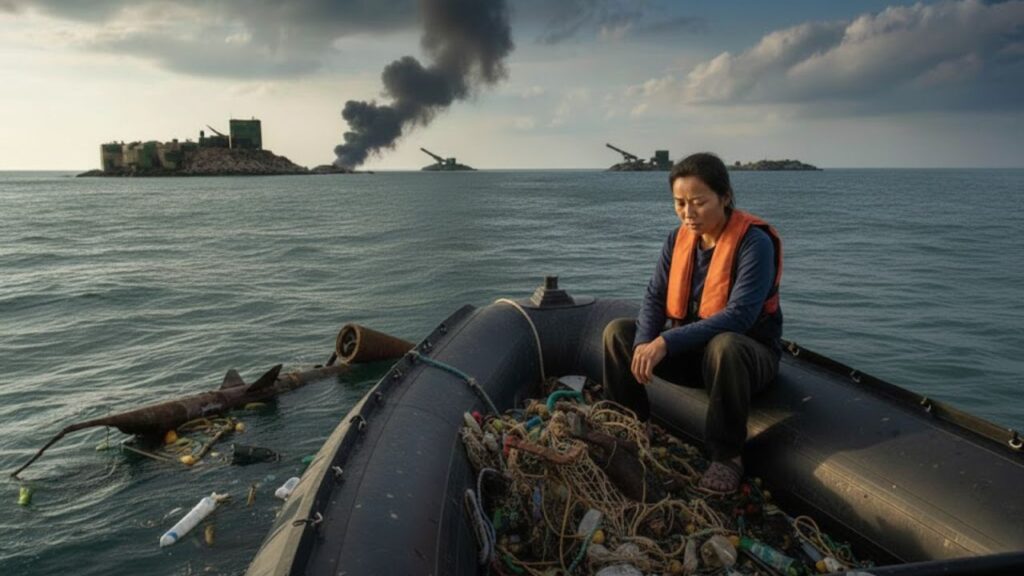
The fisherman shrugs, though his gaze stays fixed on the waves. He says the fish have shifted, or perhaps disappeared entirely. The water feels different now, he explains, as if it belongs to someone else.
He lets out a short, hollow laugh and gestures toward the sea.

“That’s a drill zone now,” he says. “Not a fishing ground.”

The wind strengthens. The sky remains quiet. The sea feels smaller by the day.
When the Frontline Slips Beneath the Waves
Across the South China Sea and the waters surrounding Taiwan, the frontline is no longer defined only by warships and fighter jets. It now cuts through coral reefs, seagrass beds, and long-used fishing grounds where generations once made their living. Beijing’s drive for military dominance has gradually transformed these living spaces into test ranges, exclusion zones, and strategic gray areas, swallowing both livelihoods and marine life.
Areas once charted for currents and fish migration are now mapped for missile paths and radar reach. The change is felt not through headlines, but through the absence of sound where small wooden boats once coughed and rattled across the water.
The sea remains, but people’s relationship with it is rapidly changing.
In August 2022, China responded to U.S. House Speaker Nancy Pelosi’s visit to Taiwan with live-fire drills encircling the island. Authorities declared vast stretches of ocean off-limits, including productive fishing grounds. Taiwanese boats were ordered to stay in port. Those who ventured near the edges of the exclusion zones returned with meager catches and accounts of patrol ships and warning broadcasts.
Data from satellite monitoring groups such as Global Fishing Watch showed fishing activity dropping sharply during and after the drills. Officially, the exercises lasted only days. On the water, the disruption and fear lasted weeks.
- This simple trick finally unlocks speed camera alerts in google maps
- Social media should be restricted to people over 25 because young adults cannot handle it responsibly
- They created liquid gears that transmit motion without touching or teeth
- Here’s what AIs really do when you put them in charge of a company
- Starlink on mobile proves that governments lied about the impossibility of full coverage
- Yogurt cake is not a real dessert according to this famous French chef
- Good news for landlords bad news for tenants the new rental law changes everything
- If an ATM keeps your bank card do this unexpected trick before calling your bank
And this was only one incident that drew global attention.
Researchers and defense analysts are increasingly examining what constant militarization does to the ocean itself. Missile launches, sonar pulses, underwater drones, and dense ship traffic combine into a persistent strain. Noise pollution disorients whales and dolphins. Repeated blasts damage reefs and seabeds that serve as nurseries for countless species. Expanding no-go zones force fishing fleets into already stressed ecosystems.
Behind the language of “strategic chokepoints” lies a simpler truth: marine life does not recognize Exclusive Economic Zones or nine-dash lines. It responds only to stress, heat, and noise.
Once those responses become permanent, recovery is difficult, if not impossible.
How Security Exercises Gradually Empty the Sea
One of Beijing’s most effective maritime tools appears harmless at first: temporary navigation warnings. These official notices declare certain waters off-limits for military activity, rocket launches, or missile tests. On maps, they appear as tidy shapes. In reality, they slice through feeding areas, migration routes, and coral shelves.
Over the past decade, these warnings and exercise zones have expanded across critical parts of the South and East China Seas. Some are brief and limited. Others are massive, closing off ocean areas larger than entire countries. From space, it looks like a color change. For a crab fisherman whose traps suddenly fall inside a missile corridor, it is a personal shock.
The trend is gradual but clear: more drills, in more locations, for longer periods.
For years, Chinese rockets launched from inland provinces such as Sichuan and Gansu have dropped spent stages into the sea. Trajectory maps show debris landing in waters near Taiwan, the Philippines, and deep within the South China Sea. Each launch brings a danger window when fishermen are advised to avoid certain coordinates.
Many small-boat crews cannot afford to wait. They head out anyway, weaving around exclusion zones marked on creased printouts or SMS alerts, hoping the sea stays calm. Stories circulate of boats struck by falling debris or crews encountering toxic-looking wreckage drifting near their lines. Such incidents rarely make the news.
 Goodbye Hair Dye for Grey Hair: The Conditioner Add-In That Gradually Restores Natural Colour
For these crews, it is simply another risk layered onto rising fuel costs, shrinking catches, and shifting weather.
Marine biologists describe the cumulative impact of repeated drills as a slow-motion industrial accident. Explosions can create temporary shock zones that kill nearby fish and invertebrates. Heavy metals and propellant residues can seep into water and sediment. Naval maneuvers disturb seabeds, while sonar and radar tests add relentless noise to an environment dependent on sound.
No one counts the stunned fish after a missile splashdown. Official narratives emphasize deterrence and readiness. The unrecorded side includes the octopus abandoning its den or the dugong avoiding areas where patrol ships now pass daily.
By the time declining catches appear in data, the damage is often already normalized.
Life Along a Coastline Turned Battlefield
Fishermen from Hainan to Luzon to Taiwan’s eastern shore describe the same survival tactic: reading military activity as carefully as tides. Crews exchange quiet messages about rumored drills, ship movements, and new exclusion boxes that appear overnight on navigation apps. One captain in Kaohsiung called it “fishing in the gaps”, short windows between exercises or narrow corridors outside danger zones.
A crew may leave before dawn, rush through a slim strip of safe water, set their lines, and return earlier than planned, anticipating a sudden warning.
This is not strategy. It is constant improvisation under pressure.
From shore, it is easy to assume coastal communities can endlessly adapt by changing species or moving farther out. The reality is harsher. Smaller boats cannot safely follow fish into deeper waters already crowded by large commercial fleets and coast guard patrols. Fuel costs rise as catches fall.
Each high-profile political visit or sudden flare-up sends rumors of new drills racing through dockside chat groups. It is the recurring moment when plans collapse and control disappears, repeating every few weeks.
On maps, it looks like strategy. On the docks, it feels like whiplash.
Alongside fishermen, scientists and conservation workers struggle to keep pace. Many choose their words carefully, but their field notes are direct.
“Every drill leaves a fingerprint,” said a marine ecologist in southern Taiwan, speaking anonymously. “Sometimes it’s dead fish on the shore. Sometimes it’s behavior. Species that were once bold become cautious. Areas full of life turn strangely quiet.”
In response, they focus on practical steps:
- Relocating monitoring stations away from constant drill zones to preserve long-term data.
- Working with fishers to record unusual events such as mass strandings or surface films after launches.
- Quietly advocating for seasonal no-drill windows during spawning and migration.
- Establishing informal quiet corners where engines and heavy gear are avoided.
- Translating military notices into clear, usable warnings for crews at sea.
These efforts are small against a vast system, but they still matter.
The Question Lurking Beneath the Surface
China’s push for military control in contested waters is often framed as a contest between great powers, filled with missiles, exercises, and diplomatic statements. Beneath that narrative lies a different reality: a living sea enduring constant strategic pressure. Fish do not care who launched a rocket. Turtles do not recognize flags on artificial islands. They respond only to noise, heat, toxins, and the loss of habitat.
There is something deeply unsettling about watching fishing grounds turn into missile zones while the damage to marine life accumulates quietly. Decisions are made far from the coast, in secure rooms and distant capitals. The consequences arrive on beaches as broken coral, empty nets, and unfamiliar debris marked with warnings many locals cannot read.
The question hovering over these waters is not only who will control them decades from now, but what will remain to control at all. That question extends far beyond China’s shoreline, touching every nation that treats the ocean first as a proving ground and only second as a living world.

Key Takeaways
- Missile zones replacing fishing grounds: Expanding exercise areas and debris zones overlap traditional fisheries and migration routes, directly affecting daily livelihoods and food supplies.
- Hidden ecological damage: Noise, explosions, and pollutants gradually alter marine behavior and survival, revealing long-term costs behind short-term drills.
- Local adaptation and quiet resistance: Fishermen, scientists, and coastal communities adjust routes, share data, and protect informal quiet areas to cope with constant disruption.