
At the edge of northern China’s Mu Us Desert, the air carries the sharp taste of dust. It clings to lips, eyelashes, and phone screens. Then the flat beige horizon suddenly shifts. A rigid, unnatural stripe of green cuts through the sand — neat rows of young poplars, each tied to a support stick and marked with a QR code. A local official gestures proudly, as if revealing a wonder. “This is how we save the planet,” he says.
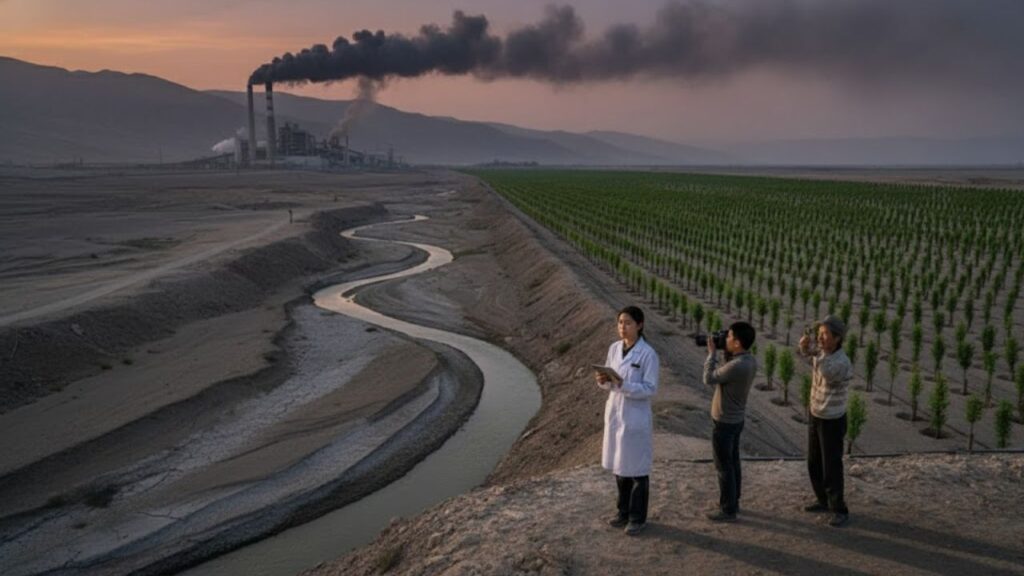
A drone hums above, recording footage for a government promotion. Nearby, volunteers smile for photos beside saplings, backed by banners promising an “ecological civilization.” The scene feels polished and hopeful. Yet turn slightly, and the dunes are still advancing, swallowing abandoned fields and half-burying power lines.
The question lingers: is this forest a true solution, or simply a green façade?

China’s Vast Green Barrier: Breakthrough or Illusion?
China has planted more trees than any other nation in modern times. Since the late 1970s, the Great Green Wall project has aimed to halt deserts in the north from pushing toward Beijing and beyond. On maps, the progress looks dramatic: expanding green bands where bare land once dominated. Satellite images show regions shifting from brown to pale green.

On paper, it reads like the climate success story the world wants. A massive country, a massive effort, billions of trees, and vast amounts of carbon captured. In an era of constant environmental alarms, it offers reassurance. But statistics rarely reveal how those trees are actually surviving — or failing — underground.
Travel through Inner Mongolia with scientists, and the story grows less clear. You encounter so-called forests planted in perfectly straight lines, made up of a single species, all the same age. Dig a few centimeters down and the soil turns powder-dry. Locals point out areas where plantations once stood tall, now filled with dead trunks bleached white by the sun. Survival rates are mentioned quietly: 15% or 20%, on good days.
One researcher tracked tree growth over ten years in a heavily promoted zone. The findings were sobering: stunted growth, shallow roots, and minimal long-term carbon storage. The trees were technically alive, but trapped between drought, poor soil, and pressure to green land that may never have supported forests. This reality rarely appears in glossy campaign imagery.
The appeal of the billion-tree vision is powerful. Plant trees, absorb CO₂, stop sandstorms, restore nature, ease responsibility. Yet landscapes are not empty canvases. In much of northern China, natural vegetation is grassland, scrub, or sparse shrubs with deep roots adapted to harsh dry seasons. Replacing them with fast-growing, water-hungry poplars can drain groundwater, weaken soil, and sometimes leave land even more fragile.
Some Chinese environmentalists note another complication. Large planting figures play well in international climate discussions, while emissions from coal, cement, and industry remain high. A billion saplings are easier to showcase than a closed coal plant. The danger is that trees become a moral offset — a green glow masking a still heavily polluting economy.
Doing Reforestation Right: What Holds Up Over Time
In Ningxia, on a blustery afternoon, a farmer named Zhao bends down to point out something unremarkable at first glance. Not trees, but knee-high shrubs, widely spaced, surrounded by straw grids laid out like a chessboard across the sand. The method is old and far from flashy. Straw barriers trap moisture, slow the wind near the ground, and give roots a chance to survive. Zhao describes the process with one word: slow.
- This signal from the gut could calm sugar cravings
- A magnetic force strong enough to lift an aircraft carrier: is France hiding the ultimate weapon of future energy?
- Here’s the viral map of “ideal climate zones for human survival”
- Father splits assets in his will equally among his two daughters and son, wife says it’s not fair because of wealth inequality
- One gesture is enough: DJI launches a drone that almost flies itself
- Greenland’s climate isn’t what you think: the myths are wrong
- Parents should need a license society is paying the price for unqualified parenting
- Doctors are hiding this cheap fruit that lowers cholesterol better than most prescriptions
Rather than planting millions of poplars at once, Zhao’s village rotated grazing land, allowed sections to rest, and mixed drought-resistant species — a few trees, many shrubs, and native grasses. It took years before the land looked green enough for aerial footage. But beneath the surface, the soil stayed cooler and retained moisture longer. Birds and insects returned. The land resembled a living ecosystem, not a plantation.
 Goodbye Hair Dye for Grey Hair: The Conditioner Add-In That Gradually Restores Natural Colour
Online discussions about planting billions of trees rarely focus on year three or year ten. Yet survival, not planting alone, determines success. In the past, many provinces were rewarded simply for the number of seedlings planted. The outcome was predictable: crowded plots, little irrigation planning, and minimal aftercare. After a few dry seasons, large sections quietly disappeared.
Newer policies now emphasize native species and mixed plantings. Even so, the push for quick, visible results remains strong. Officials seek before-and-after photos that fit short planning cycles, not the decades ecological recovery often requires. The tension mirrors everyday choices between actions that look good immediately and those that endure.
Experts in ecological restoration often repeat the same message.
“Trees are not magic solutions,” one Chinese ecologist explained. Sometimes, the most responsible choice is to protect grassland or wetland, rather than forcing it into an instant forest just to meet a target.
They return to simple principles:
- Match species to place, rather than planting the fastest growers everywhere.
- Measure survival after 5–10 years, not only the first planting season.
- Restore natural vegetation first, adding trees only where they belong.
- Support local communities so restored land is maintained, not abandoned.
- Avoid monocultures and allow space for diverse, uneven growth.
Few projects apply all of this perfectly. But this is where reforestation moves beyond symbolism and becomes meaningful climate action.
Between Green Ambitions and Hard Realities
China’s tree-planting effort balances between real environmental gains and polished public messaging. There are clear successes: fewer severe sandstorms reaching Beijing compared to the early 2000s, communities earning income from forest management rather than deforestation, and carbon genuinely stored in wood and soil. Some degraded landscapes have visibly recovered.
At the same time, there is a temptation to treat every planted tree as proof of virtue — a way to say, “Yes, we burn coal, but look at the greenery.” No nation is free from this contradiction; China’s scale simply makes it more visible. The core issue is not whether planting a billion trees is positive or negative. It is whether those trees transform how energy is produced, land is used, and resources are consumed — or merely sit on top of existing problems.
Many people recognize this tension in daily life: choosing a visible gesture over the slower work that truly changes habits. A reusable bag instead of buying less. A tree-planting donation instead of reducing flights. China’s forests reflect that same dilemma, amplified across a continent. The real measure may not be how many trees are planted by 2030, but how many remain alive, diverse, and part of functioning ecosystems in 2050 — long after the slogans fade.

- Tree planting is not automatically sustainable: Monoculture plantations in dry regions can drain water and fail within years, helping readers question overly positive headlines.
- Quality matters more than quantity: Survival rates, native species, and long-term care outweigh raw planting totals, showing what to expect from reforestation claims.
- Trees cannot replace emission cuts: Reforestation supports climate goals but does not substitute for reducing fossil fuel use, clarifying the need for combined solutions.
