
At first, the entrance barely registers. There’s only a shadow in the rock face, a faint yellow glow, and the low murmur of machinery. Then the ground starts to tremble as a freight train roars past — not across open land, but far below, deep inside the Swiss Alps. Just meters above, cows graze calmly, tourists snap photos with chocolate in hand, and a lake mirrors flawless postcard clouds. Beneath all that, hundreds of tons of steel and stone rush forward at 200 km/h through passages carved over decades.
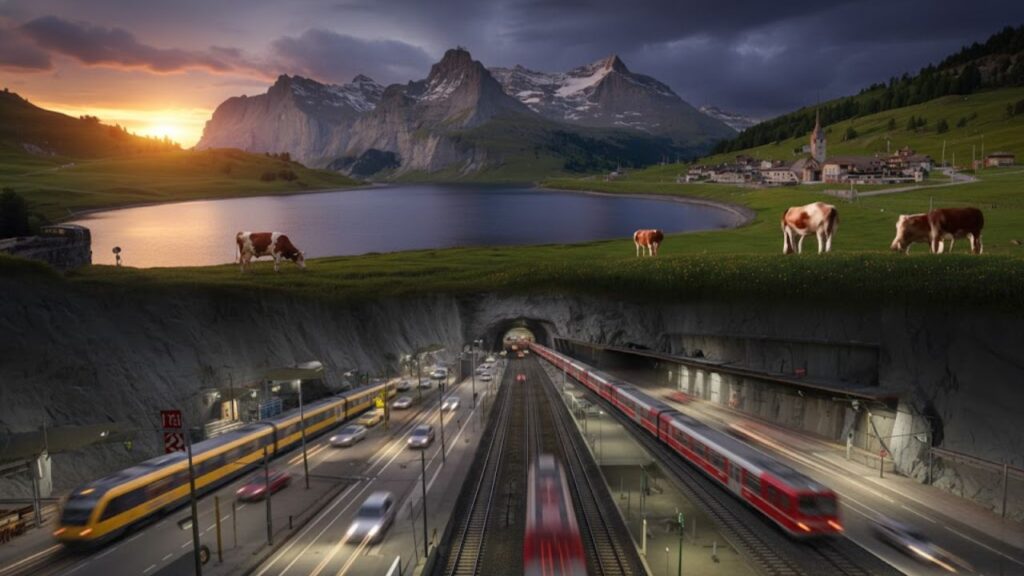
Step closer to the tunnel mouth and a stream of cold, mineral air spills out. In that moment, it feels clear: the Switzerland people imagine isn’t only on the surface anymore. Much of it lies underground.
A Nation That Quietly Moved Below Ground
Switzerland has always coexisted with its mountains, but over the past three decades, it has begun slicing through them with determination. Starting in the 1990s, the country launched a series of ambitious projects that sound almost unreal on paper: long, flat base tunnels running straight beneath the Alps, some stretching farther than many daily commutes.

Officially, it’s called infrastructure. In reality, it’s a hidden second Switzerland, stitched together in darkness, far below villages and snow-covered slopes.

The best-known example is the Gotthard Base Tunnel, often described as the longest railway tunnel on Earth. Construction began in 1996, and after nearly 20 years of drilling through solid rock, it opened in 2016. Its main tubes span about 57 kilometers, surrounded by service passages, emergency stations, cross-connections, and technical chambers branching out like a vast concrete root system.
This is no single passage. It functions as an underground district, lit by LEDs instead of streetlights and maintained by service trains rather than city crews.
Add to that the Lötschberg Base Tunnel, the Ceneri Base Tunnel, extensive suburban rail tunnels near Zurich and Geneva, bypasses under towns, and highway galleries vanishing into mountainsides for minutes at a time. Piece by piece, an invisible network has emerged, matching the surface world in scale — minus the cafés and balconies.
Turning Solid Rock Into a Hidden World
On a map, a tunnel looks like a simple line. Underground, it’s a precise dance of engineering, machinery, and patience. Swiss teams begin with seismic surveys and deep drilling, reading the mountain’s structure like a medical scan. Only then does excavation begin.
Some sections rely on massive tunnel-boring machines grinding through granite. Others advance meter by meter using controlled explosives. Every meter costs time, money, and nerve, and every fracture in the rock brings uncertainty.
At Gotthard, machines the length of a small football field operated nonstop. Inside the mountain, temperatures hovered around 40°C, with humidity so intense that clothes became soaked within minutes. Truck-sized drills ran day and night, supported by logistics systems closer to mining operations than traditional construction.
Working conditions meant spending entire shifts in fluorescent-lit tunnels, hundreds of meters from daylight, surrounded by engines, rock, and echoing breath.
Switzerland didn’t stop at straight tunnels. Engineers carved ventilation caverns as large as cathedrals, installed escape routes every 325 meters, and built underground junctions where maintenance trains can cross and switch lines. Added together, this hidden volume is immense.
If every major rail tunnel, highway tube, and service gallery were laid side by side, they would form an underground “city” larger than many real ones above ground.
Why So Much of the Country Runs Below the Surface
At first, it can seem excessive. Why not simply go over the mountains? Geography provides the answer. The Alps form a natural barrier between northern and southern Europe, and Switzerland sits squarely in the middle. Freight, commuters, tourists, and goods all need to pass through.
Moving traffic beneath the mountains is faster, safer, and quieter than forcing it over high, fragile passes.
 Goodbye Hair Dye for Grey Hair: The Conditioner Add-In That Gradually Restores Natural Colour
By shifting long-distance transport underground, villages along historic routes regain their nights. Fewer trucks mean less noise, cleaner air, and calmer valleys. Places once shaken by endless convoys slowly rediscover silence.
At the same time, base tunnels slash travel times, linking cities like Zurich and Milan in just a few hours, while high-speed freight slides safely under snow and avalanche zones.
There’s also a distinctly Swiss mindset behind it all: when horizontal space is limited, use the vertical. In a small country boxed in by mountains, lakes, and borders, underground transport frees surface land for homes, farms, and green spaces, while the noisy, polluting side of mobility disappears into rock.
How Life Above Is Quietly Transformed
Living above such a network changes daily routines in subtle ways. On a winter morning, a commuter boards a punctual train, checks messages, stares at a blank tunnel wall — and only later realizes they’ve crossed the heart of a mountain. No vertigo, no cliffs, just smooth motion.
The Alps remain dramatic, but they’re no longer obstacles. They’ve become scenery.
For residents, one of the greatest benefits is resilience. When storms close passes or heavy snow blocks roads, base tunnels continue operating below. Food arrives, mail moves, and families still travel across the country.
Anyone who’s faced a sudden road closure knows how quickly a short trip can turn into hours. In much of Switzerland, the backup route is already running — hundreds of meters underground.
Feelings about this hidden world are mixed. Many barely think about it, treating tunnels like tap water — essential but invisible. Others feel a quiet unease imagining the vast man-made space beneath their homes.
As one retired engineer from Uri put it, “Sometimes I look at the mountain and imagine all the holes we’ve drilled into it. It’s like living on the roof of a factory you almost never see.”
A Country Within a Country
From space, Switzerland appears as peaks, valleys, green plains, and orderly cities. From a control room, it looks like a web of lines, sensors, tunnels, and galleries, each monitored for the slightest vibration in the rock. Somewhere between those views lies the truth.
By carving through solid stone for nearly 30 years, Switzerland hasn’t just built shortcuts. It has created an underground system that rivals surface cities in size and complexity — yet demands almost nothing visually. No skyline. No postcard. No viral photo.
It exists so that daily life above can remain simple.
The next time you glide under a hill or cross a border without noticing, it’s worth remembering this quiet underworld — where trains race through stone, workers drink coffee in neon-lit caverns, and systems hum through the night so the rest of the country can sleep.

Key Takeaways
- Scale of the network: Decades of excavation created an underground system comparable to entire cities, revealing how much of modern life runs out of sight.
- Engineering strategy: Straight base tunnels beneath the Alps show how long-term planning can overcome extreme geography.
- Everyday impact: Quieter valleys, faster travel, and reliable transport directly improve comfort and mobility.
