
The banana peel was still resting there, half-hidden in the flowerbed, when the neighbor leaned over the fence with a raised eyebrow. “Trying to feed the roses?” she asked, sounding equal parts amused and concerned. The soil looked exhausted, the leaves lacked shine, and that bright yellow peel felt more like a last-ditch attempt than a real plan.
Most gardeners recognize that moment. You’re standing over a struggling plant and suddenly remember the old advice: banana peels are good for the garden. So you drop the peel, smooth the soil, and quietly hope for a small miracle.
A few days pass. Nothing really changes.

That’s when the story shifts, because with banana peels, results depend entirely on where you place them.

Banana Peels Everywhere — Except Where They Actually Help
In almost any community garden, the same scene repeats itself: a banana skin tossed onto bare soil, a peel tucked under a tomato plant, or one slowly decomposing beside a balcony pot. The intention is generous. The method, far less effective.
Banana peels truly do contain potassium, along with small amounts of phosphorus, calcium, and magnesium. On paper, they look like an ideal natural fertilizer. In practice, when scattered randomly, they behave more like slow-moving waste than plant food.
Plants don’t grow on slogans. They grow on nutrients their roots can actually reach.
A retired teacher on my street used to swear by banana peels for his roses. One spring, he cut them into large chunks and laid them directly on the soil surface, proud of his “organic method.” Two weeks later, the peels had turned stiff and dry, the soil hadn’t improved, and the roses looked exactly the same. The only winners were the ants.
The following year, he changed his approach. Same roses. Same bananas. This time, he dug a shallow circular trench about 10–15 cm away from the stems, buried the chopped peels, and watered thoroughly. By midsummer, he was proudly showing off thick, velvety blooms to anyone passing the gate.
- Winter storm warning issued as up to 70 inches of snow could fall in a single, rare event
- Nine habits to keep at 70 if you want people to say, “I hope I’m like that someday”
- Why dogs offer their paw, according to animal behavior experts
- A 7,000-year-old stone wall discovered off the coast of France may date back to hunter-gatherers
- State pension cut approved with a $140 monthly reduction starting in February
- Bill Gates’ retirement lesson from working at his daughter’s startup
- New €135 fine announced for unauthorized rainwater use by gardeners from February 3
- Switzerland’s underground tunnels now form an infrastructure larger than many cities
Same peel. Different location. Completely different outcome.
The explanation becomes obvious once you imagine what’s happening below the surface. Roots don’t sit right at the base of the plant. They spread outward, forming an invisible zone where water and nutrients are absorbed. That active nutrient ring is exactly where banana peels make a difference.
Left on top of the soil, peels dry out, rot unevenly, or attract pests. Buried too close to the stem, they can ferment and stress the plant. Placed in the correct ring, they slowly release potassium right where roots are ready to take it in.
The peel isn’t the secret. Placement is.
 Goodbye Hair Dye for Grey Hair: The Conditioner Add-In That Gradually Restores Natural Colour
The Exact Nutrient Ring Where Banana Peels Belong
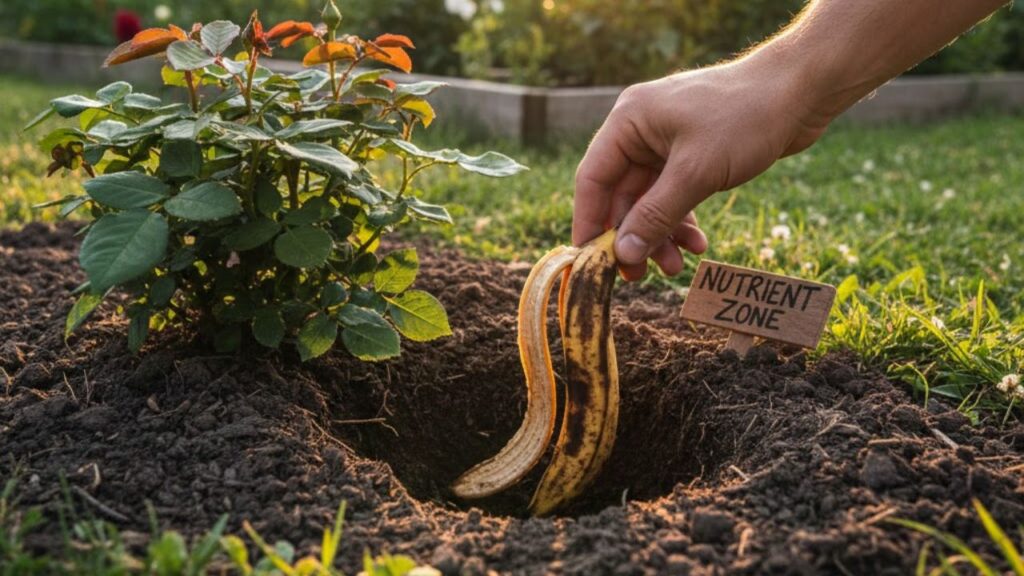
The most effective spot for banana peels isn’t at the plant’s base and it isn’t scattered randomly. It’s in a shallow trench along the drip line — the circle on the ground beneath the outer edge of the foliage. For roses, tomatoes, or potted citrus, this usually sits 10 to 20 cm from the stem.
Dig a groove about 5–8 cm deep following that line. Add finely chopped banana peel pieces, roughly thumb-sized. Cover them with soil and water to start decomposition. From above, it looks unremarkable — and that’s exactly the point.
Roots grow toward that slow release of nutrients, not toward a dried peel baking in the sun.
This is where many well-intentioned gardeners go wrong. They toss a whole peel under a plant and expect visible growth within days. Large peels break down slowly, especially in dry soil, attracting insects or rodents. Burying them too deep isolates them from active roots, while pressing them against the stem can encourage rot.
Cutting, spacing, and respecting the nutrient ring may lack online drama, but plants respond to that quiet accuracy.
Garden designer Léa Martin explained it simply during a workshop: “Banana peels don’t work because they’re bananas. They work because you respect how roots live and spread.”
- Cut peels small: Chop into tiny pieces so microbes and earthworms can break them down faster.
- Bury in a shallow ring: Place peels about a hand’s width from the stem in a 5–8 cm trench.
- Use as a supplement: Banana peels support compost, mulch, and healthy soil — they don’t replace them.
- Avoid surface placement: Peels left on top dry out, attract pests, and feed roots poorly.
- Space applications: Every 3–4 weeks during the growing season is usually enough.
Banana Peels, Small Rituals, and Watching Plants More Closely
Once you start placing banana peels in that precise ring, something else happens. You slow down. You walk around the plant. You notice new buds, pale leaves, or dry soil you might have missed before. The peel becomes a reason to observe more carefully.
Some gardeners report deeper green leaves or sturdier stems over time. Others simply enjoy knowing their kitchen scraps have a purpose. It becomes a small, almost childlike ritual linking the kitchen to the garden.
Of course, banana peels won’t save a plant starved of light or left completely dry. They support growth gently — they don’t perform miracles. In compacted or lifeless soil, their impact remains limited.
The real lesson behind the “exact spot” is simple: plants feed at their roots, not at our convenience. When that rule is respected, even a humble banana peel becomes a useful tool rather than a gardening myth.
You might begin with a single rose or tomato plant. Over time, the habit spreads quietly, ring by ring, across the garden.

Key Takeaways for Gardeners
- Correct placement: Bury chopped banana peels in a shallow ring under the drip line to maximize nutrient uptake and avoid pests.
- Proper preparation: Cutting peels small and covering them with soil speeds decomposition and nutrient release.
- Supportive role: Banana peels work best as a gentle addition alongside compost, mulch, and balanced soil care.
