
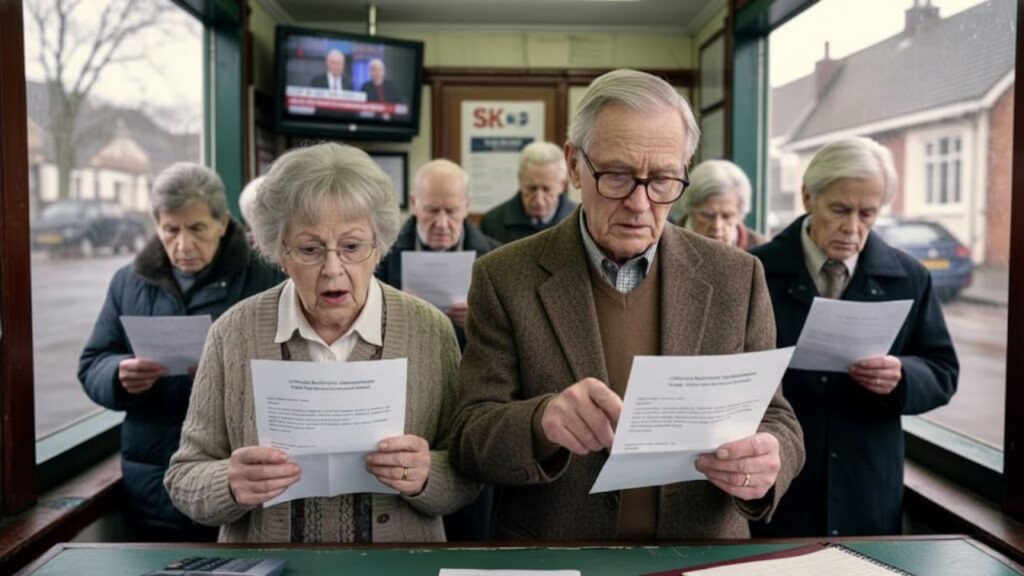
On a dull Tuesday morning in late January, the line outside a post office in a small Midlands town moved more slowly than usual. People spoke softly, holding letters from the Department for Work and Pensions, folding and refolding the same page until it felt thin. Some glanced at the television in the corner, where a news ticker repeated the update: a state pension cut formally approved, with payments set to fall by up to £140 a month from February.
The reality of losing £140 from a monthly pension
You rarely feel a policy decision until it arrives at your own front door. On paper, the wording feels remote: “adjustment”, “alignment”, “recalculation”. Then the figure appears – £140 less each month – and it suddenly becomes very real. It’s the heating bill, the weekly food shop, the bus fare to see family.
All across the UK, pensioners are discovering this reduction as February award letters arrive. For many, that single page marks the line between managing and beginning to fall behind.

Margaret, 72, from Sunderland, has lived in the same council flat for nearly forty years. She has always taken pride in paying her way. Her state pension was never generous, but it covered the essentials. Then she read the revised amount at her kitchen table: £35 less each week.

That’s close to £140 a month gone, lost to a change she never voted on and barely understood. She opened her old notebook, where her weekly budget lives. Slowly, familiar entries blurred: Sunday meat, the small pleasure of a magazine, the occasional taxi on icy mornings. On the radiator hung a note from her granddaughter reading, “Love you Nana, stay warm.” This time, it hurt to look at.
Why these pension reductions are happening
Behind the cut sits a complex mix of qualifying years, uprating formulas, and how different parts of the state pension are calculated. Official explanations mention “correcting historical anomalies” and aligning payments with contribution records. Outside of paperwork, it simply feels like a pay cut for people who have no way to earn it back.
For some, the £140 reduction comes from the removal of a specific top-up or adjustment that had quietly increased their pension. For others, it’s linked to how protected payments are being phased or recalculated under newer rules. The reality is simple: most people had no warning until the envelope arrived.
Steps to take if your pension payment has been reduced
Once the initial shock fades, a practical question takes over: what now? While you can’t personally reverse an approved policy decision, you can question how it has been applied to you. The first step is unglamorous, but essential.
Related topics people are reading right now
- Total solar eclipse set to bring over six minutes of darkness, the longest until 2114
- How Bill Gates’ retirement work at his daughter’s startup reshaped leadership thinking
- Six habits of grandparents who are deeply loved by their grandchildren
- The 2026 home design trend replacing kitchen islands with something more practical
- Using banana peels in the garden and where they actually help plants
- Why people mix baking soda with hydrogen peroxide and what it really does
- How planting over one billion trees has slowed desert expansion in China
- Astronomers confirm the date of the longest solar eclipse of the century
Start by gathering your latest pension letter, your National Insurance record, and any older paperwork. Sit down with a pen and highlight each line. Compare your previous payment with the new amount and identify exactly which part has been reduced. This careful review is the basis for any appeal, complaint, or request for clarification you make to the DWP.
Many people feel embarrassed admitting they don’t understand how their pension is worked out. Don’t. The system is notoriously complex, built layer upon layer over decades. Even professionals often need to double-check the rules. Feeling confused isn’t a personal failing – it’s a feature of the system.
The biggest mistake is putting the letter away and trying not to think about it. That’s how deadlines are missed and support goes unclaimed. This is the moment when another pair of eyes helps most. A friend, an adult child, or a Citizens Advice adviser can sit with you and say, “Let’s go through this together.”
 Goodbye Hair Dye for Grey Hair: The Conditioner Add-In That Gradually Restores Natural Colour
Why asking for help can make a real difference
Alan, 69, from Cardiff, explains: “I felt foolish asking what the different parts of my pension meant. Then the adviser spotted that one of the reductions was an error. If I’d stayed quiet, I would have lost over a thousand pounds this year.”
Those who manage best after a cut are rarely the ones with the biggest savings. They are the ones who act early, seek advice, and use every option available. Turning a frightening letter into a checklist can make it manageable:
- Contact the DWP and request a written breakdown of your new pension calculation.
- Ask for a full State Pension forecast and compare it with your current payments.
- Speak with Citizens Advice or an independent pensions adviser about possible errors or missing entitlements.
- Check whether you now qualify for Pension Credit, Housing Benefit, or council tax support.
- Contact your energy supplier to ask about additional support or special tariffs.
The quieter cost of living on less
What official statements rarely acknowledge is the emotional cost of a shrinking income. You don’t just cut figures on a page; you cut moments of daily life. The evening bath, fresh fruit instead of tins, a short bus trip just to get out of the house. Each choice seems small. Together, they narrow life.
There is a quiet grief in watching the retirement you imagined turn into a list of compromises.
Some respond with anger, others with careful planning, others with tired acceptance. None of these reactions is wrong. What matters is being honest about the impact. A £140 monthly loss cannot always be absorbed with a few minor tweaks.
Talking openly about money can ease the weight. A family member quietly adds to the weekly shop. A neighbour suggests sharing transport. A local community space keeps the kettle boiling and the heating on. These gestures don’t undo a policy decision, but they soften its edges.
You might feel angry, exhausted, or numb when you look at your reduced pension. All of that is valid. At the same time, a wider conversation is happening across the country about what kind of retirement people deserve after decades of work and care.
Policy often feels distant, but its effects are deeply personal. For some, £140 less means fewer extras. For others, it means heating one room or skipping fresh food. Between those realities sits a difficult question: how much risk are we willing to place on those least able to change their circumstances?

Key takeaways at a glance
- Understanding the reduction: Knowing exactly where the £140 cut comes from helps you spot mistakes and assess whether a challenge is possible.
- Getting help early: Contacting the DWP and advice services reduces the risk of losing money you may still be entitled to.
- Adapting day to day: Small budgeting changes and shared support can make the reduction easier to live with.
