The first time I saw the plans, they were spread across a metal table inside a loud port office, the paper edges curling from the salty air. Outside the window, cranes groaned above container ships while a gray, restless sea rolled in. Inside, two engineers in orange jackets traced a thin dotted line that vanished beneath the ocean and calmly said, “This section is already under construction.”
I blinked, instinctively waiting for a joke.
A railway running under thousands of meters of water, linking one continent to another, felt less like a tunnel and more like a buried spacecraft.

On their laptops, a rotating 3D model revealed seabed ridges, drilling heads, and pressure chambers — visuals that looked like science fiction concept art.

An Underwater Rail Line Moves From Vision to Reality
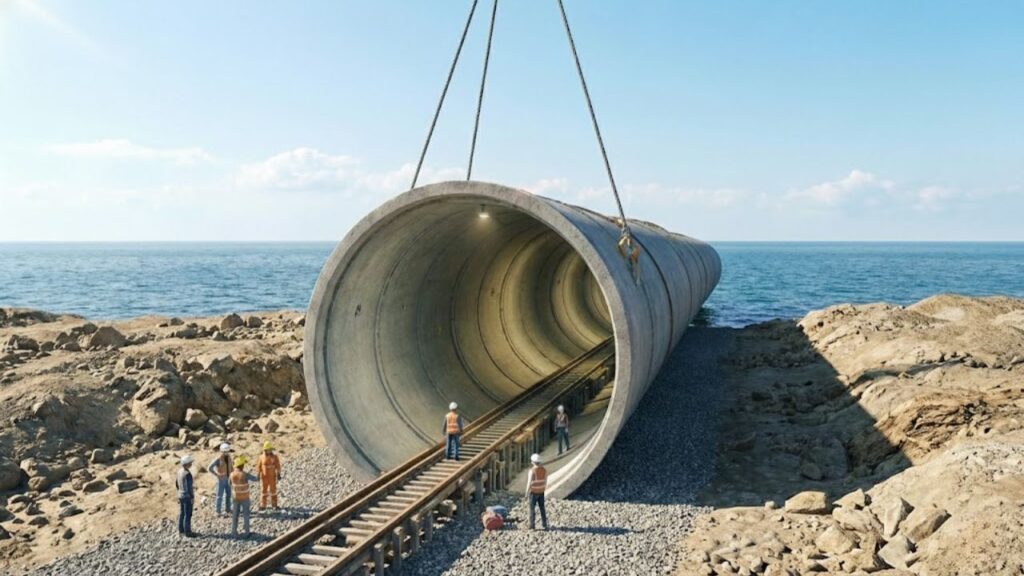
At a dry dock on a windswept coastline, the future of intercontinental travel currently resembles a long, dull gray cylinder resting on its side. Workers move along it with welding torches, sparks skittering into shallow puddles. Nothing about it suggests that this massive tube will soon be lowered into a seabed trench and locked to the next segment with millimeter-level precision.
Ask the engineers, and they’ll say it without hesitation: this is no longer a prototype — it’s a supply chain.
Concrete caissons arrive by barge. Robotic survey vessels sweep the water above. Deep-sea ROVs crawl through the trench like mechanical crustaceans.
Inside a temporary control room, large screens slowly illuminate the route between two continents, segment by segment, as the tunnel takes shape.
- At 2,670 meters below the surface, a military discovery sets a new archaeological benchmark
- After three decades of rock carving, Switzerland has created underground infrastructure larger than many surface cities
- Why baking soda and hydrogen peroxide are commonly combined — and how they’re used
- New diabetes care breakthroughs hint at a major medical shift
- How to attract owls to your yard and why timing matters
- France commits €1.1 billion to a European detection system with 550 km range
- 9 habits at 70 that still define strength and independence
- State Pension cut approved with a $140 monthly reduction starting February
The Scale and Intelligence Built Into the Tunnel
The figures behind the project sound almost unreal. The tunnel will extend for dozens of kilometers beneath the sea, in places buried under layers of silt and engineered backfill to shield it from anchors and seismic movement. Sensors will be embedded everywhere — in concrete walls, along the rails, and inside drainage systems — all sending real-time data to surface control centers.
Engineers call it “a living tunnel”, one that constantly communicates, adjusts, and responds.
One project manager showed a graph tracking seabed movement in fractions of a millimeter. Next to it, another display monitored oxygen levels inside maintenance shafts.
The goal isn’t just to set records. It’s to prove that a deep-sea rail corridor can operate as calmly and predictably as a city metro, regardless of what the ocean is doing above.
Why Build Beneath the Ocean at All?
The reasoning behind the complexity is straightforward. Air travel is crowded, costly, and easily disrupted. Shipping is slow and environmentally heavy. Meanwhile, intercontinental cables already cross the seabed, carrying global data through strands of glass.
The next step is moving people along similarly hidden routes.
Engineers point out that tunnels are safer than bridges, less exposed to storms and political boundaries. Governments see strategic value in a protected, high-capacity link capable of moving passengers, freight, and even emergency supplies when airspace closes.
From an energy perspective, electric trains traveling a flat, shielded route can significantly reduce emissions compared to long-haul flights.
Backers imagine a future where you leave one major city at dusk, sleep through the crossing, and arrive on another continent without ever leaving solid ground.
How a Railway Is Built Beneath the Sea
Technically, the approach is surprisingly modular. Instead of boring one endless tunnel, engineers pre-fabricate massive tube sections in enormous dry docks. Each segment is fitted with rails, power systems, and safety infrastructure before touching water.
Once complete, floating platforms tow a section to its exact position. Ballast tanks fill, and the segment sinks slowly, guided by GPS and winches with extraordinary accuracy. Divers and remotely operated vehicles verify seals, robots inject grout, and the next piece is brought in.
Piece by piece, a continuous tunnel grows along the seabed, much like extending a toy train track across a room.
 Goodbye Hair Dye for Grey Hair: The Conditioner Add-In That Gradually Restores Natural Colour
On site, the toughest challenges aren’t theoretical — they’re human. A connector slightly off alignment. A cable labeled in the wrong language. A storm arriving a day early and halting operations offshore.
Veterans speak openly about this reality. There’s no glamour in night shifts inside steel cabins, endless documentation, or safety drills. Nobody pretends every manual is memorized line by line.
Instead, teams rely on checklists, simulations, and flat hierarchies, where even a junior technician can halt work if something feels wrong.
One engineer pointed to photos of past mistakes pinned to a wall, not as blame, but as a reminder that “the sea won’t forgive our ego.”
On a whiteboard nearby, a handwritten note stood out, underlined twice:
“We’re not fighting the ocean. We’re negotiating with it.”
Beside it hung a simple checklist for newcomers:
- Know your role, and learn the one beside it
- Ask one “stupid” question daily — and answer one patiently
- Stop work if something feels wrong
- Remember: a quiet shift is a successful shift
Amid massive budgets and national flags, this modest list may be the tunnel’s true backbone.
Redefining Distance, Borders, and Risk
Once operational, this underwater rail line will quietly redraw what feels near and far. Overnight journeys that once meant cramped cabins and jet lag could become something closer to a long train evening — a meal, a bunk, a half-finished book.
Business routes may shift from air to seabed. Cities once considered distant could begin to feel like neighbors separated only by time.
We’ve all watched digital maps zoom out until borders fade. This project turns that abstraction into physical reality.
Debates will follow — over cost, access, and environmental impact. Some will never feel comfortable traveling inside a sealed tube beneath thousands of tons of water, regardless of safety data.
Others will accept it as naturally as today’s subway, barely noticing the pressure above.
What stands out is how many ambitions converge on a single line: faster trade, cleaner transport, new tourism routes, and scientific access to the deep sea.
The tunnel is still being welded, sunk, and aligned — not a finished showcase, but a living construction site. Yet with each new segment placed on the seabed, the world feels a little smaller.
You may never ride this train.
Still, knowing that continents can be quietly stitched together beneath the ocean has a way of lingering — the next time you book a flight, or stand on a beach staring at the horizon, wondering what’s taking shape just beyond sight.

Key Takeaways
- Deep-sea tunnel underway: Prefabricated segments are already being assembled on the seabed, proving the project is real and active
- A new way to cross continents: Electric trains will run through a pressurized rail tunnel beneath the ocean
- Safety by design: Dense sensor networks, redundant systems, and modular construction keep risks comparable to standard rail travel