There is no rumbling boiler, no humming heat pump, and no hidden burner ticking away inside a metal box. Instead, there’s only a soft gurgle of water and the faint crackle of sun-warmed pipes, stretching like silver vines across the roof of an aging farmhouse at the edge of town.
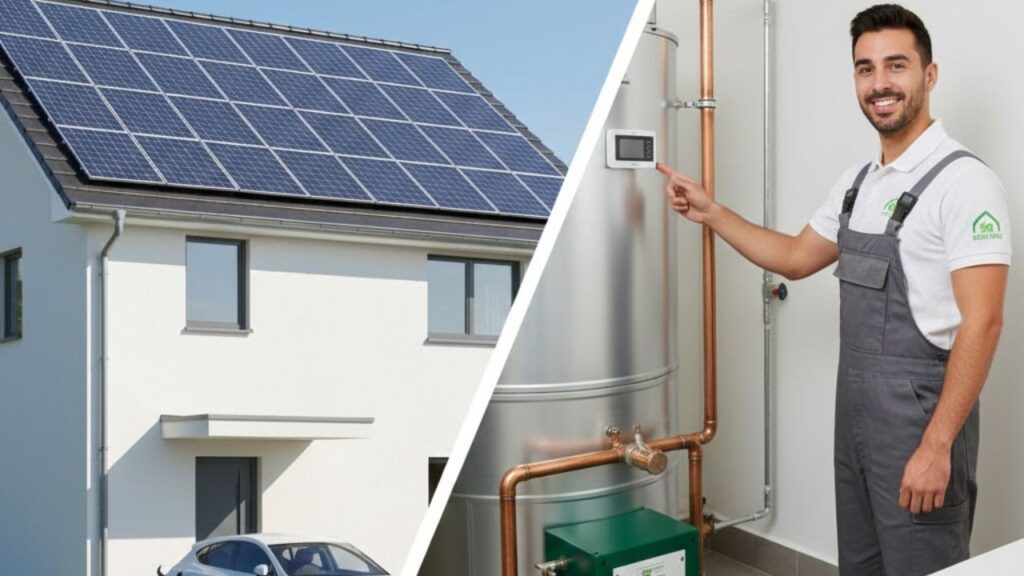
Inside, the shower comes alive. A thermometer near the storage tank climbs past 60°C. The homeowner, lean and weathered, glances at the gauge with a grin that mixes pride and quiet amusement. “About 3,000 liters today,” he says casually.
Just a homemade system that transforms daylight into hot water, day after day.

The surprising part? He insists that with enough patience, almost anyone could replicate it.

A Tinkerer Who Heats Water Using Only Sunlight
He calls himself a tinkerer, not an engineer.
Martin, 47, once spent more on heating than on groceries for his family of four. When energy prices surged a few winters ago, he didn’t vent online. He went into his barn, rolled out old graph paper on an unsteady workbench, and started drawing.
Six months later, his roof held 40 square meters of DIY solar collectors. In the basement sat a salvaged 3,000-liter storage tank, connected by a network of insulated pipes. His electricity meter barely moved. The oil tank stayed untouched. Hot showers became routine.
The Logbook That Makes It All Believable
The numbers sound unbelievable until you see his notes. Every evening, Martin records temperatures from the roof inlet and outlet, plus the top and bottom of the storage tank. On clear summer days, the tank often reaches 70°C, holding thousands of liters of hot water for showers, dishes, laundry, and even light underfloor heating on cooler nights.
Cloudy days reduce output, of course. In deep winter overcast, the system may only reach 30–35°C, enough for lukewarm showers and preheated tap water. The massive tank acts as a thermal battery, smoothing out fluctuations. “The goal isn’t perfect sunshine,” he explains. “It’s storing good days long enough to survive the bad ones.”
Simple Components, Game-Changing Scale
There’s nothing mystical about the setup: flat-plate solar collectors, a closed fluid loop, a heavily insulated tank, and pumps and gravity doing their jobs. What makes the difference is how he sized everything.
Instead of choosing the smallest kit available, Martin went bigger almost everywhere. More collector area. Larger storage. Thicker insulation. That’s why producing 3,000 liters of hot water a day doesn’t feel exaggerated once you see it running.
He doesn’t sell plans or miracle devices. He simply combined three low-tech ideas: capture as much sunlight as possible, lose as little heat as possible, and trade money for time, scavenging, and trial and error instead of a hefty invoice.
How the No-Fuel Hot Water System Works
At the core of Martin’s setup is a straightforward loop.
On the roof, black metal absorbers sit behind glass inside insulated frames. Copper pipes inside carry a glycol-water mixture. When sunlight hits the collectors, the fluid heats up and flows down toward the basement. A small circulation pump, powered by its own solar panel, switches on only when the collectors are warmer than the tank.
In the basement, that hot fluid passes through a coil inside the 3,000-liter tank, transferring heat to the household water without mixing. The cooled fluid then returns to the roof, ready to repeat the cycle as long as there’s daylight.
Learning the Hard Way
It’s tempting to romanticize the system until you hear about the early mistakes. At first, Martin miscalculated pipe sizes, and the first sunny day turned his setup into a steam machine. A pressure relief valve burst open, hissing as hot fluid spilled onto the gravel outside. That night, he reworked the pipes, added another expansion vessel, and increased safety margins.
 Goodbye Hair Dye for Grey Hair: The Conditioner Add-In That Gradually Restores Natural Colour
He keeps every failed fitting and scorched hose in a cardboard box. “This,” he says, holding up the pile, “is my real instruction manual.”
Why Scale and Storage Matter
Reaching those numbers isn’t magic. It’s the result of scale and storage. Forty square meters of collector area can harvest immense energy on long summer days. When combined with a huge insulated tank, short bursts of midday sun turn into reliable evening showers and next-morning hot water.
The system is intentionally simple. No apps, no cloud connections, no complex controllers. Just a differential thermostat, a few sensors, a small pump, and lots of insulation. Simple systems fail more slowly.
Could You Build Something Similar?
Martin believes you don’t need genius-level skills to adapt the idea. His advice starts small: a few square meters of solar thermal panels, a 300–500 liter tank, and good insulation can already cut hot water costs dramatically.
He recommends three steps: evaluate your roof’s orientation and shade, track your household’s hot water use for several weeks, and consult a plumber with real solar thermal experience. From there, decide whether to go DIY, partially DIY, or fully professional.
Common Mistakes to Avoid
The biggest mistake, he says, is copying the dream instead of the logic. People buy sleek, undersized kits or poorly matched systems, then abandon them when they don’t perform as expected. A year later, the panels remain on the roof, but the system is switched off.
Insulation is often overlooked. Even the best collectors won’t help if heat escapes through poorly insulated pipes. That’s why Martin wrapped his tank so thoroughly it resembles a giant yellow marshmallow.
“Everyone asks about the collectors,” he says. “Almost nobody asks about the tank, the insulation, or the safety valves. That’s what determines whether a system lasts decades or fails in a few years.”
Practical Principles to Follow
- Start with an energy audit: Know your actual hot water use before sizing anything.
- Think storage first: A well-insulated tank buffers cloudy days and winter dips.
- Keep it simple: Basic controls and clear layouts reduce long-term issues.
- Prioritize safety: Pressure relief valves and expansion vessels are essential.
- Plan for maintenance: Easy access and clear monitoring matter over time.
A Quiet Revolution Below the Stairs
Walking up from Martin’s basement feels strangely grounding. There’s no futuristic glow or massive display. Just a large insulated cylinder, the occasional click of a small pump, and warm pipes that feel gently alive. Outside, the only visible sign of innovation is a patch of dark glass on the roof, quietly catching sunlight.
Martin isn’t chasing off-grid perfection. He simply got tired of fearing every energy price update. His hot water isn’t completely free — it required parts, time, and mistakes — but the ongoing cost is now close to zero.
What This Means in Practice
Oversizing works: Large collectors and big storage smooth out cloudy periods, delivering a more stable hot water supply.
Insulation matters most: Properly insulated tanks and pipes prevent heat loss and improve long-term returns.
Simplicity lasts: Basic controls and robust safety components lead to easier maintenance and longer system life.