
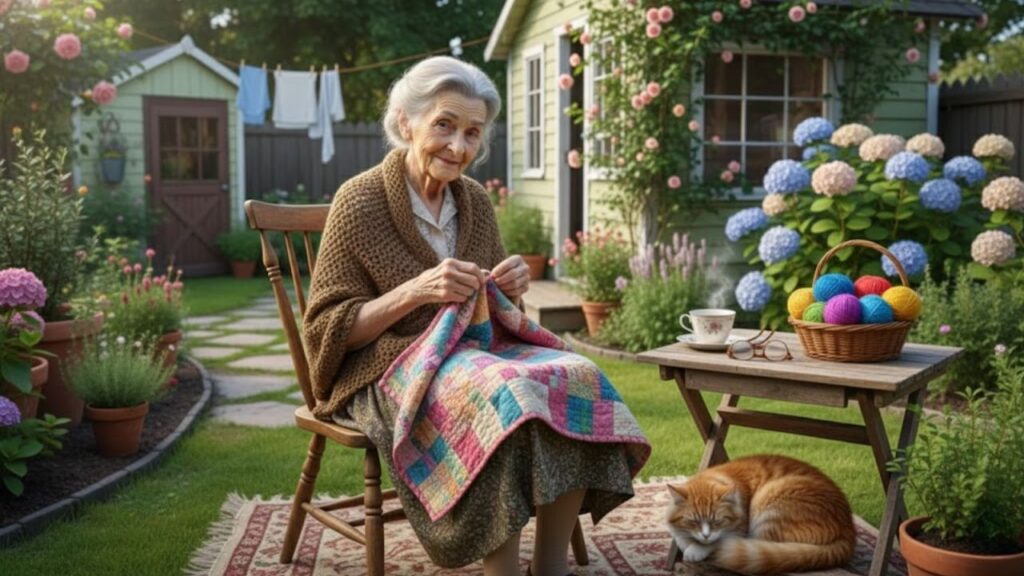
The first time you notice her, her age doesn’t register. She sits on a wooden chair in a narrow backyard, snapping green beans into a metal bowl as sunlight traces the deep lines on her hands. An old jazz tune hums from the radio, and a cat loops around her ankles with the ease of habit, as if she were 30, not 100.
Inside, the kitchen table holds a small pile of unopened letters from the local retirement home and a tidy stack of hospital appointment slips. She has pushed them aside to make room for her crossword.
“Doctors are good for broken bones,” she scoffs. “Not for living.” Then she leans closer and adds something that feels almost rebellious in 2026: she believes her everyday habits matter more than prescriptions.
Her name is Marianne. She turned 100 last spring and has declined the retirement home brochure three times this year. Each visit follows the same script. A social worker arrives, smiles kindly, and talks about comfort, safety, and supervision.

Each time, Marianne listens, thanks them, and goes back to her garden.
She still sleeps in the bedroom she once shared with her late husband. She cooks her own soup, walks to the bakery with a cane she calls “pure theatre,” and insists on hanging her laundry herself.
“I don’t want strangers deciding when I eat or nap,” she says. “That’s when you start getting old.”
Statistically, she is an outlier. In many countries, more than half of people over 85 live in some form of assisted care, and by 100 the numbers rise sharply. The familiar story repeats itself: age becomes fragility, fragility becomes medicine.
At her slightly wobbly kitchen table, Marianne offers a different equation. She talks about her routines the way others list medications: morning sunlight on her face, a strong coffee with too much sugar, and a slow daily walk, even when the wind bites.
- An exceptionally strong February polar vortex disruption is approaching
- Experts warn of a rare and unusually intense winter anomaly
- Common phrases deeply selfish people use without noticing
- €5,000 a month and free housing to live on a remote Scottish island
- A new kitchen device touted as the microwave’s replacement
- Why productive people often stop tracking one obsessive metric
- Why kitchen islands are disappearing in 2026 home design
She still swears by her weekly card game with neighbors, where the loudest remedy is laughter and a bit of harmless cheating.
Watching her day unfold, one thing stands out. There is rhythm, not obsession. She wears no smartwatch, weighs no food, and doesn’t scroll through health advice at night.
Her skepticism isn’t anti-science; it’s about not surrendering control. She watched friends hand over every decision to clinics and corridors. They stopped cooking because “the diet said so,” stopped walking because “the knee might hurt,” stopped socializing because they were tired.
“Doctors started telling them how to live,” she says, “not just how to survive.”
The habits she trusts (and what they quietly change)
Ask Marianne what keeps her out of a retirement home and she doesn’t mention genes or miracle supplements. She points to small, almost boring routines.
She wakes around the same time each day, opens the window even in winter, and takes a few long breaths of cold air. “It reminds the body it still has a job,” she says. She washes, gets fully dressed, and treats the day as something worth showing up for.
No pyjama days. No eating on the go. She sits down for every meal, sets a plate, a glass, and a real napkin. These old-fashioned rituals quietly keep her mind, balance, and dignity engaged.
Her movement is not modern exercise. No apps or targeted programs. Her rule is simple: don’t let the body stay idle.
She waters plants with a slightly heavy can. She climbs the stairs slowly but carries something each time. She peels her own vegetables, even when it takes longer.
“If you can stand to do it, don’t sit,” she says. “If you can walk to it, don’t send someone else.” That blunt rule is why her legs still remember their work.
 Goodbye Hair Dye for Grey Hair: The Conditioner Add-In That Gradually Restores Natural Colour
Her resistance to doctors is more measured than it appears. She goes when it matters. She had her hip checked after a fall. She takes a small pill for blood pressure. She owns strong prescription glasses.
What she refuses is the endless loop of appointments, tests “just to check,” and treatments for every minor ache. She would rather tolerate some discomfort than live in waiting rooms.
For her, habits are the first line of care, and medicine is the backup. She doesn’t reject doctors; she refuses to become only a patient.
How to borrow a few pages from her playbook
The surprise is how transferable her approach is. None of it requires a century of experience.
Start with one simple act you promise not to delegate as long as you can manage it. Make your coffee. Take out the trash. Walk to buy bread instead of ordering it.
This small, non-negotiable task becomes a quiet anchor. It reminds you that your body and autonomy still count, even when life feels crowded.
Many of us fall into a trap with stories like Marianne’s. We try to copy everything, fail quickly, and feel worse.
Her life isn’t a checklist. It’s a tune adjusted over 100 years. The real lesson is gentler: reduce unnecessary dependence before it settles in. Don’t stop doing things simply because you’re tired if convenience is doing most of the work for you.
Professionals can guide you. They don’t need to script every hour.
When asked what she would say to younger people, Marianne paused and looked out the window.
“Live so that when you’re old,” she said, “your body knows your habits better than your pills. Doctors fix you when you’re broken. Habits slow the breaking.”
- Move a little every day, even when motivation is low
- Prepare at least one simple meal with your own hands
- Speak to someone who knows your name, not your chart
- Step outside briefly and feel the weather on your skin
- Decide one thing each day that no one else controls
What her stubbornness quietly reveals
Watching a 100-year-old woman argue that doctors are overrated doesn’t produce a neat moral. She still needs check-ups. She still carries a medication list in her purse. She knows she is not invincible.
What her life questions is our habit of medicalizing aging too early, of filling every gap with expert care. Her refusal of a retirement home is also a refusal to be reduced to diagnoses.
Her story shines a light on compromises we make much sooner: meals replaced by delivery, walks skipped for convenience, nights spent reading health advice instead of sleeping.
She isn’t saying doctors are useless. She’s saying they can’t replace the thousands of daily choices about how we move, eat, rest, and connect.
Her habits don’t guarantee a long life. Nothing does. They simply ask a sharper question: if you stripped away appointments, apps, and advice, would your daily life still be taking care of you?
The real shock isn’t that a 100-year-old woman refuses a retirement home. It’s noticing how early many of us retire from our own bodies.

- Habits as first medicine: daily movement, simple meals, steady routines, and real social contact
- Selective trust in doctors: using care for real problems without turning life into a case file
- Protecting autonomy early: keeping non-negotiable tasks builds resilience for later years
