
The meeting room was nearly packed, yet no one spoke. Instead of conversation, there was scrolling—Slack messages, emails, phone screens. One project manager stared at a spreadsheet while ChatGPT quietly completed half the data. A designer typed prompts into Midjourney rather than opening Figma. At the end of the table, the intern had already finished tomorrow’s social posts after an AI tool generated six versions in under a minute.
The technology itself wasn’t the strange part. The silence was.
It carried that uneasy mix of excitement and anxiety you feel when something major is shifting beneath your feet, and you’re not sure whether you’re standing in the right place.

Between the jokes about robots taking over and the rush to use them, a difficult question lingered in the room.

What if Elon Musk and Bill Gates are right—and our jobs are what disappear?
A Future Where Work Shrinks and Time Expands
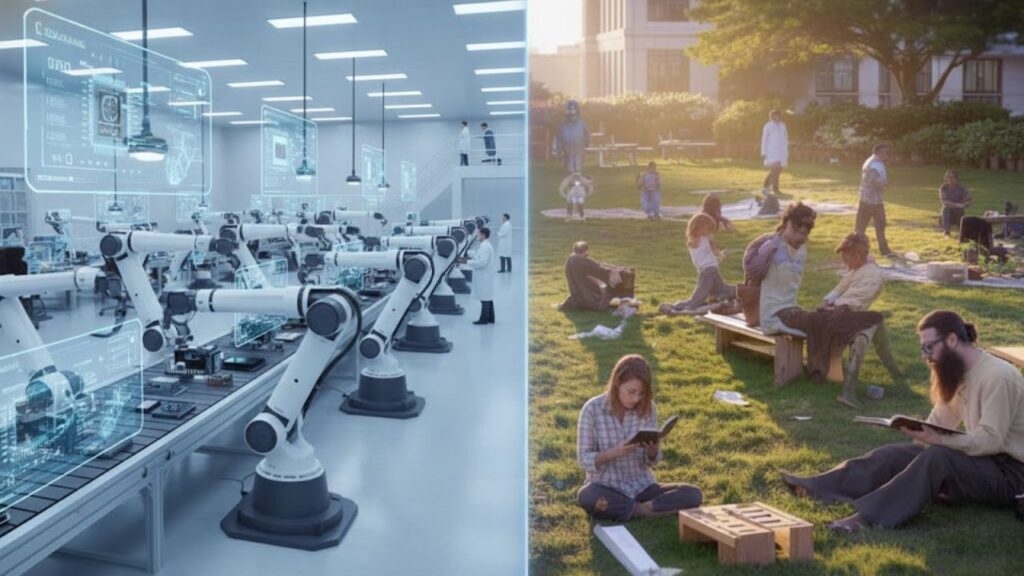
When Nobel Prize–winning physicist Giorgio Parisi echoes this concern, people take notice. The Italian scientist, famous for studying complex systems, recently reinforced a point Musk and Gates have repeated for years: AI is likely to eliminate a large share of traditional jobs while leaving society with far more free time than ever before.
On paper, it sounds ideal. Four-hour workdays. Three-day workweeks. Productivity stays high, and money continues to circulate.
Yet the first emotional response for many isn’t relief. It’s discomfort.
Free time feels appealing until it starts to resemble unemployment rather than leisure.
The early signs are already visible. Copywriters see ChatGPT answering client requests faster than they can. Customer support agents notice bots resolving tickets before their shifts even start. Radiologists read studies showing AI matching human performance on X-rays.
At one U.S. bank, dozens of back-office roles quietly vanished after AI tools were introduced and workflows were “reorganized.” No mass layoffs occurred overnight. Instead, tasks were automated piece by piece until full-time roles no longer seemed necessary.
Most people recognize that moment—when your job description begins to look uncomfortably similar to a software feature list.
It becomes hard to ignore the future when you realize that much of what fills a 40-hour week could, in theory, be done in four.
Why Musk, Gates, and Parisi Sound Alike
Parisi’s view aligns closely with predictions from Musk and Gates. Musk often describes a future where AI can perform nearly any human job. Gates frames AI as a digital co-worker that handles repetitive and tedious tasks.
From a physics perspective, Parisi sees society as a vast system seeking equilibrium. If AI dramatically increases productivity, the same level of wealth can be produced with less human labor. That leads to shorter workweeks, smaller teams, or both.
The technology already points in that direction. Chatbots that never sleep. Code assistants that don’t need breaks. Machines that don’t call in sick.
Left on its own, that balance doesn’t consider rent, identity, or job titles. It prioritizes efficiency above all else.
 Goodbye Hair Dye for Grey Hair: The Conditioner Add-In That Gradually Restores Natural Colour
How to Prepare When Your Job Might Fade—but Time Grows
People who appear calm about AI often share one habit: they already treat their job as a temporary agreement with reality. They examine every task and ask a blunt question: “Could a machine learn this?” Then they redirect their effort toward work that is harder to replace.
If you write emails, you learn to design the customer journey behind them. If you code, you become the person who decides what should be built, not just how. If you work in support, you focus on human escalation, conflict resolution, and community building.
It’s a quiet form of preparation for roles that don’t fully exist yet—but soon will.
This isn’t about fighting AI. It’s about repositioning your value alongside it.
The real danger isn’t inaction. It’s staying busy with the wrong tasks simply because they’re familiar and still paying today’s bills. Many people sense the shift but try to outrun it by working harder at exactly the work most likely to be automated first.
A practical habit can help. Once a week, run an “AI audit” on your calendar. On Friday, circle every task a capable system could realistically handle—reports, summaries, basic replies, data entry.
The result is often unsettling. It’s also revealing.
Those circles show where you need to move upward—from performing the task to designing, supervising, or improving it.
The Warning Beneath the Predictions
Parisi recently captured the issue in one stark sentence: “It is probable that the number of hours worked will be reduced, and that many people may not have a job in the traditional sense. The question is whether we organize this transition, or let it crush us.”
Musk has floated the idea of universal basic income. Gates has suggested taxes on robots or AI systems to support social safety nets. These ideas no longer feel distant or hypothetical.
To stay grounded as the discussion swings between optimism and fear, it helps to keep a short checklist in mind:
- Learn one AI tool deeply, rather than many tools superficially.
- Shift your identity from task executor to problem solver.
- Develop one income stream that doesn’t rely on your primary employer.
- Protect time for ongoing learning, even when it requires saying no.
- Talk openly with colleagues instead of pretending nothing is changing.
When Work Fades, Meaning Becomes the Hard Question
There’s a deeper issue that often goes unspoken. Jobs don’t just cover expenses. They shape our schedules, our communities, and our sense of usefulness. Remove that structure, and a calm, creative society doesn’t automatically emerge. You may instead end up with quiet rooms full of people scrolling, unsure of their purpose.
Imagine waking up with your needs covered by an AI-driven dividend or public income, while your official work shrinks to a few hours a week. What fills the rest of the day? Volunteering? Creating? Or simply drifting?
Some people will thrive in that freedom. Others may struggle without deadlines, performance reviews, or the rhythm of a Monday morning.
The physicist warns about disappearing jobs. Beneath that warning lies a quieter question we rarely ask directly: when machines take the work, what will we ask of each other instead?

| Key point | Detail | Value for the reader |
|---|---|---|
| AI will likely reduce traditional jobs | Parisi, Musk, and Gates all expect automation to handle most repetitive and even complex tasks | Helps you see your current role as fragile, not fixed, and plan ahead |
| Your safest space is human-centric skills | Shift toward judgment, creativity, relationship-building, and defining problems, not just executing tasks | Gives you a concrete direction for upskilling and career moves |
| More free time will question your sense of purpose | A future with less paid work asks you to design your own structure, meaning, and contribution | Prepares you emotionally, not just technically, for the transition |
