
You’re at a family lunch, halfway through your phone under the table, when your grandpa leans over and says, “Did you put that on the World Wide Web?”
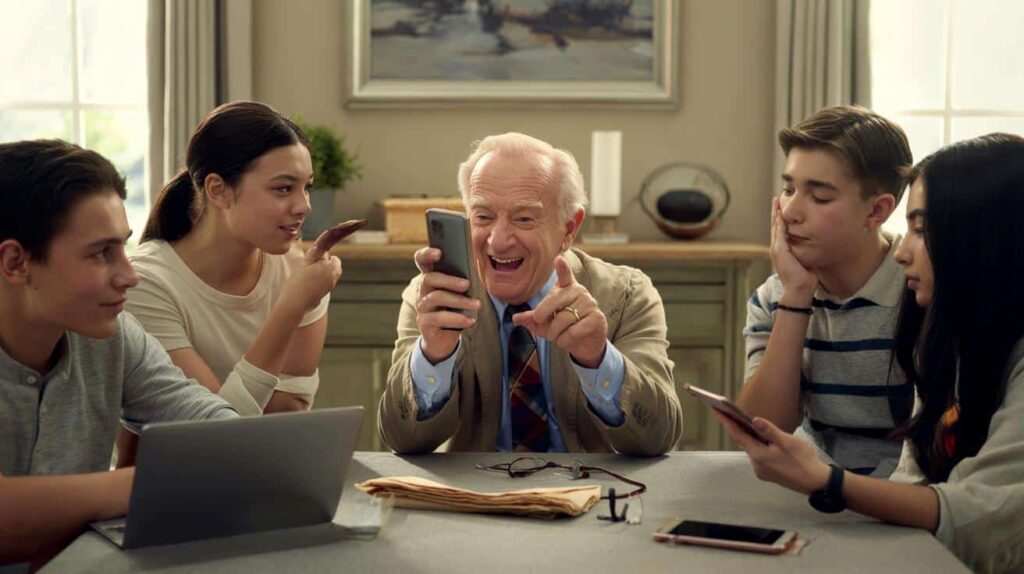
Everyone freezes for half a second.
Your cousin snorts into her Coke. Your aunt fixes her napkin like she’s heard this line since 1998. Grandpa smiles, proud of being “tech-savvy,” and you’re stuck between laughing and cringing.

That tiny silence between generations? It happens every day, in kitchens, group chats, and awkward car rides.

Some words just scream age before you’ve even finished the sentence.
1. “The World Wide Web” and other museum-piece tech words
When someone over 65 says “the World Wide Web,” you can almost hear a dial-up modem in the background.
Younger people say “online,” “on TikTok,” “on Insta,” not like they’re using a tool, but like they’re living in it.
So when an older relative drops “surfing the web” or “using the computer machine,” the vibe instantly shifts from 2026 to 1996.
Picture this: a 22-year-old shows her grandma a viral meme on her phone.
Grandma squints, nods, and says proudly, “Oh yes, I saw that on the World Wide Web last week.”
The room goes quiet. The girl’s little brother whispers, “Who even says that?”
Nobody is actually offended. It’s more like watching someone walk into a Zoom meeting with a fax machine. The words are technically correct, but they sound like they belong in a museum with floppy disks and Netscape.
The gap comes from how each generation met technology.
Older adults remember a time when “going online” was an event. You pressed buttons, listened to weird noises, then arrived somewhere called “the web.”
Younger people never “go” online; they’re just there. So phrases that frame the internet as this distant, separate place feel clunky and out of touch.
It’s not that older people can’t be tech-savvy. They just carry the language of the first internet with them, like a digital accent they’ll never quite lose.
2. “Back in my day…” and the nostalgia trap
“Back in my day” might be the most efficient way to make every young person mentally exit a conversation.
The phrase almost always predicts a speech about how things were tougher, better, simpler, or somehow more “real.”
Young people don’t hate the past. They’re just exhausted by being told their present is inferior before they’ve even started living it.
A 19-year-old I spoke to described family dinners as “weekly retro TED Talks.”
Her grandpa starts: “Back in my day, we respected our elders.”
She instantly braces for a lecture on phones, music, or “kids these days.” By the time he’s reached the price of bread in 1973, half the table is scrolling under the tablecloth.
The story might even be good, but the opener shuts everyone down. It feels like a verdict, not a memory.
What older people often want is to share context and hard-earned lessons.
But “back in my day” sounds like a judgment, like the current generation is already failing some invisible test.
A softer opener changes everything: “When I was your age, we did it differently, want to hear?” Now it feels like an invitation, not a complaint.
The memory hasn’t changed, only the emotional frame around it. That makes all the difference in whether a young person listens or tunes out.
3. “Young lady / young man” and the fake-politeness vibe
“Listen here, young lady” might sound polite on paper, but in real life it often lands like a verbal pat on the head.
For a lot of people under 30, being called “young lady” or “young man” feels less respectful and more like a warning label.
It usually shows up right before a correction, a lecture, or a passive-aggressive life lesson nobody asked for.
Take a simple scene: a barista with blue hair and piercings hands change to an older customer.
He frowns at the touchscreen tip option and says, “You know, young man, you kids don’t know the value of money anymore.”
The barista is 27, pays rent, and works two jobs. He laughs it off, but later he tells friends, “Young man? I pay my own health insurance.”
The phrase doesn’t acknowledge adulthood. It shrinks it.
For many over 65, “young lady” and “young man” were once standard politeness.
The problem is that respect language has shifted. Today, respect sounds more like using someone’s name, asking their pronouns, or simply saying “you.”
When older people lean on these formulas, they often don’t realize they’re triggering that old-school parent-child dynamic.
*Nobody making rent wants to feel like they’re back in the principal’s office.*
4. “Kids these days…” and the blanket judgment
Nothing makes a room of young people mentally check out faster than the phrase “Kids these days.”
It’s a sweeping judgment wrapped in four tiny words. You can almost predict what comes next: phones, laziness, cancel culture, or “no one wants to work anymore.”
By the time the sentence ends, any chance of real conversation is gone.
I watched this play out on a bus once. An older man glanced at a row of teenagers on their phones and muttered loudly, “Kids these days don’t even look out the window.”
One girl paused her music and replied, “I’m doing my homework.” Another was texting her sister to check on their sick mom.
But his story was already written in his head. The phones weren’t tools, they were proof of decline. The teens shared eye-rolls and slipped right back behind their screens, now for protection more than entertainment.
The irony is, every generation has used some version of this line.
Boomers heard it from their parents about rock music. Gen X heard it about MTV. Millennials heard it about avocado toast.
When older people say “kids these days,” what young people actually hear is: “I’ve already decided who you are.”
Let’s be honest: nobody really changes their mind after that kind of opener.
5. “That’s not a real job” and the work-respect disconnect
If there’s one phrase that cuts deep, it’s “That’s not a real job.”
Freelancers, creators, Twitch streamers, delivery riders, OnlyFans workers, Uber drivers, social media managers — all of them hear some version of this from someone over 65.

Work used to mean office, factory, uniform. Now it might mean laptop, ring light, or notifications at 2 a.m.
A 24-year-old content creator told me her grandfather still introduces her as “between jobs” because he doesn’t believe brands pay for TikTok campaigns.
She earns more than he did at her age, but the phrase “post videos online” sounds like a hobby to him.
At Christmas, he asked when she’d get a “proper” job with a pension. She laughed it off publicly, but later admitted it made her doubt herself for a week straight.
Words stick, especially when they come from someone whose approval you grew up craving.
Older generations often link “real job” to stability: contracts, benefits, long-term security.
Younger workers, raised on layoffs and economic crises, chase flexibility and multiple income streams instead.
So when someone over 65 dismisses a new kind of job, it feels like they’re not just questioning the work. They’re questioning the future young people are building.
Respecting that shift doesn’t mean pretending every hustle is healthy. It just means **not treating unfamiliar as illegitimate**.
6. “Why don’t you just call?” and the communication clash
For many over 65, the ultimate solution to any misunderstanding is simple: “Why don’t you just call?”
For a lot of Gen Z and millennials, a phone call can feel oddly intense, like knocking on someone’s front door unannounced.
Text, voice notes, DMs — these aren’t signs of emotional weakness. They’re a whole new etiquette.
A 21-year-old told me her granddad scolded her for texting her boss instead of calling.
“He said, ‘Pick up the phone like an adult.’ My boss had literally written in his email: ‘Text me if you need anything.’”
The young woman wasn’t being rude, she was following the culture of her workplace. The old rulebook about calls = serious, texts = casual just doesn’t apply the same way anymore.
The clash isn’t about laziness. It’s about two completely different communication maps.
For older adults, a call shows courage, clarity, and respect.
For younger people, a call can feel intrusive — like hijacking someone’s focus without warning. A text gives both sides time to think, respond, and keep receipts when needed.
When someone over 65 insists on calling, young people often feel steamrolled. When young people avoid calls, older adults feel ignored.
Both are trying to connect. They’re just speaking in different “channels.”
7. “We didn’t have that, and we turned out fine” and the empathy gap
Few phrases shut down a conversation about mental health or boundaries faster than “We didn’t have that, and we turned out fine.”
It usually comes up when a young person mentions therapy, burnout, ADHD, or needing a day off.
Instead of support, they get a highlight reel of surviving worse with less help.
A 26-year-old told me about opening up to her grandmother about panic attacks.
Her grandmother replied, “In my day, we just got on with it. No therapists, no labels. We turned out fine.”
The younger woman nodded, then cried alone in the bathroom. Because what do you say to that? Your pain suddenly feels like a luxury, not something real.
The older woman wasn’t trying to be cruel. She was describing her reality — a reality where there was no language, no space, no budget for emotional struggle.
The phrase hurts because it erases progress.
Younger generations are trying to break cycles: of silence, of overload, of “just coping” until everything collapses.
When they’re told the old way was “fine,” it sounds like their efforts to heal are being mocked.
**Acknowledging that you survived without help doesn’t mean the help was never needed.** It just means nobody gave it to you.
How to talk across generations without stepping on landmines
There’s a quiet skill that bridges age gaps: noticing which phrases freeze the room and gently retiring them.
Instead of “kids these days,” try “young people I meet seem to…” and leave space for pushback.
Swap “back in my day” for “when I was your age, my experience was…” and ask what’s changed now.
If you’re over 65, you don’t need to suddenly speak like TikTok. That’s not the point.
The goal is curiosity, not imitation. Ask what your grandkid actually does for work instead of assuming it’s “not real.”
If you’re younger, you can also flag these phrases kindly: “When you say ‘we turned out fine,’ it makes me feel like my problems don’t matter.”
It’s not about winning. It’s about staying in the same conversation.
Older words aren’t wrong, they just carry emotional weight that the speaker often doesn’t see.
- Replace judgment phrases with curiosity-based ones.
- Tell stories without using them as proof that one era was better.
- Ask how certain words feel to the other person, not just what they mean.
- Remember that language is a living thing, not a fixed rulebook.
- Allow each generation to keep its slang without mocking the other’s.
Language as a mirror of the generation gap
Listen closely at any mixed-age gathering and you can almost map the generation lines by the phrases people use.
Older voices carry “World Wide Web,” “proper job,” “young lady.” Younger ones say “side hustle,” “low-key,” “mentally done.”
Neither side is wrong; they’re just revealing what shaped them, what scared them, what they were taught to respect.
The small phrases that sound out of touch today once signaled modernity, good manners, or survival.
Some will disappear. Some will come back as retro jokes. Some will linger in family kitchens like wallpaper nobody bothers to peel off.
The interesting question isn’t who talks “right.” It’s what we’re willing to learn from the words that make us wince a little.
Language ages. People do, too. The only thing that really stays fresh is the decision, in the middle of a tense sentence, to pause and ask: “How does that sound to you?”
That’s where a rant can quietly turn into a real conversation.

| Key point | Detail | Value for the reader |
|---|---|---|
| Spot out-of-touch phrases | Examples like “kids these days” or “that’s not a real job” | Recognize language that shuts down young listeners |
| Shift how you start stories | Swap “back in my day” for neutral, curious openers | Keep attention and reduce defensive reactions |
| Use language as a bridge | Ask how certain phrases feel, not just what they mean | Build more honest, less tense cross-generational conversations |
FAQ:
- Question 1Are younger people just being too sensitive about these phrases?
- Question 2Should older adults stop using their natural way of speaking?
- Question 3What can I say instead of “back in my day”?
- Question 4How do I tell an older relative their words feel hurtful without starting a fight?
- Question 5Is it okay to laugh about these phrases together?
