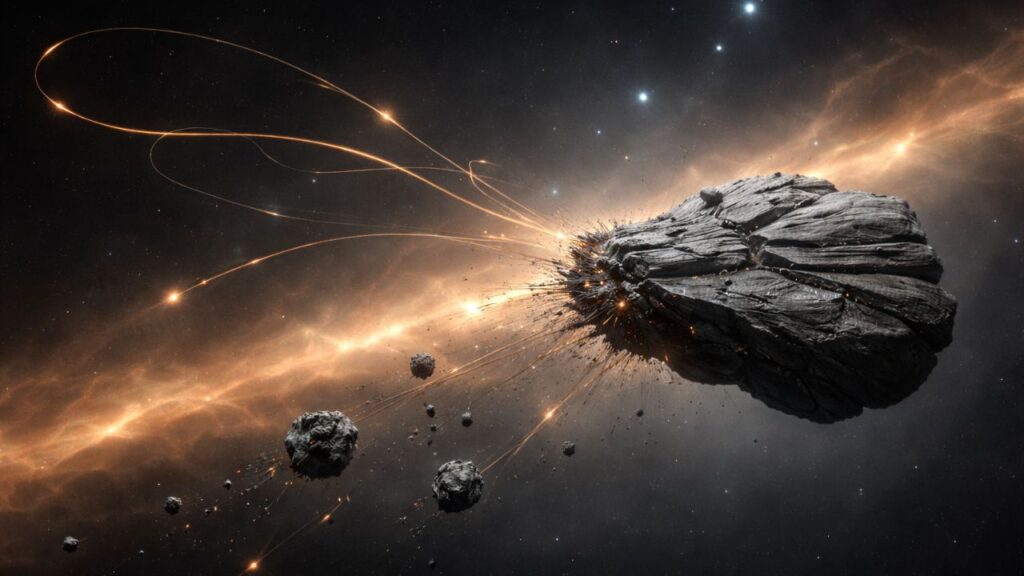
The moment the first clear images of 3I ATLAS appeared on the control room screens, conversation stopped. No one anticipated an interstellar visitor to look so damaged — fractured, unstable, and visibly coming apart. Against a faint backdrop of stars, the comet’s nucleus looked like a ghostly shard, wrapped in a torn, dusty halo. Rather than a smooth, icy traveler, it appeared wounded and fragile.
One researcher quietly asked, “This really came from another star?” The question shifted the mood instantly. Eight separate images, captured by different telescopes and spacecraft, all confirmed the same unsettling truth: 3I ATLAS is not an orderly passerby. It is a survivor under strain.
Eight Images That Redefined a Distant Smudge
For months, 3I ATLAS was little more than a faint blur in astronomical data. Its motion was tracked, its path calculated, but it looked unremarkable. That changed once a coordinated observing effort began. Eight independent instruments, each operating at different wavelengths, turned their focus toward the comet.

Viewed together, the images feel almost invasive. The nucleus lacks a clean outline. It appears elongated, fractured, and unstable, shedding material as it moves. Fine jets and clumps stream away from the core, suggesting a body under intense stress.
 Goodbye Hair Dye for Grey Hair: The Conditioner Add-In That Gradually Restores Natural Colour
One deep-space image reveals a core resembling shattered glass. Another long-exposure frame shows the tail splitting into multiple faint strands, as though the comet were releasing matter in uneven bursts. The detail is sharp enough to track tiny dust knots drifting away from the nucleus.
The timestamps tell a quiet story of decline. An initially fuzzy core becomes stretched. Days later, distinct fragments appear along the orbit. Solar heating and tidal forces compress vast timescales of erosion into something observable night by night.
Scientists expected behavior similar to 2I/Borisov. Instead, these images show an object that is far more delicate, likely rich in volatile ices that cannot withstand solar warmth.
The fractures hint at a violent past — collisions, temperature extremes, or both. Unusual brightness patterns suggest unfamiliar chemistry, possibly from ices rarely preserved near our Sun. With each closer look, the comet feels increasingly alien.
How Researchers Study an Interstellar Comet from Afar
Capturing these views required more than a single telescope. Astronomers organized a carefully timed campaign, using space-based instruments and ground observatories. Ultraviolet, visible, and infrared data were combined with long and short exposures to reveal both faint structures and rapid changes.
Brightness was measured nightly. Scientists tracked how the coma expanded, how the tail evolved, and how the nucleus shape shifted. By layering images and spectra, they built a multi-dimensional picture of a body they will never physically reach.
When high-resolution frames became available, researchers noticed uneven tail structures. Instead of a smooth flow, the dust appeared clumped, suggesting episodic releases. Tracking a single fragment across nights allowed teams to estimate the force of outgassing jets.
Polarimetric data revealed a strange mix of fine dust and larger debris. This combination differs from most known Solar System comets, implying formation in a colder, more volatile-rich environment around another star.

The comet appears both fragile and highly active. Chaotic gas releases alter its rotation and drive fragments apart. The images capture brightness flares and twisting jets, freezing moments of rapid change.
What 3I ATLAS Reveals About Distant Planetary Systems
Understanding 3I ATLAS starts with basic measurements — orbit, brightness, color — but meaning emerges from subtle variations. Automated tools track shape changes frame by frame, while models test different combinations of spin, mass, and composition.
Researchers compare the comet against known Solar System objects. When familiar models fail, they adjust assumptions, lowering density or fragmenting the nucleus in simulations. The goal is not perfection, but insight into where and how the comet formed.
Scientists remain cautious. Individual images can mislead, hiding darker regions or exaggerating structures due to viewing angles. Context matters more than spectacle.
Only by stitching together changes over time does the comet’s story become clear. The process reflects a careful balance between curiosity and restraint, mirroring the object itself — incomplete, unstable, yet deeply informative.
As one researcher summarized, interstellar comets are remnants of other solar systems. In this case, the remnants are large enough to study in remarkable detail.
- Fragmented nucleus: Suggests extreme internal weakness and possible past impacts.
- Multiple tail streamers: Indicate episodic outgassing and complex rotation.
- Brightness fluctuations: Reveal rapid exposure and loss of volatile ices.
- Distinct dust behavior: Points to unusual chemistry from another star’s disk.
- Short observation window: Weeks of data reflect millions of years of history.
Sharing the Sky with a Fading Interstellar Visitor
Despite its distant origin, 3I ATLAS currently shares our sky like any other comet. Amateur astronomers may see only a faint blur, while professional instruments capture a fragmenting relic from another star system.
The comet itself may not survive long. Future stellar encounters could finish what the Sun has started. Yet the data it provides will remain, preserved for future analysis and reinterpretation.
In its brief passage, 3I ATLAS connects distant worlds. Thrown from another system, drifting for eons, and observed for mere weeks, it reminds us how small, connected, and transient our place in the galaxy truly is.

| Key point | Detail | Value for the reader |
|---|---|---|
| Unprecedented precision | Eight spacecraft and telescope images capture 3I ATLAS fragmenting and venting in real time | Gives a vivid, almost cinematic understanding of how an interstellar comet behaves |
| Alien composition clues | Odd tail structures and dust patterns suggest exotic ices and a different birth environment | Offers a window into how other planetary systems might form and evolve |
| Living science process | Researchers blend multiple wavelengths, models, and nights of data | Helps readers see how raw images turn into real knowledge about our galaxy |