At first look, it resembles a miniature fortress built for tender greens. A second glance reveals the truth: every “spike” is nothing more than everyday cutlery.
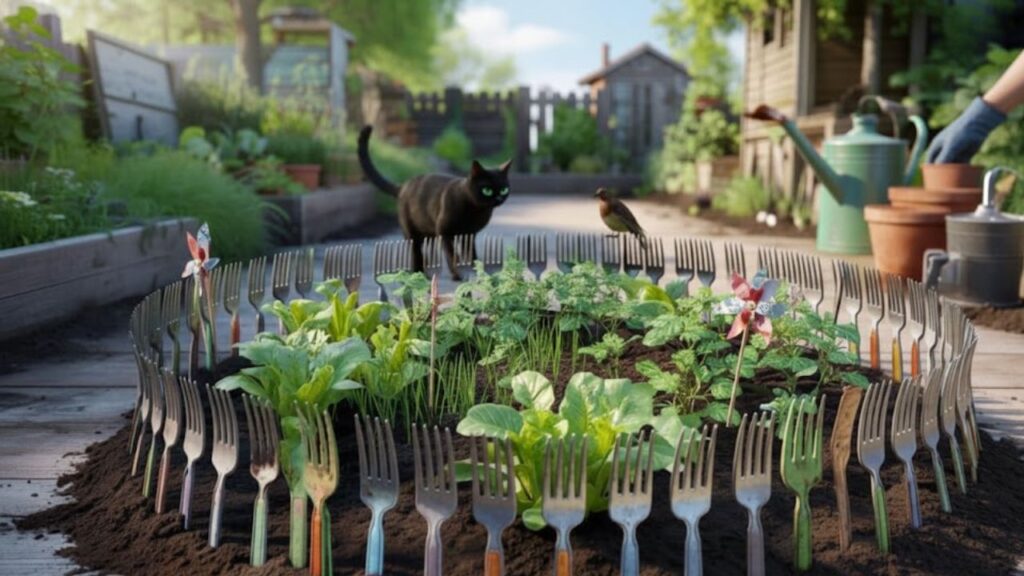
Across allotments and home gardens, more growers are quietly pushing old forks into the soil, turning neat beds into unusual picket fences. Behind this quirky setup is a straightforward goal: protect fragile seedlings from cats, birds, and other intruders without using a single chemical deterrent.
Why gardeners are lining beds with forks
The frustration is familiar. You plant lettuce seeds or bury tulip bulbs in the evening, only to wake up to disturbed soil, crushed sprouts, and exposed bulbs. Neighbourhood cats have used the bed as a toilet, while birds have scratched and pecked in search of worms. What feels like sabotage is simply natural animal behaviour.

To counter this, some gardeners have adopted a tip popularised by the North American site Farm Flavour and later echoed in UK media. Instead of discarding plastic or wooden forks after gatherings, they place them around young plants. The handles are pushed into the earth, leaving the tines facing upward in a dense grid.

When forks are positioned close together, they create a simple physical barrier. Paws, claws, and beaks no longer find the soil welcoming.
The aim is to alter the texture of the bed. A cat stepping onto the surface finds it awkward to scratch or settle. Birds trying to land encounter an uneven maze rather than open ground. The intention is not harm, but discomfort—enough to encourage animals to move elsewhere.
How the fork barrier works in practice
Freshly worked soil is soft, warm, and rich with scents of compost and worms. For cats, that signals the perfect bathroom. For birds, it suggests an easy meal. The fork method disrupts this appeal using nothing more than spacing and structure.
Each fork acts as a short stake. When arranged closely, they break up the smooth surface into tight gaps. A cat struggles to dig without hitting something firm. Birds cannot peck freely between the tines and stems.
The effectiveness lies not in sharpness but in density. Too many awkward points leave no comfortable place to land or dig.
Gardeners who rely on this trick often report fewer scratch marks and sturdier seedlings. While there is no formal scientific study to confirm it, the method lives on through shared photos, personal stories, and the relief of undisturbed vegetable rows.
Step-by-step: placing forks in the vegetable patch
Setting up a fork barrier is quick, but spacing is key. Too far apart, and animals slip through. Too close, and tending the bed becomes difficult.
Basic placement guidelines
- Push each handle about 3–4 cm into the soil to keep it stable.
- Keep the tines pointing upward and roughly vertical.
- Leave 10–15 cm between forks so a cat’s paw cannot land comfortably.
- Position forks just outside plant bases, avoiding contact with stems or leaves.
- Remove the forks once plants are strong and established.
On balconies or in containers, gardeners often reduce the spacing, as pots are favourite resting spots for local cats. The goal is to protect the compost surface while still allowing light, air, and water to reach the soil.
Wood, plastic, or metal: which forks work best?
Different materials behave differently outdoors:
- Wooden forks: Lower injury risk, blend naturally into soil, biodegradable over time, but prone to rot in very wet conditions.
- Reused plastic forks: Durable and easy to insert, often already available, but may break down into small fragments if left too long.
- Metal forks: Extremely sturdy and reusable for years, yet more visible, potentially hazardous, and prone to heating up in strong sun.
Many gardeners favour wooden or reused plastic forks, with one rule in mind: remove them at the end of the season. Leaving plastic to weather in the soil can cause breakage and environmental issues.
Safety considerations: where forks should not go
Any pointed object deserves caution. While garden forks used this way are short, they still pose risks to children or pets running through beds.
Experts advise keeping fork barriers away from paths, play zones, and sharp corners. In family gardens, shorter and blunter wooden forks are safer than long metal ones. In shared allotments, some growers limit the method to fenced plots with clear walkways.
 Goodbye Hair Dye for Grey Hair: The Conditioner Add-In That Gradually Restores Natural Colour
Think of the forks as temporary, discreet fencing: useful around crops, unsuitable where people or animals move freely.
Kitchen items that support the fork defence
Forks may not stop every pest. Slugs, for example, ignore tines entirely. For that reason, many gardeners combine this tactic with other household solutions.
Coffee grounds, cayenne, and natural deterrents
Used coffee grounds are often scattered around plants like hostas or strawberries. Their coarse texture can discourage slugs and snails, and their dark colour blends easily into the soil. Results vary, but many gardeners notice less grazing when grounds are refreshed regularly.
Cayenne pepper is another popular choice. A light sprinkle on the soil, reapplied after rain, can deter animals and insects that dislike its smell and taste.
Gardening advisers note that cayenne, when used sparingly, does not harm plants but can persuade many nibblers to move on.
These methods work best together. Forks create awkward footing, pepper adds an unpleasant scent, and coffee grounds roughen the surface. Layered together, they tilt the balance back toward the gardener.
When the fork method works best
This approach is most effective in certain situations:
- Newly sown carrots, beets, or lettuce with very delicate seedlings.
- Freshly planted bulbs that animals love to dig up.
- Raised beds and planters in areas with many roaming cats.
- Small urban gardens where permanent fencing is impractical.
Once plants gain height and strength, they can handle occasional disturbance. At that stage, many gardeners remove the forks for appearance and safety, relying instead on mulch, dense planting, and routine checks.
Real-world use and common drawbacks
Picture a compact city courtyard with two raised beds and several local cats. The gardener sows salad mixes every few weeks from spring through summer. Fork barriers protect each new sowing for three to four weeks, until leaves form a dense mat. As one section matures, the forks shift to the next freshly planted strip.
There are limits. Strong winds can knock poorly anchored forks onto plants. Children may pull them out as curiosities. Some neighbours may question the spiky look. Regular inspections and adjustments help keep the method safe, effective, and neighbour-friendly.
Key ideas behind this low-tech strategy
For beginners, a few simple concepts explain the logic. A physical barrier is anything that blocks access—netting, cloches, fencing, or, in this case, forks. It relies on obstruction, not chemicals or poisons.
Another idea is integrated pest management, which means combining several gentle tactics. Forks protect seedlings from trampling, coffee grounds slow slugs, and mixed planting reduces total loss. Each method has limits, but together they build resilience.
What looks playful and improvised hides a serious aim shared by many modern gardeners: protect crops, avoid harming wildlife, and use what’s already at hand, even if it comes from the kitchen drawer.