At a local market, I once saw a father trying to persuade his young son to choose a vegetable. The boy scanned the stalls, pointed at broccoli, and firmly said no. He pointed at cauliflower—another no. Then his eyes landed on a red cabbage. He beamed and declared, “This one is different!” The vendor smiled quietly and weighed the cabbage beside neat stacks of broccoli and a large pile of white cauliflower, like three siblings carefully pretending they weren’t related.
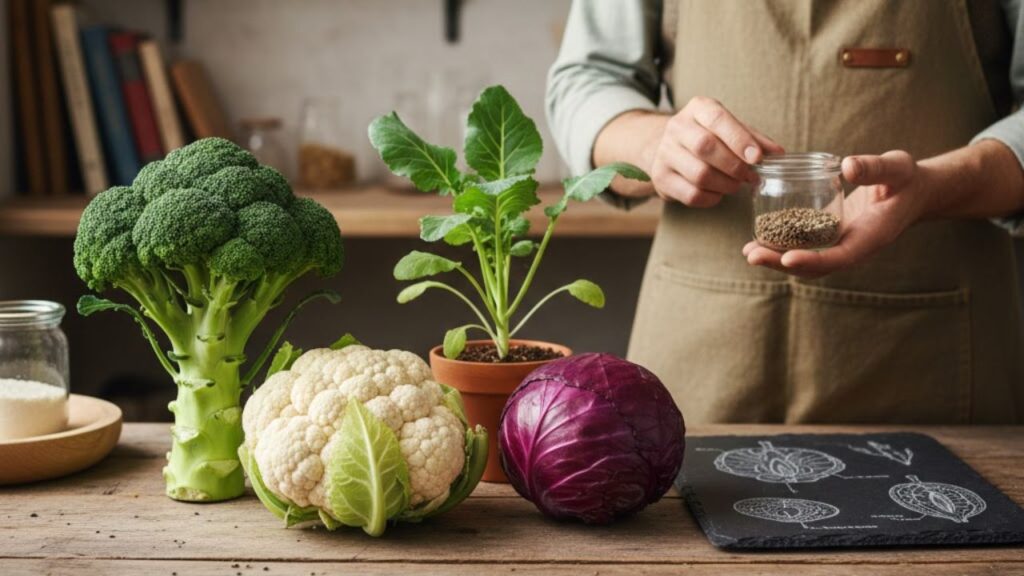
Most of us grow up believing these vegetables are only loosely connected. One resembles a brain, another a tiny tree, the third a purple ball. They live in different sections of the store, star in different recipes, and carry different emotional baggage from childhood.
And yet, they all come from the same plant.

Three Vegetables Shaped From One Ancestral Plant
Place cauliflower, broccoli, and cabbage together on your kitchen counter, and your mind instantly separates them. One belongs to creamy bakes, another to quick sautés, the third to crunchy salads. Their colors, textures, and associations feel unrelated. Our eyes decide first. Our taste memories follow. Shopping habits keep them neatly apart.
 Goodbye Hair Dye for Grey Hair: The Conditioner Add-In That Gradually Restores Natural Colour
Botany tells a quieter truth. All three descend from a single species: Brassica oleracea. Long ago, it was a tough, salty plant clinging to rocky European coastlines. Over generations, humans didn’t create new species—they selected new shapes. By favoring broader leaves, tighter buds, or thicker stems, people gradually molded one plant into many forms.
Picture a long, invisible timeline. At the start stands a wild coastal plant, hardy enough to survive when other crops failed. Farmers noticed small differences: fuller leaves here, denser flower clusters there. Seeds were saved from the most useful plants, season after season. No laboratories, just patience and repetition.
This is how cabbage emerged with its compact leafy head. This is how broccoli developed from carefully chosen immature flower buds. Cauliflower followed, bred for its pale, tightly packed curd. It was never scientific in name, but deeply practical. Everyday people reshaped food by saving what worked.
Biologically, the relationship is similar to dog breeds. A husky, a poodle, and a Labrador look nothing alike, yet belong to one species. The same is true for broccoli, cauliflower, and cabbage. Their genetics are close enough to cross, giving rise to hybrids like Romanesco or broccoflower. The plant’s natural flexibility did most of the work; humans simply guided it.

Spotting the Shared Roots in Your Own Kitchen
Once you accept they’re one species, everyday cooking feels different. Try this once: cut broccoli, cauliflower, and cabbage into similar pieces, coat them with oil, salt, and crushed garlic, then roast them together. Watch how they soften, brown, and release nearly the same warm, nutty aroma.
The illusion fades. Instead of strangers, you see one plant in different forms, responding almost identically to heat and seasoning. Habit is what keeps them apart. We steam broccoli too long, boil cabbage until it smells, and smother cauliflower in cheese to make it tolerable. These routines stick, even when they don’t serve us well.
You don’t need to overhaul your cooking. Just switch roles occasionally. Use shredded cabbage in a broccoli-style stir-fry. Roast broccoli the way you would cauliflower. Finely chop cauliflower into a lemony cabbage-style salad. Gradually, your palate recognizes the shared structure beneath the flavors.
Once you know they share a species, the question changes. It’s no longer “What can I make with cabbage?” but “What can this plant do in all its forms?”
A Simple Mental Guide
- Broccoli = flower buds eaten before blooming
- Cauliflower = compact flower head bred for density and color
- Cabbage = leaves layered into a tight head
- Same species = similar cooking methods work across all three
- Different shapes = different textures and visual appeal
How This Connection Shifts How You Cook and Think
Once you see the relationship, it’s hard to ignore. The vegetable aisle starts to look less like separate items and more like one family branching outward. You can rotate between leafy, flowering, and compact versions while feeding your body nearly the same nutrients—high fiber, vitamin C, and sulfur compounds responsible for both flavor and health benefits.
This understanding makes cooking more flexible. If broccoli is missing, cabbage can step in. If cauliflower isn’t available, broccoli works just as well. It’s not breaking a recipe—it’s using the same plant under a different shape.

| Key point | Detail | Value for the reader |
|---|---|---|
| One species, many shapes | Cauliflower, broccoli and cabbage are all Brassica oleracea, selected over centuries for different traits | Breaks the myth of “totally different” vegetables and frees you to swap them in recipes |
| Shared cooking logic | Similar structure and composition mean roasting, stir-frying and seasoning overlap a lot | Simplifies meal planning and reduces food waste by using what you already have |
| Everyday food, quiet science | Traditional farmers acted as plant breeders long before genetics had a name | Gives fresh respect for humble vegetables and the people who shaped them |