The cameras captured it in an instant. Standing on the balcony of Buckingham Palace, surrounded by bright red uniforms and the thunder of the flypast, Kate Middleton made a small, almost tentative move. Her hand reached out and gently touched Prince Louis’s shoulder, guiding him with a quiet, reassuring tap. It was a familiar gesture to seasoned royal watchers, echoing the same discreet motion Duchess Sophie has used for years with her children and younger royals. A light touch, a calm lean-in, a near-maternal signal that wordlessly says, “You’re safe, I’m here.”
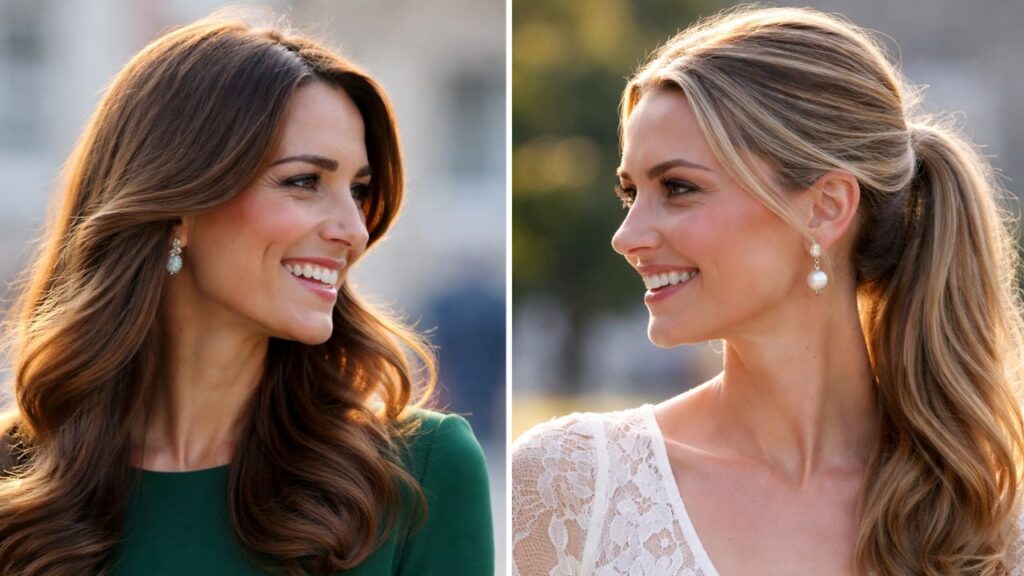
The internet noticed almost immediately.
Within hours, side-by-side images of Sophie and Kate spread across social media. Captions accused the Princess of Wales of “copying” the Duchess of Edinburgh and even crossing an invisible line of royal protocol. What began as a quiet parental moment quickly escalated into a full-blown online storm.
 Trimming Every 6 Weeks Can Make Hair Look Longer - It Stops Split Ends From Crawling Up the Shaft
How a tiny gesture became a royal flashpoint
On the surface, it seemed insignificant: a mother steadying her youngest child while millions watched. Yet for royal fans, that brief movement became loaded with meaning. Kate’s posture — leaning slightly down, arm placed behind Louis’s back, hand resting softly near his middle — closely mirrors a gesture long associated with Sophie, Duchess of Edinburgh during major state events.

Some viewers saw it as a gentle echo of warmth. Others read it as something more calculated. Online commentators were quick to label it a “borrowed comfort gesture,” suggesting it blurred the boundary between strict protocol and natural instinct.
Looking back at footage from past Trooping the Colour ceremonies, Sophie can be seen repeating this motion time and again. She quietly steadies Lady Louise, subtly guides James, and offers a calm hand behind the late Queen’s great-grandchildren when the noise and spectacle swell. The gesture is never dramatic — more like a trusted presence quietly managing the chaos behind the scenes.
Kate’s return and the scrutiny of every movement
Kate’s recent appearance carried added weight, marking her first major public moment after months away due to health concerns. As Louis fidgeted, waved, and pulled faces at the planes — entirely on brand — Kate stepped into that same Sophie-style stance. Royal watchers clipped the footage, slowed it down, and shared it with captions questioning whether she was “channeling Sophie” or “copying the Duchess again.” The comparison was swift and unrelenting.
This is where royal protocol entered the conversation. Traditionally, senior royals were expected to maintain visible distance in public: upright posture, minimal physical contact, and no obvious displays of parenting on the balcony. The late Queen followed this approach with near-religious discipline.
Sophie gently softened that tradition by showing warmth while still respecting the rules. Kate echoing that gesture feels like the next step in a gradual evolution — a future queen allowing herself to appear like an ordinary mother in extraordinary circumstances. That deeper meaning explains why the debate has been so charged.
Why “copying Sophie” may be more strategy than scandal
Beneath the headlines lies another layer. Kate has been subtly adopting Sophie’s softer public style for some time. Not in an exaggerated way, but through details visible only to those who watch closely: an arm lightly placed behind a child, an open and relaxed smile offered to nervous members of the public, or a small step back to let another royal take the spotlight.
This approach has long been Sophie’s hallmark. For years, she has acted as the understated emotional anchor at royal events, especially following the deaths of Prince Philip and the late Queen. Kate leaning into that style appears less like imitation and more like learning from someone who has quietly held things together during high-pressure moments.
After the Queen’s passing, Sophie was often seen offering subtle guidance to younger family members — a nod, a gentle hand, a brief but steady glance. No speeches, no theatrics, just calm reassurance. Kate, who entered the family under intense scrutiny and with far less time to adapt privately, had to learn quickly. Watching Sophie navigate ceremonial settings has likely served as a live lesson in modern royal composure.
Where protocol bends without breaking
Despite public assumptions, royal protocol is more flexible than many believe. There is no formal rule declaring that parents must not touch their children on the balcony. Instead, there exists a network of expectations: don’t overshadow the monarch, don’t appear chaotic, and don’t disrupt the image of control.

At the same time, the monarchy relies on public support in an era that prizes authenticity. Kate reflecting Sophie’s calming, human gestures may be quietly strategic. It suggests a generation of royals willing to follow tradition without sacrificing relatability — real parents managing real children in very public moments.
The subtle choreography behind royal warmth
So what exactly defines this so-called “Sophie gesture”? It is simple and restrained. One arm curves lightly behind a child’s back, neither fully embracing nor fully distant. The shoulders soften, and the upper body leans forward just enough to signal attention without dominating the official pose.
The detail lies in the hand. It doesn’t grip or pull. It rests. That balance makes the gesture appear both affectionate and controlled, instantly communicating reassurance while maintaining duty.
These signals are often misunderstood. Some assume every touch is deeply symbolic or rehearsed, while others view repetition as pure public relations. In reality, royal mothers are balancing cameras, crowds, weather, children, and centuries-old expectations all at once.
No one maintains flawless posture every second while a young child wriggles beside a railing. Gestures like Sophie’s — and now Kate’s — function as quiet survival tools, offering stability amid highly choreographed settings.
A family learning in plain sight
A widely shared insider remark captured the mood surrounding the controversy: “People forget that the royals also learn from each other. Of course Catherine watches Sophie — she’s one of the safest pairs of hands in the family.” Rather than spin, it reflects a familiar workplace reality, simply played out in gowns and tiaras.
What unsettles some critics is not the borrowing itself, but what it represents: a gradual redefinition of acceptable public behavior. This shift appears in patterns such as softer body language with children during major ceremonies, more visible reassurance when young royals feel overwhelmed, and a move away from rigid poses toward understated warmth.
A monarchy evolving through small, shared moments
Strip away the headlines and the situation becomes clear. A woman under intense scrutiny mirrored a gesture from another woman who has learned how to endure the same pressures. That is not scandal; it is instinct.
The debate is less about whether the Princess of Wales copied the Duchess of Edinburgh and more about expectations placed on women entering an ancient institution. Must every action be entirely original, or is adaptation allowed?
Perhaps the answer lies in those balcony images themselves — Sophie in the background, Kate guiding Louis, and the late Queen’s legacy present in every frame. The monarchy is changing slowly, measured in millimetres rather than leaps, carried in hand placements, glances, and borrowed gestures. Whether seen as copying or growth, those small movements reveal an institution learning in real time, under constant watch.