
At first, no one realised anything was off. Pedestrians scrolled their phones, cars drifted through intersections, and the familiar mid-morning light sat flat against the buildings. Then a few people glanced upward. Squinting. Pointing. A thin bite was missing from the sun. Someone laughed nervously, tossing out the word “apocalypse,” and suddenly the city stalled, frozen in a shared second of disbelief.
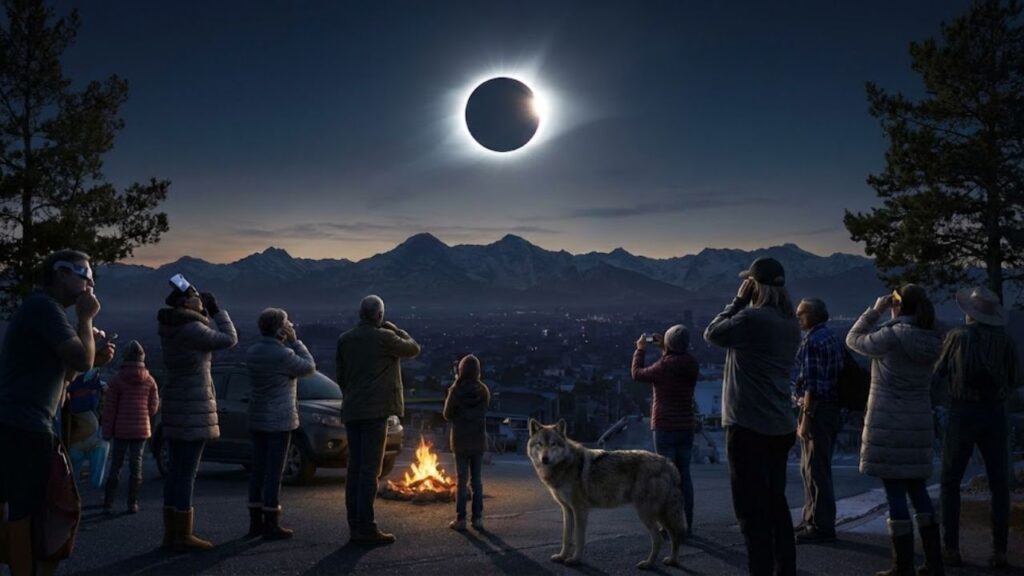
Moments later, the atmosphere shifted. The light turned harder and colder. Shadows blurred, doubling like a faulty screen. Dogs fell silent. Birds fluttered without settling. Shop lights snapped on well before noon, guided by instinct rather than logic.
The day the sky briefly powers down
A total solar eclipse is rare enough to disrupt an ordinary day. This one stands apart. Astronomers are quietly calling it the longest eclipse of the century, with total darkness lasting nearly six minutes in some locations. That’s not a blink. That’s enough time to feel the temperature dip, notice your skin prickle, and wonder why your body is reacting before your brain catches up.

Streetlights will glow at midday. Temperatures may fall by several degrees. Even people convinced they “aren’t into space” will wander outside, meetings forgotten, eyes fixed upward. For a few minutes, the sky becomes the only topic that matters.

Anyone who saw the 2017 eclipse across the United States, the 1999 event in Europe, or the 2024 path over North America remembers the same thing: the silence. Office windows slid open. Children gasped on playgrounds. On a Kentucky interstate, traffic stopped completely as strangers climbed out of cars, sharing eclipse glasses like prized passes.
The mechanics were familiar: the moon aligning perfectly with the sun, the corona blooming like a pale crown. Yet what people recall first isn’t the science. It’s the emotion. The tightness in the chest. Birds diving for cover as if night had arrived early. The fleeting, irrational fear that the light might not return. We all recognise that moment when the world tilts slightly and every sense sharpens at once.
Why this eclipse lingers longer than most
This extended darkness comes down to geometry. The moon will appear almost perfectly sized in our sky, its shadow sweeping the Earth at just the right distance and angle. That alignment stretches the experience from seconds into full, immersive minutes. Long enough for your mind to drop the “cool science event” label and tap into something far more instinctive.
Ancient cultures feared eclipses. Today, we have formulas, simulations, and tidy animations. Still, when daylight collapses and stars appear at noon, logic steps aside. No chart or infographic prepares you for seeing a black disc where the sun should be.
How to truly experience those six minutes
The most important decision is location. Totality is everything. Step just outside the path and you’ll see a dim, unsettling partial eclipse, but not the full plunge into darkness. Study the path map, mark the nearest point of totality, and plan like it’s an event you refuse to miss.
- €5,000 a month and free housing to live six months on a remote Scottish island with puffins and whales
- A psychologist insists: “the best stage of life begins with this mindset”
- Everything you should know about canned sardines
- Experts warn a rare polar vortex disruption could peak in February
- Why your home feels cold even when the heating is on full
- Eight spacecraft images reveal the interstellar comet 3I ATLAS in startling detail
- France’s discovery of millions of tonnes of so-called “white hydrogen”
- A new kitchen appliance experts say could replace the microwave
Focus on logistics, not perfection. Can you reach your spot without a marathon traffic jam? Is there a field, rooftop, or open car park with a clear sky view? Choose a primary location, set a backup, and note the exact times for partial coverage and totality. Arrive early, well before the final sliver of sunlight disappears.
 Goodbye Hair Dye for Grey Hair: The Conditioner Add-In That Gradually Restores Natural Colour
Next: safety. Certified eclipse glasses with proper solar filters are essential during the partial phases. Ordinary sunglasses don’t work. Neither do phone cameras or bare eyes. The only safe moment to look directly is during totality itself, when the sun is fully covered and the corona is visible. The instant sunlight returns, the glasses go back on.
Many people miss the magic by chasing photos. Be realistic. Set up your camera ahead of time, test it, then let it go. Your footage will likely be shaky and blown out. That’s fine. The memory will be clearer than any image. The most powerful snapshot is the one etched into you when noon turns into night.
There’s also the emotional side, and it catches people off guard. Some cry. Some laugh. Some freeze, afraid to break the moment. You might want to share this with people who understand, or at least won’t mock you for whispering “wow” on repeat.
Seasoned eclipse chasers swear by these minutes. One summed it up simply: “You come for the astronomy. You stay for the feeling that the universe leaned in and reminded you how small you are, and how okay that is.”
- Arrive early enough to notice the light shifting, not just the darkness.
- Keep your hands free for at least one minute of totality.
- Watch the ground; shadows fracture into thousands of tiny crescents.
- Listen closely—birds, insects, even traffic sound different.
- Write a few lines about how it felt before opening social media.
After the light returns, what stays with us?
Once the moon’s shadow moves on and daylight creeps back, normal life rushes in. Horns blare. Notifications reappear. Someone shrugs and asks about lunch. Yet if you pause, the world may feel slightly rearranged, like furniture shifted just enough to notice.
Eclipses act as mirrors. They don’t change our lives, but they strip away the noise long enough to show how fragile routines are against the scale of the sky. You might reassess a deadline, a calendar entry, an argument that suddenly feels small. Or you might simply file the memory alongside other rare days when reality briefly stopped pretending to be ordinary.
Six minutes of darkness won’t solve your problems. They won’t fix your inbox or your worries. But they can become a reference point: “I was here when day became night and returned again.” That may be why people cross continents for eclipses—not for flawless photos or pure science, but for the chance to be fully present during something the sky rarely does.
When the alert arrives urging you to prepare for the longest eclipse of the century, you’ll have a choice. Swipe it away as another notification, or treat it as an invitation. Step outside. Look up. Borrow six minutes from a universe that almost never pauses.

What matters most to remember
- Being in the path of totality: Only the moon’s central shadow delivers full darkness and the complete six-minute experience.
- Eye safety comes first: Certified solar filters protect your vision during partial phases.
- Expect an emotional response: The mix of silence, darkness, and shared awe often hits harder than expected.
