
Five minutes before noon, the street looked ordinary. Cars idled at the light, a delivery guy zipped past on an electric bike, phones glowed in people’s hands. Then the light began to bend in a way your brain didn’t quite trust. Shadows sharpened, the warmth on your skin thinned, and conversations softened into that strange half-silence you usually hear before a storm.
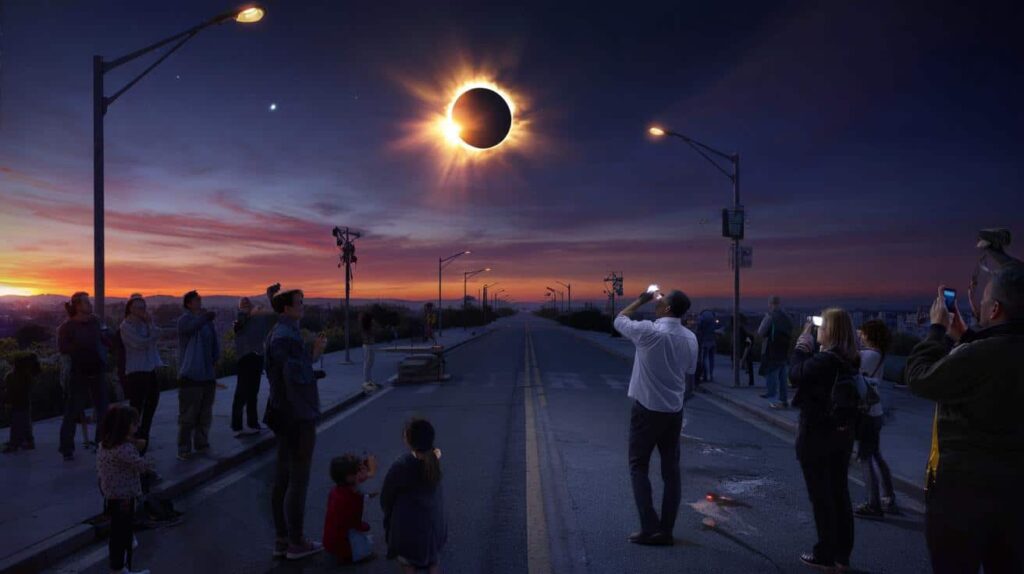
Two minutes later, the sky had already turned a bruise-like blue and the birds around you were acting like someone had switched channels on reality.
This is what astronomers say is coming: up to six full minutes when day will simply… switch off.

Six minutes when the Sun blinks
A total solar eclipse is already a rare guest. One that lingers in full darkness for around six minutes is almost mythical. Astronomers are calling this upcoming event one of the longest total eclipses of the 21st century, a stretch of darkness long enough for your eyes, your brain, and your nerves to completely recalibrate.

In those minutes, the Moon’s disk will slide perfectly over the Sun, turning the familiar sky into a 360-degree twilight dome. Streetlights will flicker on. Temperatures can drop several degrees in moments. Some people cheer, some cry, some just forget to breathe.
Ask anyone who stood under the 1991 “Big One” over Mexico and Hawaii, the last marathon eclipse. Many still remember the way dogs whined and hid, and how the crowd’s noise dissolved into a collective exhale when the Sun finally returned.
One witness described hearing roosters crow at midday and then again after the light came back, like the day had hit a cosmic reset button. Another recalled how for a brief moment, the horizon glowed like sunset all around while overhead the sky looked like midnight with a hole punched through it.
Statistics back up the strange feeling. Heart rate monitors worn by volunteers during past eclipses show spikes at totality. Light sensors record a sudden plunge, not smooth like sunset but more like someone dimmed the universe with a switch.
There’s a simple reason this eclipse will be so long. The Moon will be at a point in its orbit where it appears slightly larger in our sky, while Earth will be a bit closer to the Sun than usual. That geometry means the Moon’s shadow stretches broader and lingers longer over a narrow path on Earth’s surface.
The path of totality — the strip where the Sun is fully covered — will see those famous six minutes of darkness near the central line. On either side, people will still witness a partial eclipse, a cosmic bite taken from the Sun, but without that astonishing plunge into night.
Astronomers have modeled this path down to the kilometer. Your exact experience will depend on where you stand when the shadow arrives.
How to actually live those six minutes
There’s a ritual to preparing for a long eclipse, and it starts weeks before the Moon even moves. First, you check the path: maps from space agencies and observatories show where totality will cross, with the predicted timing for each location. Then comes the decision that separates the casual from the truly curious — will you travel to stand under the shadow’s heart, or settle for a partial view at home?
If you choose to go, you’re not just booking a trip. You’re chasing a moving slit of darkness that will cross continents at thousands of kilometers per hour, and you have a rendezvous with it that you can’t be late for.
On eclipse day, the best advice from seasoned “shadow chasers” sounds surprisingly simple. Eat early. Charge everything. Arrive hours before first contact. That slow, eerie nibble of the Sun starts long before totality, and that’s when nervous energy hits the crowd.
 He is the world’s richest king, owning 17,000 homes, 38 private jets, 300 cars, and 52 luxury yachts
People spread blankets, set up tripods, argue about camera settings, then fall weirdly quiet as the light turns metallic. Kids start asking if it’s safe. Parents fumble with cardboard glasses. Somewhere, a scientist is calmly calling out the times, like a referee for the sky.
We’ve all been there, that moment when nature’s about to do something big and half the crowd is still fighting with smartphone autofocus.
There’s a plain truth here: **if you’re staring through a screen the whole time, you will miss the actual miracle**. Photographers who’ve chased dozens of eclipses say the same thing — plan your shots, then drop the gear as totality hits and simply look.
One veteran eclipse hunter put it this way: “The first time, I cried behind a camera. The second time, I cried with my own eyes. The second one changed me.”
- Certified eclipse glasses ready — and not scratched to death.
- A simple plan: when totality starts, no more photos, just watch.
- A light jacket: the temperature drop can surprise you.
- A tiny checklist on paper, so your brain isn’t juggling details.
- One intention written down: “During those six minutes, I want to feel…”
What this darkness does to us
Something curious happens when millions of people stop what they’re doing and look up at the same patch of sky. During past eclipses, phone traffic has dipped in some regions right at totality, as if even notifications lose their grip for a moment. Strangers lend spare glasses to each other, share snacks, shrug together at the sudden chill.
You might stand there with your family, your neighbors, or total strangers who feel oddly like co-conspirators in a secret show that daytime isn’t supposed to allow.
Scientists will be just as busy as the crowd is stunned. Telescopes will be trained on the Sun’s corona, that ghostly halo of plasma that only appears clearly when the blinding disk is blocked. Temperature sensors, animal trackers, and even aircraft will be recording how the atmosphere and wildlife react to these stretched-out minutes of makeshift night.
Birds often roost. Spiders sometimes dismantle webs, as if the day has ended early. Street animals pause, listen, and occasionally howl. There’s data behind the poetry.
Yet beyond all the numbers, this long eclipse drags one quiet thought into the open: our daylight feels permanent until something reminds us it isn’t. *Six minutes of darkness is long enough to feel that in your bones, not just read it in a science explainer.*
You might walk away remembering less about the exact timing than the way your skin prickled when the light fell away and the world around you collectively held its breath.
That’s not just astronomy. That’s perspective.

| Key point | Detail | Value for the reader |
|---|---|---|
| Path of totality | Narrow corridor where the Sun will be fully covered for up to six minutes | Helps you decide whether to travel or watch a partial eclipse |
| Preparation matters | Glasses, timing, location, and a simple plan for devices and photos | Maximizes your chance of actually experiencing the moment, not fighting gear |
| Emotional impact | Shared awe, strange animal behavior, sudden darkness and temperature drop | Turns a rare astronomical event into a personal memory worth planning for |
FAQ:
- Question 1Is it really going to be the longest eclipse of the century?
- Answer 1Among total eclipses, this one ranks at the top for duration of totality, with some locations seeing close to six minutes of full darkness. Most eclipses last just two to three minutes at maximum.
- Question 2Can I look at the eclipse without special glasses?
- Answer 2Only during totality, and only if the Sun is completely covered in your location. The rest of the time you need certified eclipse glasses or an indirect viewing method. Your eyes don’t feel the damage immediately, which is what makes this so risky.
- Question 3Will it really feel like nighttime?
- Answer 3In the path of totality, the sky darkens dramatically, stars and planets can pop out, and the horizon glows like a weird 360-degree sunset. Outside that path, it looks more like a deep, unsettling dimming than full night.
- Question 4Do animals actually react to eclipses?
- Answer 4Yes. Studies and countless observations show birds roosting, crickets chirping, farm animals heading back to barns, and pets acting anxious or confused during the sudden darkness.
- Question 5What if the weather is cloudy where I am?
- Answer 5Clouds can block the view of the Sun, but you’ll still feel the eerie dimming and temperature drop. Some die-hard eclipse chasers travel along the path of totality to areas with historically clearer skies, but let’s be honest: nobody really does this every single day.
