
The first snowflake taps softly on the windshield, almost like a harmless joke. Ten minutes later, the road disappears in a sea of white. Tail lights blur into a red haze as the wipers struggle against the thickening snow. Your phone buzzes with the dreaded alert: “Winter storm warning in effect — up to 55 inches of snow possible.”
Gas stations begin to fill, and grocery carts crowd the aisles. Someone in line nervously laughs and asks, “It won’t be that bad, right?” No one answers. You can feel the silent calculation in the air — work, school, deliveries, and Wi-Fi, all hanging by a thread, hoping the forecast is wrong.
The radar says otherwise.
From Forecast to Reality: When Snow Covers the Streets
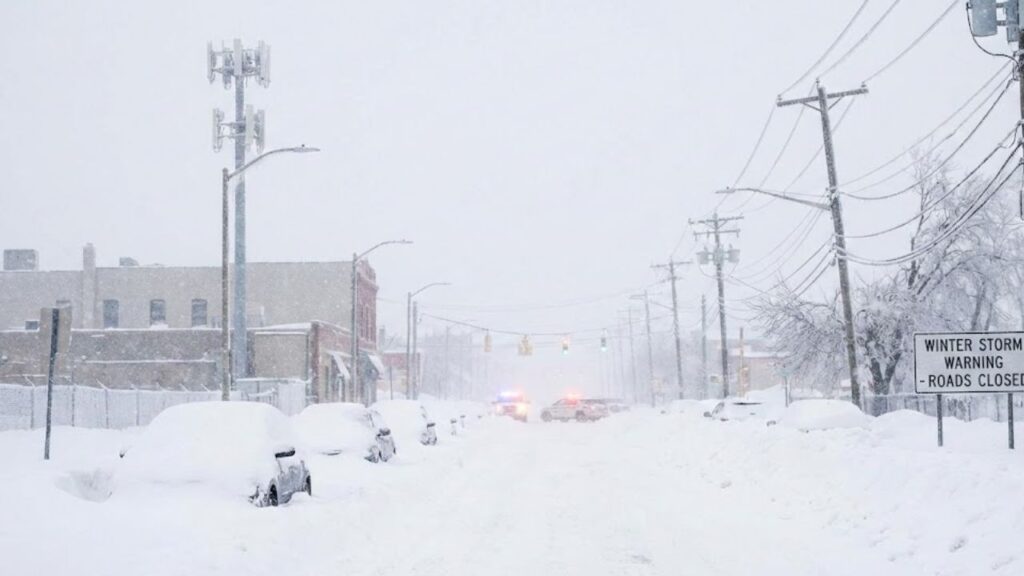
On the map, “up to 55 inches” appears as a bruised purple blob sliding over counties and highways. On the ground, it transforms into abandoned cars, bumpers swallowed by snow, and plow trucks blinking orange in a losing battle. Stepping outside, the cold rushes in, dry and biting, stealing your breath.

The world turns muffled and quiet. Power lines hum under the weight, branches creak, and you start wondering how long your phone battery will last. This isn’t the picturesque snow you see on Instagram; this is the kind that buries road signs and strips away your sense of direction.
Remember the Buffalo lake-effect storm of 2022? Some neighborhoods saw more than six feet of snow in just a few days. Highways were shut down. Ambulances had to be dug out by neighbors. Even snowplows got stuck, their flashing lights submerged in drifts. People had to climb out of second-story windows because the front doors wouldn’t open.
Forecasts suggest a similar pattern here: bands of heavy, almost stationary snow locking onto narrow corridors, dumping inches per hour. That’s how 55 inches happens — not from a gentle, all-day snow, but from explosive bursts that outpace shovels, plows, and all good intentions. You go to bed with clear roads and wake up to a white wall.
When Roads and Networks Lose the Race
Weather services don’t throw around numbers like that lightly. When they say “overwhelming roads and networks,” they mean it. Roads have limits: plows, crews, salt, and how fast a truck can crawl through whiteout conditions. Networks, too, have limits: cell towers that ice over, power grids stretched by electric heaters, and data lines vulnerable to falling branches.
Once the snowfall rate crosses a certain threshold, every system we rely on starts to fail. Response times increase. Delivery routes disappear from GPS. Even emergency operators struggle as calls rise, and infrastructure strains. *A winter storm like this doesn’t just blanket everything in white — it reveals every weak spot we’ve quietly learned to live with.*
Preparing for the Storm Before It Hits
The small, often overlooked tasks before the first snowflakes fall are the ones that save you later. Focus less on hoarding supplies and more on preparing for 48 hours of not needing to go anywhere or charge everything at once. Fill your car, charge your power banks, and clear your gutters and vents while you still can. That quick walk around your property to check for potential hazards is often more useful than another grocery run.
- From February 31, hedges over 2 meters high and within 50 cm of a neighbor’s property must be trimmed, or face penalties.
- Place a bowl of salt water by the window in winter — it works just as well as aluminum foil in summer.
- Greenland has declared an emergency after researchers spotted orcas breaching dangerously close to melting ice shelves.
- Try a light and easy apple cake made with oil and yogurt — the perfect everyday dessert.
- Japan unveils a new toilet-paper innovation that shoppers can’t believe didn’t exist sooner.
- Here are 9 phrases self-centered people use that reveal their true nature.
- If someone from your past keeps crossing your mind, it might not be a coincidence.
- Stop giving this kind of advice that quietly undermines self-esteem.
Inside, create a warm core zone where everyone can gather if the power goes out. Close off extra rooms with towels or blankets at the base of doors. Lay out layers — socks, sweaters, and hats — where people can grab them in the dark. One well-placed flashlight is better than three lost in a drawer.
We’ve all been there: the alert pops up, and you think, “I’ll deal with it later.” Then later comes at 3 a.m., the lights go out, and you’re fumbling for a half-charged phone and a cold cup of coffee. Let’s be honest: no one does this perfectly. The key is not perfection, but a few smart steps before the first flake sticks.

People often over-prepare on food and under-prepare on connectivity and medication. They stock up on snacks but forget prescription refills, backup chargers, or a printed list of important numbers in case contacts and apps don’t load. A storm like this doesn’t just trap you physically — it can also disconnect you from the digital shortcuts you rely on without thinking.
A veteran emergency manager once told me, “Snow is just frozen water until it blocks an ambulance or a cell tower. Once you lose roads and networks at the same time, you’re living on what you already have — information, batteries, neighbors.”
Keep Low-Tech Channels Open
Battery-powered or hand-crank radios provide updates when Wi-Fi and cell service fail. It may seem old-fashioned, but that’s why it works.
Layer Your Power Sources
Use wall outlets while you can, then rotate through power banks, car chargers, and, if you have one, a small generator placed safely outside away from windows.
Plan Your Check-ins
Agree on one time in the morning and one in the evening to contact family or friends. This simple routine helps reduce the urge to constantly check and saves battery life.
Map Your “Walkable Help”
Know in advance which neighbors have a snow blower, who has medical training, and where the nearest open shelter might be. When roads vanish, walking distance becomes your new reality.
Protect What’s Invisible
Back up key documents to the cloud and store paper copies in a dry folder. Power and internet failures feel different when you’re not worried about losing proof of your identity or ownership.
What a Storm Like This Really Leaves Behind
Once the snow stops falling, the story doesn’t end. Mountains of plowed snow turn into gray walls, shrinking streets into one-lane chutes. Melting and refreezing create slick sidewalks. People dig out their cars only to find that the bus routes are still suspended, or their usual office has gone dark due to a transformer failure. The first clear blue sky after a 55-inch storm can almost feel mocking.
Yet, it’s also when quiet resilience shines. Neighbors trade shovels and phone chargers, kids turn impassable side streets into sledding hills, and someone grills frozen food on their balcony because the power’s out, but the propane tank isn’t. These storms reveal how isolated we’ve been, and how quickly that can change when we literally can’t go anywhere.

Key Takeaways
- Understand “55 inches” as a system shock that outpaces plows, knocks out power, and disrupts communication networks for days.
- Prepare for 48 hours of semi-isolation, focusing on warmth, light, medications, and at least one offline source of information.
- Rely on low-tech and local support — radios, printed contacts, and neighbor networks often work when high-tech tools fail.
